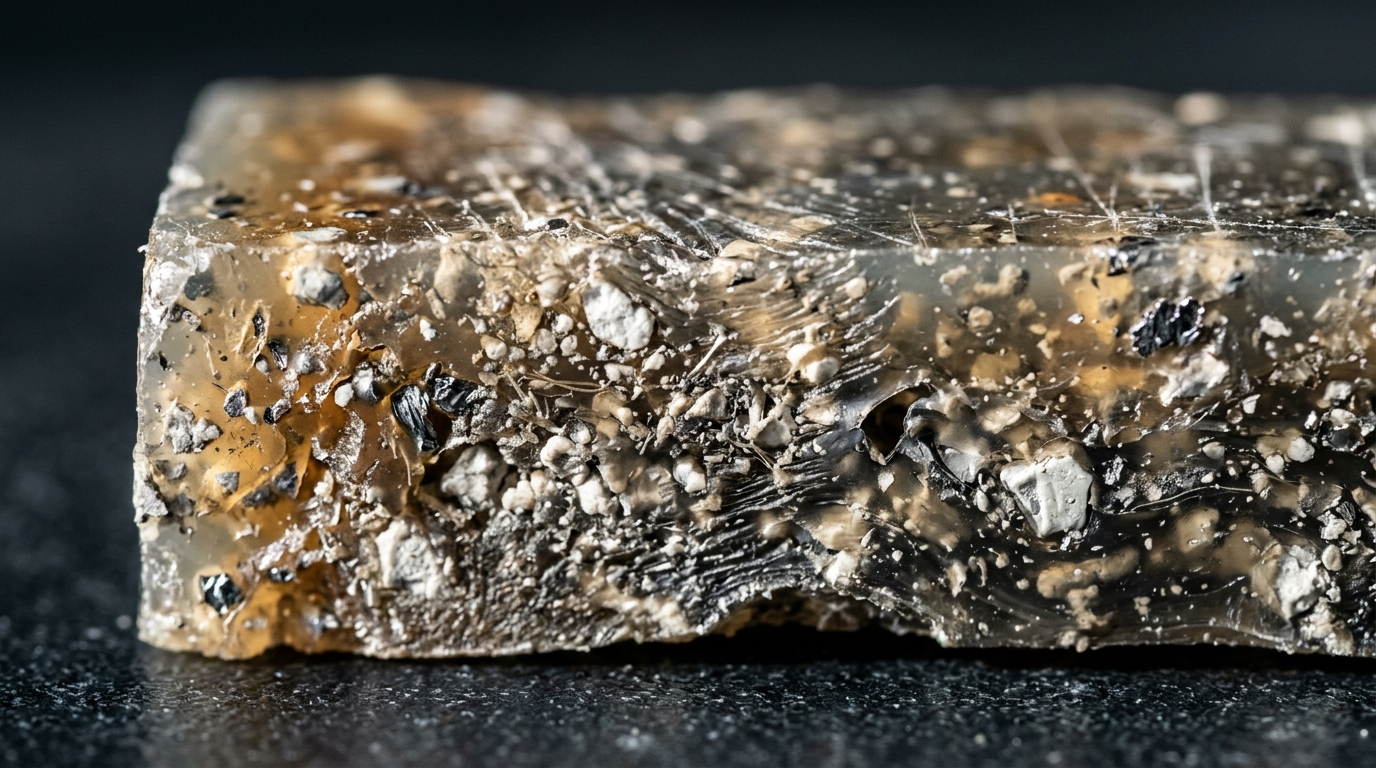
A multiscale theoretical investigation in Acoustical Physics demonstrates that the slow time relaxation of elastic moduli in heterogeneous materials originates from a hierarchy bridging microscopic diffusion and mesoscopic barrier fluctuations. Heterogeneous solids subjected to dynamic mechanical deformation exhibit an anomalous recovery of stiffness that follows a characteristic logarithmic dependence on time, persisting across seconds, hours, or days after external loading ceases. While this phenomenon has been widely documented in geological formations, concrete, and damaged ceramics, its physical origin has remained a subject of debate. Author A. V. Lebedev formulated an analytical framework establishing that macroscopic elasticity recovery is governed by internal contacts trapped in metastable states. By linking thermal fluctuations on microscopic scales to Poissonian bond restoration across structural elements, the research resolves unexplained mechanisms of structural memory and confirms that the logarithmic relaxation profile is controlled directly by the profile of interfacial energy barriers.
In classical solid mechanics, the response of homogeneous media to deformation is governed by linear elastic moduli entering Hooke’s law, with physical nonlinearity emerging only at finite strains through higher-order expansion coefficients of the elastic free energy. In materials with complex internal architectures, such as composites, concrete, damaged glasses, and sedimentary rocks, acoustic nonlinearity departs significantly from classical predictions, exhibiting pronounced stress-strain hysteresis and protracted post-excitation recovery. These distinct behaviors are classified as fast time and slow time processes. In homogeneous crystals and metals, interatomic bonds are determined strictly by atomic forces, whereas heterogeneous media derive their mechanical characteristics from contacts between structural elements across multiple spatial scales. Sedimentary rocks represent a prominent example where structural inhomogeneities span several orders of magnitude formed over geological history. When dynamic acoustic waves perturb these contacts, microscopic interfaces experience detachment events, producing measurable alterations in wave velocities and elastic moduli that permit non-destructive evaluation of internal integrity.
To establish the physical criteria governing contact detachment, the study examines curved elastic bodies under compressive force, evaluating the interplay between interfacial adhesion and elastic deformation. The mechanical behavior of contacting asperities is governed by an equivalent curvature radius and an effective Young modulus derived from the elastic properties of the participating bodies. Adhesion hysteresis occurs when the stiffness of the adhesive layer exceeds that of the deformable bodies in contact, characterized mathematically by a dimensionless adhesion parameter exceeding unity. Under this condition, contact breaking and restoration occur at distinct separation distances, generating hysteretic mechanical losses during cyclical loading. When uniform displacement imposes local strains within a heterogeneous medium, bond rupture requires exceeding a defined strain threshold on the order of ten to the negative seventh. Upon reaching this critical threshold, mechanical instability initiates contact separation, leaving the torn interface at a separation distance determined by elastic properties, curvature radius, and effective surface energy.
The investigation incorporates kinetic and dissipative effects to evaluate the physical rapidity of bond rupture and the subsequent transition into metastable configurations. During adhesive bond detachment, dissipative processes substantially increase the effective adhesion coefficient by up to two orders of magnitude, expanding the critical separation distance required for mechanical instability. Crucially, the velocity of adhesive bond rupture is bounded by the propagation velocity of Rayleigh surface waves across the contact interface. Calculating the transit time of a Rayleigh wave traversing the critical contact diameter reveals that rupture concludes within a microscopic fraction of a microsecond. For acoustic conditioning frequencies reaching one hundred kilohertz, the product of angular excitation frequency and bond rupture duration remains far below unity, demonstrating that the transition of broken contacts occurs almost instantaneously within a single wave cycle. If the post-rupture separation distance aligns with the attraction basin of a secondary potential minimum, the severed interface becomes stabilized in a metastable state.
To describe the microscopic kinetics governing the detached interface, the author utilizes the Derjaguin-Landau-Verwey-Overbeek surface interaction potential combined with the Fokker-Planck diffusion equation. The surface potential incorporates attractive van der Waals dispersion forces, short-range Born atomic repulsions, and repulsive electrostatic forces arising from electrical double layers within interfacial pore fluids. Depending on solute ion concentration and surface electrical potentials, this interaction potential exhibits a primary equilibrium well, an intermediate barrier, and a secondary metastable minimum at nanometer separations. Because the equilibrium of surface interactions is disrupted by charge redistribution, ion movement, and fluid transport, the evolution of state probabilities across the separation coordinate obeys a Fokker-Planck equation. Normalizing this transport equation by a characteristic equilibrium transition time reveals timescales on the order of ten to the negative seventeenth to ten to the negative thirteenth seconds. Consequently, microscopic fluctuations driven by thermal energy allow detached interfaces to diffuse rapidly into the secondary minimum during dynamic mechanical excitation.
Bridging microscopic diffusion to structural scales, the study models the restoration of metastable bonds as a mesoscopic fluctuation phenomenon occurring across an ensemble of structural contacts. Individual interfaces between grains, microcracks, and asperities represent intermediate structural elements within a representative material volume. When the population of detached contacts is large compared to unity but constitutes a small fraction of the total structural bonds, the probability distribution of bond transitions follows Poissonian statistics. The transition rate of an individual contact overcoming the protective energy barrier to return from the secondary minimum to the primary equilibrium state is governed by an Arrhenius equation. In this formulation, the transition velocity is proportional to an attempt frequency and inversely exponential in the ratio of the barrier height to thermal energy. The macroscopic elastic modulus defect, representing the relative reduction in material stiffness caused by weakened metastable bonds, is expressed as an integral over the survival probability of the excited state across all available barrier energies.
Evaluating the macroscopic modulus defect integral demonstrates the mathematical mechanism by which logarithmic time relaxation emerges from mesoscopic barrier distributions. By substituting the Arrhenius rate into the Poissonian survival integral, the relative change in elastic modulus is expressed through a difference of first-order exponential integral functions evaluated at the minimum and maximum transition rates. At the beginning of relaxation, the asymptotic expansion reveals that the initial modulus defect is directly proportional to the population of metastable states at a characteristic barrier energy, yielding values consistent with experimentally observed modulus drops of approximately ten to the negative third under moderate strain amplitudes. As relaxation progresses through intermediate times, the higher transition rate term decays while the lower rate remains small, causing the exponential integral difference to reduce exactly to a linear function of the natural logarithm of time. The model confirms that complete relaxation requires a total duration defined by the difference between the inverse minimal and maximal transition rates.
A central conclusion of the paper is that the universality of logarithmic relaxation depends strictly upon the presence of a wide, smooth distribution of activation barrier heights. To test this requirement, numerical simulations sampled approximately one million distinct barrier energy values by systematically sweeping electrolyte ion concentrations and surface electrical potentials within the model interaction potential. The resulting statistical histogram demonstrated that the probability of encountering activation barriers spanning from thermal energy levels up to one hundred thousand times thermal energy is remarkably smooth and uniform. This computational confirmation verifies the analytical assumption that the barrier distribution function can be evaluated as a smooth multiplier outside the relaxation integral. Conversely, the model reveals that if a heterogeneous material possesses a narrow spectrum of barrier energies where minimum and maximum values coincide, the integral collapses to a single exponential decay function, demonstrating that deviation from logarithmic recovery provides a sensitive indicator of interfacial uniformity.
The theoretical framework also resolves the excitation or conditioning stage, establishing an underlying mathematical reversibility between dynamic pumping and post-excitation relaxation while incorporating strain-induced kinetic effects. During external acoustic excitation, tensile deformation phases drive detached bonds with separations slightly below the barrier position across into the metastable basin through microscopic fluctuations. However, unlike the low-amplitude probing waves employed during relaxation monitoring, high-amplitude conditioning waves introduce substantial fluid flow velocities within pore spaces and asperity contacts. Based on the Bernoulli principle for fluid mechanics, dynamic fluid motion generates a localized hydrodynamic pressure drop proportional to fluid density and the square of flow velocity. This pressure reduction diminishes the electrostatic repulsion exerted by the electrical double layer, effectively depressing the activation barrier height. Consequently, the transition rate into metastable states during conditioning accelerates relative to recovery, explaining why experimental conditioning achieves rapid modulus saturation far faster than the prolonged logarithmic relaxation that follows.
To validate the theoretical formulations against empirical observations, the author compared analytical predictions with independent acoustic measurements obtained from Berea sandstone and carbonate rock specimens. In laboratory experiments, dynamic excitation at strain amplitudes of approximately ten to the negative sixth produced relative reductions in compressional wave velocity on the order of negative ten to the negative fourth, corresponding to an initial modulus defect of negative two to three times ten to the negative fourth. Analyzing the measured logarithmic slope and the ratio of final to initial relaxation times yielded activation barrier energy widths ranging between five and ten times thermal energy across both experimental sources. Furthermore, the model successfully explains documented dependencies of recovery kinetics on excitation duration and strain amplitude, demonstrating that incomplete conditioning excites only a sub-spectrum of barriers and produces segmented logarithmic slopes. By establishing a rigorous foundation for multi-scale fluctuations, this theoretical approach provides a unified physical basis for non-destructive acoustic evaluation in complex engineering materials.
Subject of Research: Multiscale fluctuation mechanisms of slow time elastic relaxation in heterogeneous solids
Article Title: Slow Time Phenomena in Heterogeneous Materials: from Microscopic Fluctuations to Macroscopic Relaxation
Article References: Lebedev, A. V. (2023). Slow Time Phenomena in Heterogeneous Materials: from Microscopic Fluctuations to Macroscopic Relaxation. Acoustical Physics, 69(1), 58-73. https://doi.org/10.1134/s1063771022700543
Image Credits: AI Generated
DOI: 10.1134/S1063771022700543
Keywords: slow time relaxation, heterogeneous materials, elastic moduli, acoustic nonlinearity, metastable states, microscopic fluctuations, mesoscopic fluctuations, Fokker-Planck equation, DLVO potential, adhesion hysteresis, Arrhenius rate, Poissonian process, modulus defect, energy barrier distribution, Berea sandstone, carbonate rock, non-destructive testing
News Source: Denise Maddox. (November 25, 2026). Microscopic Fluctuations Drive Logarithmic Elastic Relaxation in Heterogeneous Materials. Scienmag.