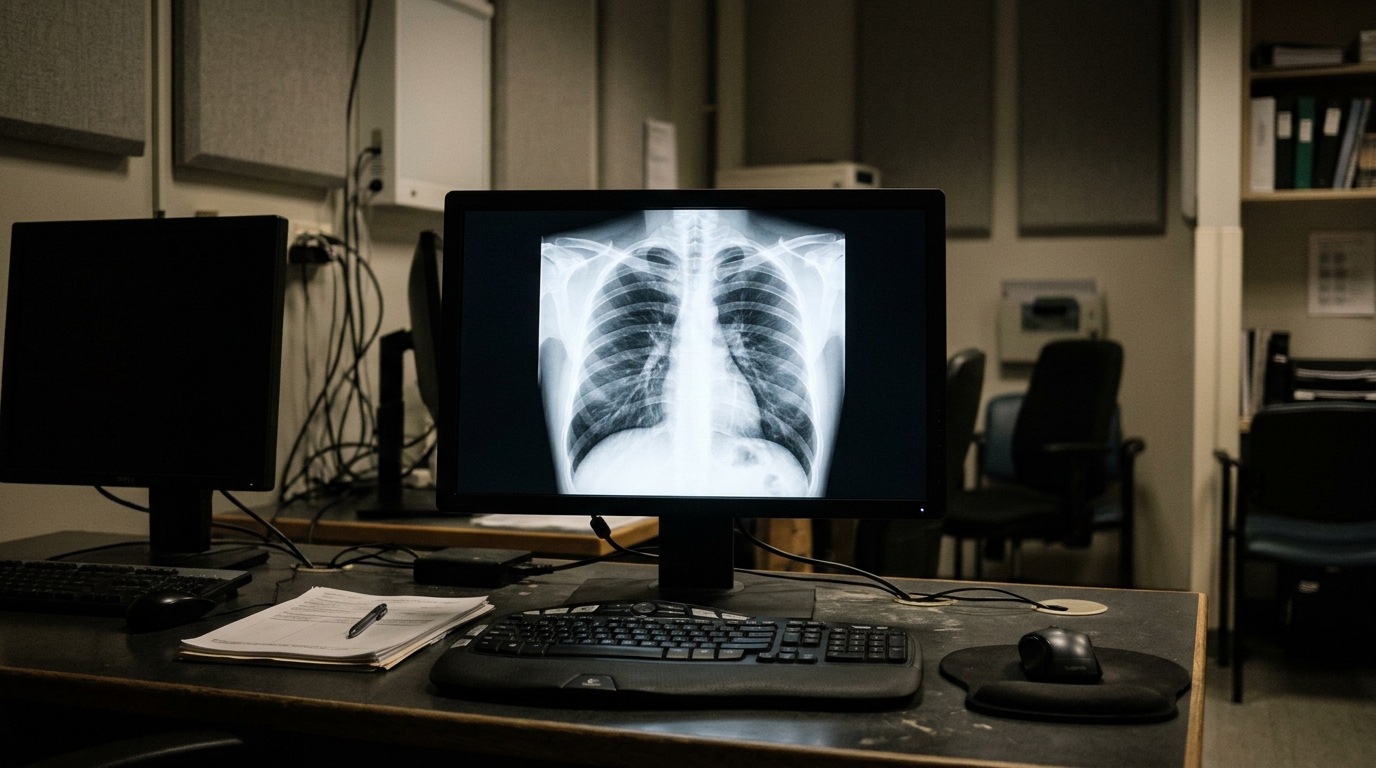
Researchers have evaluated IMAP-FL, an Intelligent Multi-Agent Privacy-Preserving framework for Federated Learning designed to protect decentralized medical image analysis without requiring centralized data pooling. In simulated healthcare evaluations focused on chest radiograph classification, the framework’s fixed-schedule implementation achieved diagnostic utility identical to that of a differential-privacy-only baseline system. Specifically, the fixed-schedule setup recorded macro F1 scores of 71.2 percent at a privacy budget parameter of epsilon equals 1, and 80.1 percent when evaluated at epsilon equals 2.
Developed by Rahul Bhole, Sachin R. Sakhare, and Parikshit N. Mahalle from the Vishwakarma Institute of Information Technology and the Bansilal Ramnath Agarwal Charitable Trust in Pune, India, the framework represents an architectural integration of established mechanisms rather than an entirely new privacy primitive. Federated learning allows independent hospitals to collaboratively train a shared diagnostic model without directly pooling confidential patient records. However, standard federated learning remains vulnerable because transmitted client updates can inadvertently leak sensitive information through gradient inversion and membership inference, while untrusted or adversarial clients can intentionally degrade overall model performance through data poisoning attacks.
To address these multiple vulnerabilities simultaneously, the IMAP-FL architecture operates in a zero-trust setting by coupling three distinct components: client-side Differentially Private Stochastic Gradient Descent (DP-SGD), Bonawitz-inspired pairwise masking, and agent-level privacy-budget management. Differential privacy and secure aggregation target fundamentally different aspects of this security problem. Differential privacy bounds what the trained global model and the transmitted client updates reveal regarding any single training record. In contrast, secure aggregation cryptographically conceals each individual hospital’s raw parameter update from the central server, preventing intermediate inspection during the aggregation phase.
From a theoretical perspective, the research team proved formal record-level (ε,δ)-differential privacy guarantees for a fixed noise schedule by applying Rényi differential privacy accounting. Alongside this mathematically proven configuration, the authors implemented an adaptive scheduler driven by validation loss across training rounds. The authors emphasize that this adaptive scheduler is evaluated purely empirically and is not covered by their theoretical differential privacy proof. Although the adaptive configuration reached substantially higher utility—achieving F1 scores of 90.19 percent at epsilon equals 1 and 95.30 percent at epsilon equals 2—the study did not include a controlled ablation analysis, meaning the exact source of this utility increase could not be isolated.
The empirical experiments were carried out using the three-class COVID-19 Radiography Dataset, which comprises 15,153 chest X-ray images. To simulate realistic institutional environments with heterogeneous clinical data distributions, the researchers partitioned the dataset across five simulated hospital clients using a Dirichlet non-identical and independently distributed (non-IID) data split. Under this partitioned setup, the fixed-schedule IMAP-FL maintained identical utility to the baseline differential-privacy model because secure aggregation computes and returns the exact mathematical sum of client updates, introducing no additional distortion to the aggregated model weights.
To evaluate vulnerability against reconstruction attacks, the authors tested gradient inversion against masked client updates. The inversion attacks failed completely, yielding a structural similarity index measure (SSIM) of 0.09 ± 0.02. Importantly, the researchers clarify that this empirical failure directly reflects the attacker’s complete loss of access to individual updates under pairwise masking, rather than demonstrating intrinsic algorithmic resistance to gradient inversion under conditions of equal update access.
Against membership inference attacks, the adaptive configuration produced area under the receiver operating characteristic curve (AUC) values of 0.563 ± 0.019 at epsilon equals 1 and 0.581 ± 0.022 at epsilon equals 2. The authors also conducted label-flipping experiments as an adversarial stress test on model integrity. They explicitly note that neither differential privacy nor secure aggregation constitutes a Byzantine-robust defense mechanism against malicious participants, meaning the framework does not inherently prevent poisoning attacks from degrading the shared model.
Published in Frontiers in Computer Science under the Networks and Communications section, the investigation outlines clear boundaries regarding the generalizability of its findings. The authors caution that all reported experimental results are derived from a single public benchmark dataset and therefore do not establish clinical readiness for deployment in real-world hospital workflows.
Subject of Research: Privacy-preserving federated learning architectures for medical image classification
Article Title: IMAP-FL: an intelligent multi-agent privacy-preserving framework for federated learning combining client-side differential privacy and secure aggregation
Article References: Bhole, R. H., Sakhare, S. R., & Mahalle, P. N. (2026). IMAP-FL: an intelligent multi-agent privacy-preserving framework for federated learning combining client-side differential privacy and secure aggregation. Frontiers in Computer Science, 8, 1927143. https://doi.org/10.3389/fcomp.2026.1927143
Image Credits: AI Generated
DOI: 10.3389/fcomp.2026.1927143
Keywords: federated learning, differential privacy, secure aggregation, IMAP-FL, DP-SGD, pairwise masking, privacy-budget management, Rényi differential privacy, COVID-19 Radiography Dataset, chest X-ray classification, Dirichlet non-IID partition, gradient inversion defense, membership inference, label-flipping stress test, zero-trust architecture, multi-agent systems, simulated hospital clients
News Source: Denise Maddox. (November 25, 2026). Privacy Framework Matches Baseline Utility Across Simulated Chest X-Ray Network. Scienmag.