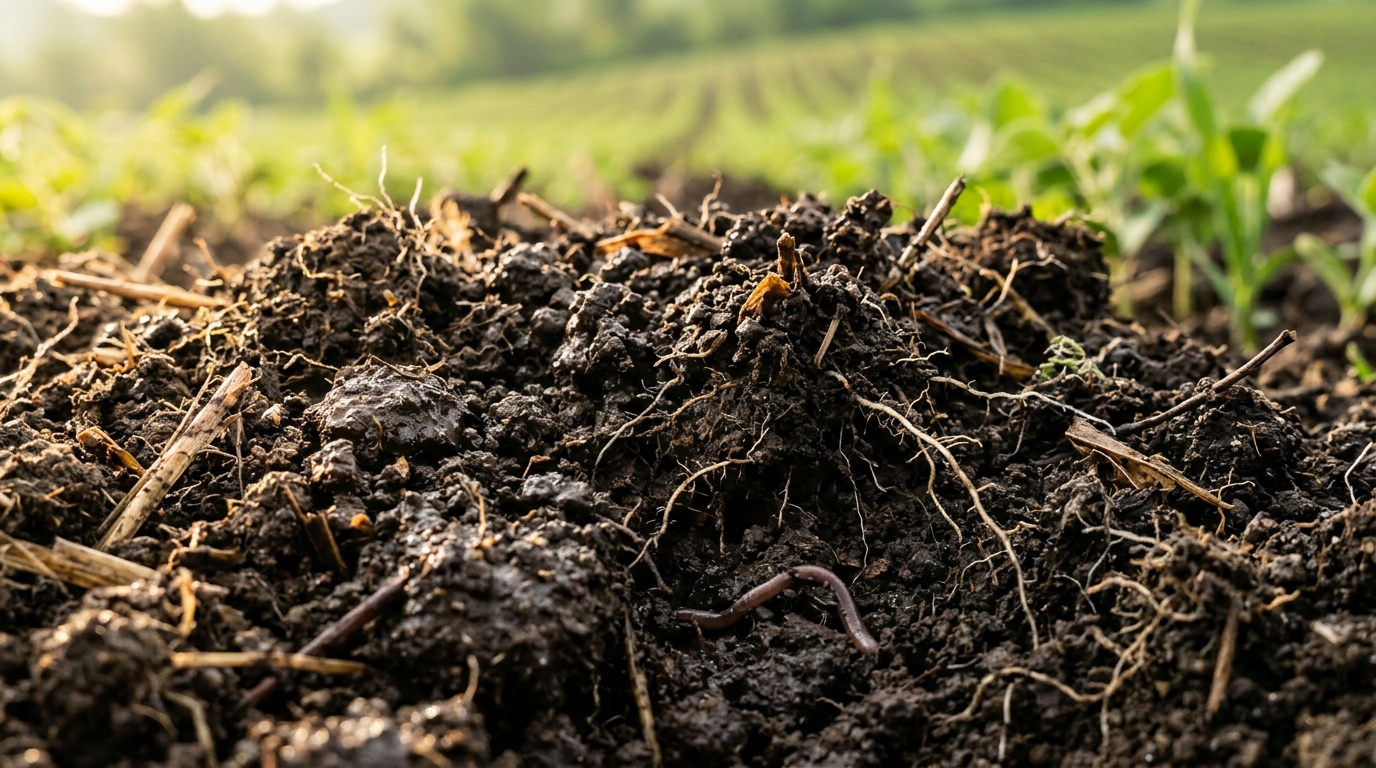
A two-year agricultural field trial has demonstrated that recurring applications of composted dairy manure significantly enhance the carbon use efficiency of soil microbial communities compared to conventional synthetic nitrogen fertilization. Conducted over a span of 665 days within a Mediterranean climate, the study tracked microbial community dynamics and functional genetics across twenty-two distinct sampling intervals. Researchers found that integrating composted manure into a standard corn and wheat crop rotation restructured the subterranean ecosystem, favoring specialized bacterial populations equipped to process diverse organic substrates. Rather than releasing substrate carbon into the atmosphere through accelerated respiration, the microbial communities established under repeated manure treatments directed a greater proportion of assimilated carbon toward cellular growth and microbial biomass formation. This physiological transition offers a mechanistic explanation for how organic soil management fosters long-term carbon stabilization beneath agricultural croplands.
The extensive field investigation was established at the University of California Davis Russell Ranch Agricultural Sustainability Institute on a silty clay loam characterized under the United States Department of Agriculture taxonomy as a thermic Mollic Haploxeralfs. The soil profile exhibited a baseline composition consisting of twenty percent sand, forty-nine percent silt, and thirty-one percent clay, with a total carbon content of twelve grams of carbon per kilogram of soil and a bulk density measuring 1.30 grams per cubic centimeter. Prior to establishing the experimental plots, the experimental site had been maintained in a fallow state. Agronomists organized the experimental area into eight randomized experimental plots measuring 4.57 meters by 36.58 meters, each constructed with three raised soil beds measuring 1.52 meters by 36.58 meters. Management regimes were split between organic and synthetic nutrient inputs to directly contrast the ecological trajectories of composted manure against conventional synthetic fertilizer regimes across identical cropping cycles.
The experimental treatments comprised four individual plots receiving composted dairy manure applied at an input rate of 2.24 kilograms per square meter, calculated to deliver one hundred percent of the total nitrogen required to satisfy crop physiological demand and target yields. Conversely, four control plots received chemical fertilizer administered as urea-ammonium-nitrate 32 at an application rate of 207.4 kilograms of nitrogen per hectare without any supplemental compost or winter cover cropping. Both treatments adhered to standard regional commercial practices regarding tillage, planting, and irrigation. Agricultural operations followed a cyclical rotation alternating between corn cultivation during summer seasons and winter wheat plantings. Manure was incorporated into the top thirty centimeters of soil before bed formation at the onset of each growing season, and analytical determinations of total nitrogen, mineral nitrogen, and moisture content were completed prior to every amendment event to ensure accurate nitrogen dosing across treatments.
To evaluate temporal shifts in community structure, researchers gathered soil cores on an approximately bi-monthly schedule synchronized with primary agricultural events including tillage, seeding, irrigation, fertilizer application, and crop harvest. Across the 665-day experiment, twenty-two individual sampling events were conducted using seven-centimeter-diameter twist augers penetrating to a depth of fifteen centimeters. Ten soil cores were randomly collected from the central bed of each plot during every sampling round, thoroughly mixed into composite samples, transported on ice, and preserved at minus eighty degrees Celsius. On day 665, freshly collected subsamples were immediately transferred to the laboratory for carbon use efficiency assays and DNA-based stable isotope probing. High-throughput molecular profiling of the 16S rRNA gene V4 hypervariable region was conducted across all temporal points using the 515-F and 806-R primers, generating eleven million paired-end reads on an Illumina MiSeq system processed via the DADA2 algorithmic pipeline.
Microbial carbon use efficiency was quantified using laboratory microcosms established from sieved composite soils adjusted to eighty percent water-holding capacity, corresponding to twenty-three percent gravimetric soil moisture content. Replicate microcosms were amended with glucose enriched with five atom percent carbon-13 at dosing rates of either one milligram or three milligrams of glucose per gram of dry soil, followed by room-temperature incubation inside sealed one-liter vessels for seventy-two hours. Headspace gas was harvested through rubber septa to measure respired carbon-13 carbon dioxide via isotope ratio mass spectrometry, while microbial biomass carbon was extracted using standard chloroform fumigation procedures converted with an extractability factor of 0.45. Calculations revealed that carbon use efficiency was significantly higher in manure-amended soils than in zero-manure soils when incubated with one milligram of glucose per gram of soil. Furthermore, lower substrate additions systematically increased efficiency values across treatments by an average of 0.15 compared to higher substrate additions.
Parallel stable isotope probing microcosms received glucose uniformly enriched to one hundred atom percent carbon-13 at a concentration of three milligrams per gram of soil, paired alongside non-labeled glucose controls, to identify the taxonomic groups directly assimilating substrate carbon into their genomes. Following seventy-two hours of incubation, total genomic DNA was extracted, subjected to cesium chloride density gradient ultracentrifugation for forty-four hours, and fractionated into sixteen distinct density windows using an automated dual-channel syringe pump system. Fraction libraries sequenced on the Illumina MiSeq platform were analyzed through the High-Throughput Sequencing Stable Isotope Probing workflow. The analysis uncovered 102 total amplicon sequence variants acting as functional carbon incorporators. Manure-amended soils contained sixty-one incorporator sequence variants, forty-three of which were uniquely present under manure management, whereas zero-manure soils possessed fifty-nine variants, including forty-one unique variants, with eighteen core variants shared across both agronomic treatments.
Taxonomic classification showed that the carbon-incorporating bacterial community in manure-treated soils spanned seven distinct phyla: Actinobacteriota, Bacteroidota, Firmicutes, Gemmatimonadota, Myxococcota, Planctomycetota, and Proteobacteria. In contrast, active assimilators within zero-manure soils were restricted to Actinobacteriota, Bacteroidota, Firmicutes, and Proteobacteria. Representatives of Gemmatimonadota, recognized as versatile metabolic generalists, and Planctomycetota, known to proliferate during the enzymatic breakdown of manure and extracellular nucleic acids, were exclusive to manure soils. The predatory bacterial group Myxococcota was also observed solely in manure-amended soils, suggesting that carbon-13 entered predatory cells via environmental uptake or secondary trophic consumption. While Firmicutes were active assimilators under both treatments, manure soils hosted seven unique Firmicutes taxa compared to only one unique taxon in zero-manure soils, highlighting the pronounced recruitment of chitinolytic and copiotrophic organisms specialized in degrading complex macromolecular structures present within composted livestock residues.
Longitudinal tracking across the twenty-two field sampling milestones revealed that the abundance of manure-selected carbon incorporators exhibited pronounced seasonal dynamics, rising to significant peaks in manure plots relative to zero-manure plots on days 1, 35, 64, 262, 323, 343, and 357. Incorporator populations expanded rapidly following manure applications at the start of each warm summer growing cycle, reaching a peak at day 87 during the initial summer season and peaking at day 323 during the second summer rotation before gradually receding across the winter periods. In contrast, the abundance of incorporators native to zero-manure soils remained essentially flat throughout the 665-day observation window, exhibiting significant between-treatment divergence on only three isolated sampling dates. These contrasting patterns demonstrate that recurring manure inputs maintain a dynamic, seasonally responsive cohort of specialized decomposers that repeatedly expand to process nutrient inputs without displacing the baseline resident microbial taxa.
To uncover the metabolic mechanisms supporting higher carbon use efficiency, shotgun metagenomic sequencing was carried out on thirty-two soil samples collected on day 451, a transitional sampling point two weeks after manure application but prior to crop seeding. High-throughput sequencing on the Illumina NovaSeq S4 platform yielded 3.65 terabase pairs of sequence data, averaging 110 million reads per sample. Functional annotation against the Kyoto Encyclopedia of Genes and Genomes database identified 6,104 functional genes across the assemblage. Soils treated with composted dairy manure exhibited significantly higher functional gene diversity, measured by both Shannon diversity and Simpson evenness indices. Analysis via the multinomial species classification method revealed that manure treatment stimulated a broad diversification of metabolic capacities, creating an evenly balanced genomic network capable of utilizing diverse nutrient fractions previously locked within complex organic residues.
Metagenomic profiling of 7,645 total structural and functional genes indicated that 1,282 genes were significantly elevated in abundance in manure-amended soils, whereas only 348 genes were significantly less abundant compared to unamended soils. Focusing specifically on 269 genes dedicated to carbon cycle transformations, forty-nine genes exhibited statistically significant enrichment in manure-treated plots, representing an overall 18.1 percent increase in relative abundance for functional carbon processes, whereas only four carbon-related genes were enriched in zero-manure soils. Mapping these enriched sequences to hierarchical metabolic pathways showed widespread upregulation of key metabolic circuits, including prokaryotic carbon fixation, glycolysis, gluconeogenesis, the tricarboxylic acid cycle, fructose and mannose metabolism, and pentose phosphate pathways. The only carbon pathway showing greater relative abundance in zero-manure plots was fatty acid elongation, confirming that repeated organic fertilization fundamentally expands enzymatic machinery for carbohydrate processing and cellular energy generation.
The pronounced upregulation of core glycolytic, gluconeogenic, and tricarboxylic acid cycle genes explains how manure-conditioned microbial communities achieve higher growth yields and carbon retention. In unamended soils supplied exclusively with chemical nitrogen, microorganisms expended substantially more energy on nutrient foraging and cellular maintenance, releasing elevated quantities of carbon-13 as carbon dioxide gas during microcosm incubations. By contrast, the balanced nutritional stoichiometry and metabolic versatility afforded by composted manure enabled microbes to allocate assimilated glucose directly toward cellular biosynthesis and biomass production. Metagenomic evidence confirmed that microbes capable of maintaining stable internal carbohydrate pools via gluconeogenesis while actively processing sugars through glycolysis support heightened biomass accrual. Consequently, recurring organic amendments avoid the excessive respiration losses typical of nutrient-depleted environments, effectively channeling labile carbon into persistent microbial residues that contribute directly to long-term soil organic matter stabilization.
Collectively, the findings demonstrate that multiple manure applications elevate soil microbial carbon use efficiency by curating an adaptable microbial consortium enriched in diverse carbon-metabolizing pathways. Combining simultaneous stable isotope probing and carbon use efficiency microcosms with deep metagenomic sequencing established a direct empirical link between taxonomic carbon incorporators and functional genomic traits in an active agricultural field system. The researchers emphasized that building resilient subterranean carbon stocks requires recognizing organic amendments as recurrent, long-term agronomic practices rather than single-season interventions. Because microbial communities adapt over extended timescales, repeated seasonal applications are essential to sustain the specialized functional groups and diversified enzymatic machinery that govern belowground carbon sequestration in working agricultural soils.
Subject of Research: Microbial carbon use efficiency and functional gene dynamics in manure-amended soils
Article Title: Increased microbial carbon use efficiency and metabolic capacity in manure amended soils: A 665-day field experiment
Article References: Sayre, J. M., Wang, D., Erikson, C., Gontijo, J. B., Scow, K., & Mazza Rodrigues, J. L. (2026). Increased microbial carbon use efficiency and metabolic capacity in manure amended soils: A 665-day field experiment. Biology and Fertility of Soils, 62(4), 457-468. https://doi.org/10.1007/s00374-026-01986-w
Image Credits: AI Generated
DOI: 10.1007/s00374-026-01986-w
Keywords: soil carbon use efficiency, dairy manure amendment, stable isotope probing, soil metagenomics, carbon cycling genes, microbial biomass carbon, agricultural soils, corn wheat rotation, Actinobacteriota, Firmicutes, Planctomycetota, Myxococcota, Gemmatimonadota, microbial respiration, chloroform fumigation extraction, KEGG pathways, Russell Ranch
News Source: Morgan Morrow. (November 25, 2026). Repeated Dairy Manure Applications Increase Soil Microbial Carbon Use Efficiency. Scienmag.