A structured ten-week exercise intervention demonstrated that the Six-Spot Step Test is sensitive to improvements in dynamic balance and walking performance in people diagnosed with multiple sclerosis, according to a post-hoc investigation published in Acta Neurologica Belgica. Researchers led by Esben Køhler, Jacob Callsen, and John Kodal Brincks evaluated longitudinal score adjustments across fifty-three completing participants with disability levels ranging from mild to severe. The analysis recorded a statistically significant median reduction of 1.4 seconds in completion time on the Six-Spot Step Test, spanning individual score changes between a decrease of 11.4 seconds and an increase of 4.7 seconds, with an associated significance level of p < 0.001. This measured alteration produced a Rank-Biserial effect size of -0.84, indicating a substantial responsiveness to physical rehabilitation. Furthermore, changes registered on the Six-Spot Step Test correlated moderately and negatively with observed improvements in established clinical benchmarks, specifically the mini-Balance Evaluation Systems Test and the Timed 25-Foot Walk, substantiating the assessment tool as a responsive instrument capable of capturing shared dimensions of functional mobility.
Multiple sclerosis represents an autoimmune neurological disorder of the central nervous system that affects more than 2.3 million individuals globally, presenting approximately twice as frequently in women compared to men. Pathological processes associated with the condition induce focal demyelinating lesions across the brain, spinal cord, and optic nerves, which manifest in a wide spectrum of functional impairments, including muscle weakness, spasticity, persistent fatigue, coordination deficits, sensory disturbances, visual alterations, and cognitive changes. Because balance control, steady ambulation, and the prevention of falls depend heavily on integrated sensorimotor networks, individuals living with the disease frequently experience progressive mobility limitations. While traditional clinical assessments capture isolated elements of straight-line ambulation, evaluating dynamic balance requires instruments capable of registering complex multidirectional movements and rapid base-of-support adjustments during active stepping. The Six-Spot Step Test was developed specifically to capture these complex components of dynamic ambulation, though prior systematic reviews underscored a distinct shortage of empirical evidence validating its longitudinal responsiveness against comprehensive balance criteria after structured therapeutic interventions.
To rigorously address this gap in clinical measurement science, the researchers conducted an evaluation structured around the COnsensus-based Standards for the selection of health Measurement INstruments framework, known as COSMIN. The investigation operated as a post-hoc responsiveness analysis utilizing data collected during a multi-center randomized controlled trial registered at ClinicalTrials.gov under identifier NCT 02870023 and cleared by the Regional Ethics Committee under ID 1-10-72-316-15. Participant recruitment took place across seven specialized multiple sclerosis clinics in Jutland, Denmark, between September 2016 and October 2018. Eligibility criteria required participants to be adults aged eighteen years or older possessing a confirmed diagnosis of relapsing-remitting, secondary-progressive, or primary-progressive multiple sclerosis with Expanded Disability Status Scale scores between 2.0 and 6.5. Candidates had to demonstrate the ability to walk 100 meters, register baseline performance times exceeding 8 seconds on the Six-Spot Step Test and 5 seconds on the Timed 25-Foot Walk, and remain relapse-free without alterations to disease-modifying or gait-influencing pharmacological treatments for at least eight weeks prior to enrollment.
The study protocol excluded individuals displaying cognitive disorders or alcohol abuse based on clinical judgment, medical conditions that precluded participation in progressive resistance exercises more than once per week, or engagement in systematic intensive rehabilitation within the preceding three months. From ninety-one candidates initially screened for eligibility, sixty-nine individuals were enrolled across the study branches. During the intervention, sixteen participants, representing twenty-three percent of the enrolled cohort, were lost to follow-up, leaving fifty-three individuals who completed post-intervention testing. In the resistance training cohort, six of twenty-three participants dropped out due to an unknown reason in one case, illness unrelated to the intervention in one case, intensive fatigue in one case, and falls unrelated to exercise sessions in three cases. In the balance training cohort, four of twenty-eight individuals discontinued due to unknown reasons in three instances and logistical conflicts in one instance. Among the combined cohort, six of eighteen participants discontinued due to logistical factors in three cases and clinic group closures below minimum thresholds in three cases.
Participants underwent ten weeks of physical training structured as two weekly sessions lasting approximately one hour each. Cohorts were assigned to progressive resistance training, balance and motor control training, or a waitlist control condition that maintained usual daily activity for ten weeks before completing a combined program featuring one weekly resistance session and one weekly balance session. Resistance training utilized seated, lying, or supported machine-based exercises tailored to progressively overload major muscle groups. The balance and motor control curriculum employed task-oriented motor drills addressing transitional movements such as sitting and sit-to-stand transfers, static standing balance, targeted stepping sequences, walking exercises, and coordinated eye movements. Despite procedural variations in exercise formats, overall training duration and session quantities remained identical across regimens. Because previous primary trial analyses demonstrated that all three exercise approaches elicited statistically significant improvements across walking speed, complex walking, and balance capacity, the investigative team pooled baseline and follow-up data from completers across all training modes to evaluate overall test responsiveness.
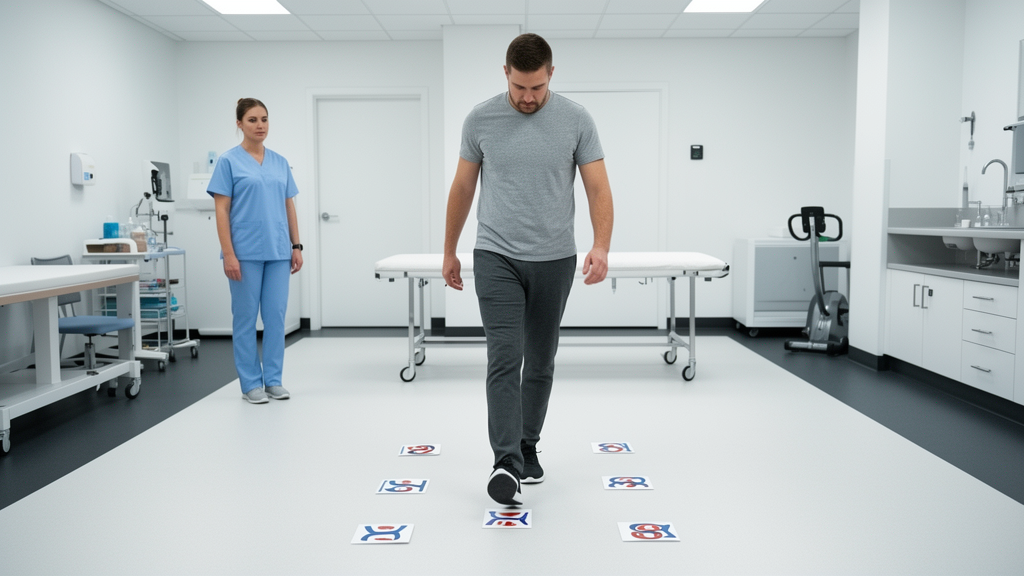
Functional capacity was documented through standardized clinical performance tests administered before and immediately following the ten-week training period. Walking speed was evaluated using the Timed 25-Foot Walk, conducted on a 10-meter walkway where participants completed two trials at their fastest safe velocity, with the fastest trial converted into meters per second. Balance capacity was determined using the 14-item mini-Balance Evaluation Systems Test, scored on a continuous scale from 0 to 28 points, with higher scores reflecting superior balance control. This assessment encompasses four distinct clinical subdomains based on Fay Horak’s balance model: anticipatory transitions scored from 0 to 6 points, postural responses scored from 0 to 6 points, sensory orientation scored from 0 to 6 points, and dynamic gait scored from 0 to 10 points. By contrast, the Six-Spot Step Test assessed complex ambulation over a rectangular course measuring 1 by 5 meters containing six designated circular targets. Four target circles on outer sidelines and two centered on baseline boundaries each contained an eight-centimeter-wide, four-centimeter-high wooden block, which participants shoved out of position using medial and lateral foot surfaces in a criss-cross pattern across four timed trials.
Statistical computations executed in JASP software version 0.95 prioritized a per-protocol analysis to accurately detect instrument responsiveness upon completion of the prescribed training stimulus. Because test parameters deviated from normal distribution assumptions under Shapiro-Wilk evaluations, non-parametric analytical techniques were implemented. Score changes between baseline and follow-up were evaluated using Wilcoxon signed-rank testing, alongside Rank-Biserial correlation coefficients providing paired effect size metrics. Relationships among pre-to-post change scores across the three outcome instruments were analyzed using non-parametric Spearman rank correlation coefficients, denoted as rs. Pre-specified hypotheses derived from COSMIN guidelines anticipated that changes in Six-Spot Step Test times would correlate moderately and negatively with changes in mini-BESTest balance scores and Timed 25-Foot Walk speeds within an expected range of rs between -0.30 and -0.50, reflecting the shared construct of functional mobility.
The experimental results confirmed these primary a priori hypotheses, showing that longitudinal change scores on the Six-Spot Step Test were negatively and moderately correlated with changes across both comparator tests. A Spearman correlation coefficient of rs = -0.33, accompanied by a 95 percent confidence interval from -0.55 to -0.07 and a p-value of 0.02, was established between Six-Spot Step Test adjustments and mini-BESTest improvements. Concurrently, changes between the Six-Spot Step Test and the Timed 25-Foot Walk yielded a correlation coefficient of rs = -0.37, with a 95 percent confidence interval from -0.58 to -0.11 and a p-value of 0.01. Across the whole sample, the median reduction in Six-Spot Step Test execution time represented an overall performance improvement of 12.6 percent. Comparatively, median walking speed on the Timed 25-Foot Walk rose by 0.09 meters per second, with individual changes spanning from -0.21 to 0.54 meters per second, yielding an effect size of 0.71, a p-value below 0.001, and an improvement of 7.2 percent. The mini-BESTest recorded a median improvement of 3 points, with scores ranging from -3 to 13 points, generating an effect size of 0.89, a p-value below 0.001, and an 18.8 percent gain.
Subdomain evaluations within the mini-BESTest provided additional physiological insight into the specific movement elements captured by the Six-Spot Step Test. When correlating individual subdomain change scores with total Six-Spot Step Test time changes, the authors observed weak and statistically non-significant associations for sensory orientation at rs = -0.04 (p = 0.75), postural responses at rs = -0.08 (p = 0.58), and dynamic gait at rs = -0.24 (p = 0.08). In contrast, changes in anticipatory postural adjustments exhibited a statistically significant, moderate correlation with Six-Spot Step Test time reductions at rs = -0.39 (p = 0.004). The authors noted that tasks in the Six-Spot Step Test demand unilateral single-leg support, directional changes, and active coordination while shoving blocks, elements that closely reflect anticipatory balance control rather than reactive postural recovery strategies provoked by external perturbations. Similarly, straight-line walking speed assessed via the Timed 25-Foot Walk excludes sudden turning, acceleration changes, and foot precision demands, explaining why association coefficients between the two walking-based measures remained moderate rather than strong.
The study authors identified several methodological boundaries that contextualize the findings. Although demographic and baseline functional comparisons between completing participants and individuals lost to follow-up revealed no systematic differences, the twenty-three percent attrition rate presents a possible risk of attrition bias. Furthermore, the trial compared the Six-Spot Step Test primarily against straight-line walking, whereas utilizing tests with broader agility requirements, such as the Timed Up and Go test, might offer complementary comparative data. Additionally, because mini-BESTest subdomains lack formal psychometric validation as independent stand-alone scales, subdomain correlation findings require cautious interpretation. The authors also underscored that while this investigation validated the longitudinal responsiveness of the Six-Spot Step Test, it did not determine the Minimal Clinically Important Difference or Minimal Important Difference from the patient or clinician perspective. In conclusion, the comparable effect sizes and moderate correlations observed across assessments establish that the Six-Spot Step Test is an efficient, responsive instrument for tracking clinically meaningful functional mobility gains in multiple sclerosis rehabilitation.
Subject of Research: Responsiveness of the Six-Spot Step Test to exercise training in multiple sclerosis
Article Title: A study of the responsiveness of the Six-Spot Step Test in people with multiple sclerosis
Article References: Køhler, E., Callsen, J., & Brincks, J. K. (2025). A study of the responsiveness of the Six-Spot Step Test in people with multiple sclerosis. Acta Neurologica Belgica, 125(6), 1567-1574. https://doi.org/10.1007/s13760-025-02887-9
Image Credits: AI Generated
DOI: 10.1007/s13760-025-02887-9
Keywords: Six-Spot Step Test, Multiple Sclerosis, Timed 25-Foot Walk, mini-BESTest, Dynamic Balance, Gait Speed, Functional Mobility, Responsiveness, Progressive Resistance Training, Balance and Motor Control Training, COSMIN Framework, Expanded Disability Status Scale, Psychometric Properties, Anticipatory Postural Adjustments, Rehabilitation Assessment, Effect Size
News Source: Ophelia Keating. (November 25, 2026). Six-Spot Step Test Detects Meaningful Mobility Changes in Multiple Sclerosis Rehabilitation. Scienmag.