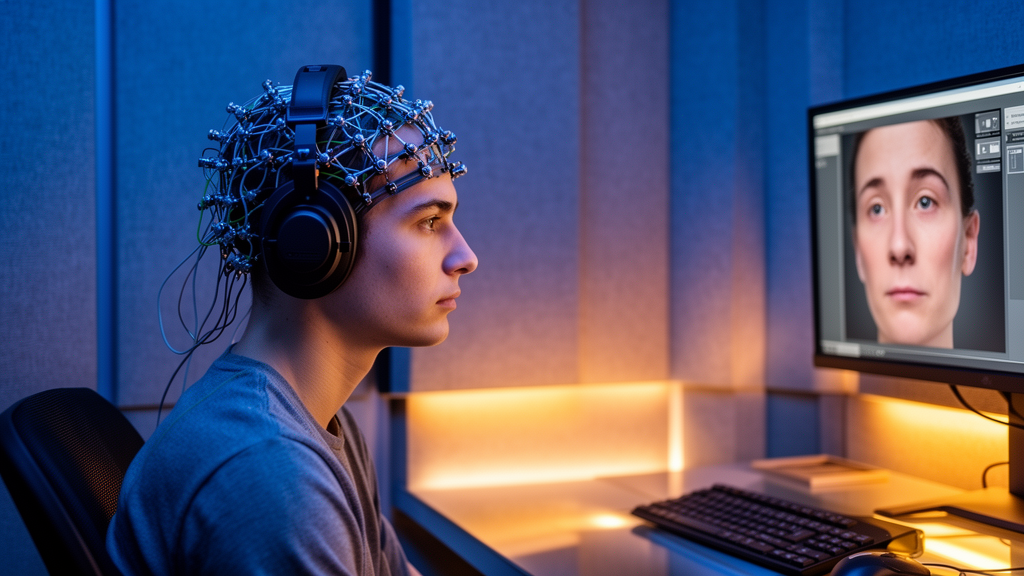
Individuals with subthreshold depression exhibit altered temporal dynamics and distinct neural interaction patterns when processing combined auditory and visual emotional signals, according to new research. By evaluating behavioral responses alongside recorded electroencephalography data, investigators detected specific differences in how the brain integrates facial and vocal cues during emotion recognition. These electrophysiological variations occurred across precise processing intervals, highlighting potential depression-related vulnerabilities in multisensory emotional processing.
Subthreshold depression is clinically recognized for its association with an elevated risk of developing major depressive disorder, alongside documented abnormalities in emotional processing. Because everyday human emotion recognition relies heavily on the integration of facial and vocal cues, researchers sought to examine the behavioral and electrophysiological characteristics of audiovisual emotional processing in individuals with subthreshold depression compared to healthy controls.
The investigation tested twenty-two individuals with subthreshold depression alongside twenty-two healthy control participants in a laboratory setting. To ensure that the study had sufficient statistical power to detect meaningful effects across conditions, the sample size was determined through an a priori power analysis specifically designed for a mixed-design analysis of variance evaluating group, modality, and emotion.
During the experimental session, participants completed a comprehensive emotional discrimination task while electroencephalography continuously recorded scalp electrical activity. The experimental design incorporated auditory-only, visual-only, and combined audiovisual presentations across happy, neutral, and sad stimuli. This multimodal configuration allowed the researchers to simultaneously evaluate overt behavioral performance and underlying event-related potential responses to differing emotional expressions.
The research team analyzed behavioral accuracy, response time, and relative multisensory response enhancement across the experimental conditions. Behavioral results revealed that discrimination accuracy was significantly higher for combined audiovisual stimuli than for unimodal auditory or visual presentations. In contrast, relative multisensory response enhancement did not differ significantly between the subthreshold depression group and the healthy control group.
Response time measurements revealed notable patterns between the two participant groups across the various conditions. Individuals with subthreshold depression responded faster overall than healthy controls throughout the emotional discrimination task. At the same time, both participant groups exhibited slower response times when evaluating sad and neutral stimuli compared to their responses to happy stimuli.
Electrophysiological interaction was formally indexed using the formula AV minus the sum of A and V, wherein AV, A, and V represent event-related potential responses to audiovisual, auditory-only, and visual-only stimuli, respectively. The absolute deviation of this difference wave from zero was utilized descriptively to characterize the overall magnitude of audiovisual interaction, whereas the polarity of the wave indicated the direction of deviation from linear additivity.
Event-related potential analyses demonstrated localized group differences in signed difference wave amplitudes across several distinct spatiotemporal windows. Significant effects emerged in the central-parietal region at 190 to 220 milliseconds, in the occipital, central, and fronto-central regions at 250 to 280 milliseconds, and in the occipital region at 290 to 350 milliseconds. For each of these observed effects, the subthreshold depression group exhibited amplitudes closer to zero, descriptively suggesting reduced absolute interaction magnitudes within these specific spatiotemporal windows.
Furthermore, sad stimuli produced a distinct occipital interaction pattern at 290 to 350 milliseconds, characterized by larger absolute amplitude and opposite polarity in individuals with subthreshold depression compared to healthy controls. The researchers concluded that these findings suggest altered temporal dynamics of audiovisual emotional integration in subthreshold depression, which may reflect depression-related vulnerabilities in multisensory processing. However, the authors noted that future studies utilizing larger sample sizes and longitudinal designs will be necessary to ascertain the reliability and clinical relevance of these electrophysiological effects.
Subject of Research: Audiovisual emotional integration and event-related potentials in subthreshold depression
Article Title: Altered audiovisual emotional integration in individuals with subthreshold depression: evidence from behavioral and event-related potentials
Article References: Ren, Y., Li, S., Luo, R., Zheng, H., Yang, X., Li, Y., & Yang, W. (2026). Altered audiovisual emotional integration in individuals with subthreshold depression: evidence from behavioral and event-related potentials. BMC Psychiatry. https://doi.org/10.1186/s12888-026-08809-0
Image Credits: AI Generated
DOI: 10.1186/s12888-026-08809-0
Keywords: subthreshold depression, audiovisual integration, event-related potentials, electroencephalography, multisensory processing, emotion recognition, emotional discrimination task, relative multisensory response enhancement, happy stimuli, sad stimuli, neutral stimuli, central-parietal region, occipital region, fronto-central region, linear additivity, response time, major depressive disorder risk
News Source: Glenn Wilkins. (November 25, 2026). Subthreshold Depression Alters Brain Dynamics During Audiovisual Emotional Integration. Scienmag.