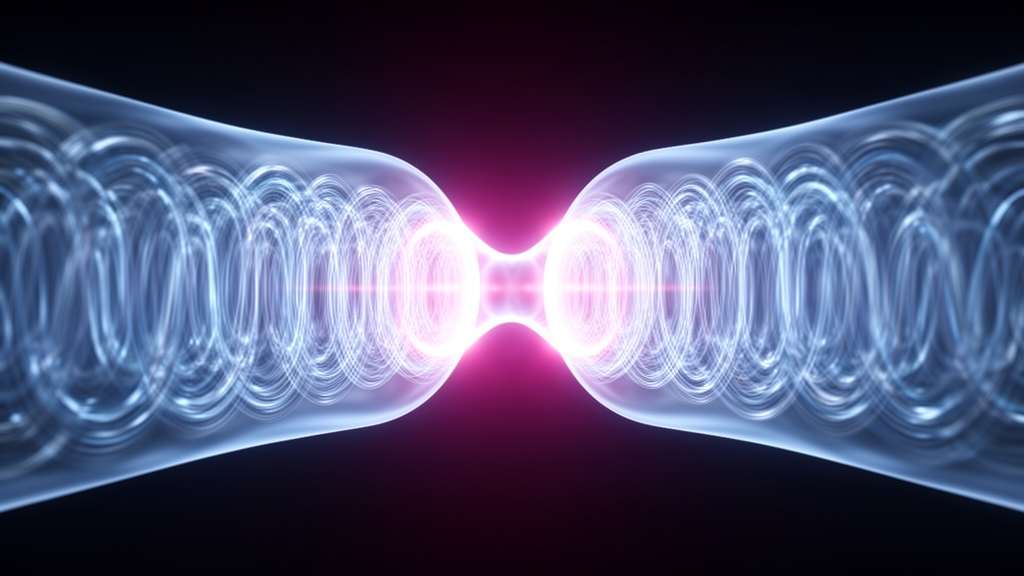
Theoretical and numerical investigations have revealed that colliding subcycle light pulses inside a resonant medium can dynamically generate and control microscopic optical cavities and photonic time crystals on ultrafast timescales. The research, reported by R. M. Arkhipov and colleagues, analyzes how extremely brief electromagnetic waveforms create transient structures whose refractive properties vary rapidly in space and time. The study establishes that the overlap of counter-propagating pulses reorganizes atomic populations, carving out localized channels bounded by sharp population difference gratings.
The foundational elements of this optical phenomenon are unipolar half-cycle ultrashort pulses, which represent the physical limit for shortening electromagnetic signals within a given spectral range. Unlike standard multicycle laser pulses comprising oscillating electric field cycles with a net zero time-integrated field, a unipolar half-cycle pulse contains an isolated half-wave of a single polarity. This profile yields a non-zero electric area, defined as the integral of the electric field vector over time at a specific spatial coordinate. Generating such waveforms has become feasible through distinct methods across different frequency domains. In the optical spectrum, quasi-unipolar pulses lasting hundreds of attoseconds can be produced by coherently synthesizing monochromatic components from broadband optical pumping or through the deceleration of relativistic electron beams in thin targets. In the terahertz regime, unipolar pulses are generated using nonlinear plasma interactions or the superradiation of stopped polarization.
Understanding the significance of using ultrashort subcycle pulses requires contrasting them with historical methods used to manipulate population lattices in resonant media. Coherent light-matter interactions and atomic population gratings were first observed decades ago during pioneering experiments on photon echoes. However, those early studies relied on long multicycle pulses of nanosecond duration that did not overlap simultaneously within the medium, restricting their use to echo holography and measurements of polarization relaxation times without enabling ultrafast control. Similarly, conventional methods producing spatial gratings rely on the interference of intersecting continuous-wave or long monochromatic laser fields. Because these approaches depend on sustained optical cycles and slow relaxation processes, they cannot achieve rapid optical modulation, such as erasing or multiplying the spatial frequency of induced gratings on femtosecond intervals. Coherent propagation of ultrashort pulses overcomes these limitations by interacting faster than the polarization relaxation time.
When two counter-propagating ultrashort pulses collide directly within a resonant medium, their spatial and temporal overlap initiates the formation of a dynamic microcavity. Within the specific spatial region where two fields cross, the population difference between quantum energy levels reaches a nearly uniform value, establishing what researchers identify as a light-induced channel. At the outer boundaries of this overlap zone, the atomic population changes abruptly, creating steep population difference gratings that effectively function as reflective mirrors. The resulting localized cavity exhibits spatial dimensions on the order of the resonant transition wavelength. These light-induced architectures are intimately connected to the physics of temporal and spatiotemporal photonic crystals, wherein the refractive index of a material is modulated rapidly in time or across space and time simultaneously. Because traditional nonlinear optical mechanisms respond too sluggishly, dynamic excitation through ultrashort pulses provides a practical mechanism for rapid refractive modulation.
A central breakthrough reported in the investigation concerns overcoming fundamental polarity restrictions that had hindered previous microcavity generation schemes. Earlier theoretical and numerical studies on unipolar pulse collisions within two-level media concluded that dynamic microcavities could only be established when colliding pulses possessed opposite polarities, while collisions between pulses of identical polarity failed to produce trapped cavity structures. The authors demonstrate that this operational limitation is completely lifted when subcycle pulses incorporate a trailing edge of opposite polarity behind their primary half-cycle wave. By employing these quasi-unipolar waveforms, pulses characterized by identical dominant polarity reliably establish localized microcavities upon collision. The inclusion of the secondary trailing edge modifies the net coherent interaction with the medium, allowing self-induced transparency pulses with a characteristic two-pi area to stabilize localized population channels that were previously considered impossible under symmetric excitation conditions.
To describe the microscopic origins of cavity formation analytically, the researchers developed mathematical models based on the time-dependent Schrödinger equation across different operational regimes. In the simplest formulation, valid when field amplitude is low and the medium is sparse and weakly excited, an analytical description was derived using the sudden approximation, treating pulse duration as shorter than the transition period. Expanding beyond the sudden approximation, the team utilized quantum perturbation theory to model atomic populations. In the first order of perturbation theory, when two Gaussian half-cycle pulses interact with atoms, the resulting population depends on the individual electric areas and an interference term modulated by transition frequency and arrival delay. At the collision center where delay is zero, atomic population is determined by the square of the summed pulse areas, while spatial delay outside produces harmonic population oscillations acting as Bragg mirrors.
The persistence of these population lattices and microcavities was further verified in denser media and multilevel atomic configurations where simple approximations break down. In strong optical fields and dense material environments, interactions between adjacent atoms and pulse reshaping effects necessitate comprehensive multilevel models. Numerical evaluations incorporating three-level atomic systems showed that harmonic population gratings remain robust, with parameters matching rubidium-87 atoms and atomic hydrogen. Quantum calculations for a one-dimensional potential well including ionization channels confirmed that these structures are preserved provided the medium is not excessively excited. Specifically, high-quality harmonic lattices are sustained when the pulse duration is shorter than the characteristic time scale linked to ground-state energy, and the electric area remains smaller than the characteristic atomic scale defined by electron charge and quantum system dimensions. Under these conditions, ground-state depletion and ionization remain negligible, ensuring reliable optical performance.
To analyze spatio-temporal dynamics during pulse collisions in strong fields, the authors implemented numerical simulations solving the coupled one-dimensional Maxwell-Bloch equations. This numerical framework couples the wave equation for the electric field strength with quantum material equations governing the non-diagonal elements of the atomic density matrix, polarization, and population inversion of the resonant two-level medium. The simulation domain spanned twelve resonant transition wavelengths with reflecting boundary conditions at both extremities, while the absorbing resonant medium occupied the central region between coordinates four and eight wavelengths. A pair of subcycle pulses acting as two-pi self-induced transparency pulses with Gaussian envelopes and carrier frequencies matching the atomic transition were launched simultaneously from vacuum boundaries toward the center. By computing spatial and temporal distributions of the electric field, polarization, and population inversion, the researchers mapped the real-time evolution of the cavity during successive pulse passes.
The numerical simulations reveal distinctive developmental stages when two subcycle pulses of identical polarity collide in the center of the resonant medium. Following the initial collision event at approximately twenty-three femtoseconds, the medium remains in a weakly excited state without establishing a defined cavity structure. However, after the pulses reflect from domain boundaries and undergo a second collision at approximately fifty femtoseconds, the dynamic microcavity begins to emerge clearly. The population difference across the central overlap zone assumes a nearly constant value, while sharp gradients develop at boundaries to confine the light-induced channel. As repeated reflections produce subsequent collisions at seventy-five, one hundred, and one hundred twenty-five femtoseconds, the microcavity profile becomes progressively more pronounced. Crucially, complex spatial polarization structures form within the microcavity zone, persisting over the polarization relaxation lifetime and acting as localized oscillating sources radiating electromagnetic waves in opposing directions.
When colliding subcycle pulses possess opposite polarities, the physical dynamics of the resonant medium exhibit marked differences in both timing and structure. In this opposite-polarity configuration, a fully formed dynamic microcavity appears immediately after the very first collision event, rather than requiring multiple reflections. The atomic medium at the exact central collision point remains in an unexcited state characterized by an inversion value of unity, while steep population boundaries arise instantaneously at the edges of the overlap zone. With each successive collision, the spatial frequency of the induced population difference lattices steadily increases, resulting in dense periodic structures that function as Bragg reflectors with calculated reflection coefficients reaching approximately thirty percent. Standing waves of macroscopic polarization form concurrently within the localized cavity region. The continuous interaction between propagating pulses and these sustained polarization fluctuations drives the observed multiplication of spatial grating frequencies across subsequent collision cycles.
The demonstrated capacity to generate and control dynamic microcavities using subcycle pulses introduces promising pathways for ultrafast photonic technologies and fundamental optics. Because the physical dimensions, modulation depths, and mirror periodicities of microcavities can be manipulated dynamically by adjusting pulse timing, front steepness, and collision counts, these systems offer a versatile framework for manipulating optical signals on attosecond and femtosecond scales. The underlying mechanisms provide practical routes for developing ultrafast all-optical attosecond switches, novel holographic recording schemes with extreme temporal resolution, and tunable spatiotemporal photonic crystals. By demonstrating that trailing-edge subcycle pulses remove earlier polarity constraints, the authors expand the theoretical and practical scope of coherent attosecond optics.
Subject of Research: Dynamic microcavities and photonic time crystals generated by colliding subcycle light pulses in resonant media
Article Title: Microcavities and Photonic Time Crystals Formed by the Colliding of Half-Cycle Light Pulses in a Resonant Medium
Article References: Arkhipov, R. M., Arkhipov, M. V., Pakhomov, A. V., Diachkova, O. O., & Rosanov, N. N. (2025). Microcavities and Photonic Time Crystals Formed by the Colliding of Half-Cycle Light Pulses in a Resonant Medium. Bulletin of the Russian Academy of Sciences: Physics, 89(1), 63-70. https://doi.org/10.1134/s1062873824709152
Image Credits: AI Generated
DOI: 10.1134/S1062873824709152
Keywords: dynamic microcavities, photonic time crystals, half-cycle pulses, self-induced transparency, ultrashort pulses, resonant medium, Maxwell-Bloch equations, population inversion, polarization waves, attosecond physics, optical switches, Schrödinger equation, perturbation theory, Bragg reflection, dipole moment, two-level medium, light storage, quantum coherence
News Source: Katie Riggs. (November 25, 2026). Colliding Half-Cycle Light Pulses Form Controllable Dynamic Microcavities in Resonant Media. Scienmag.