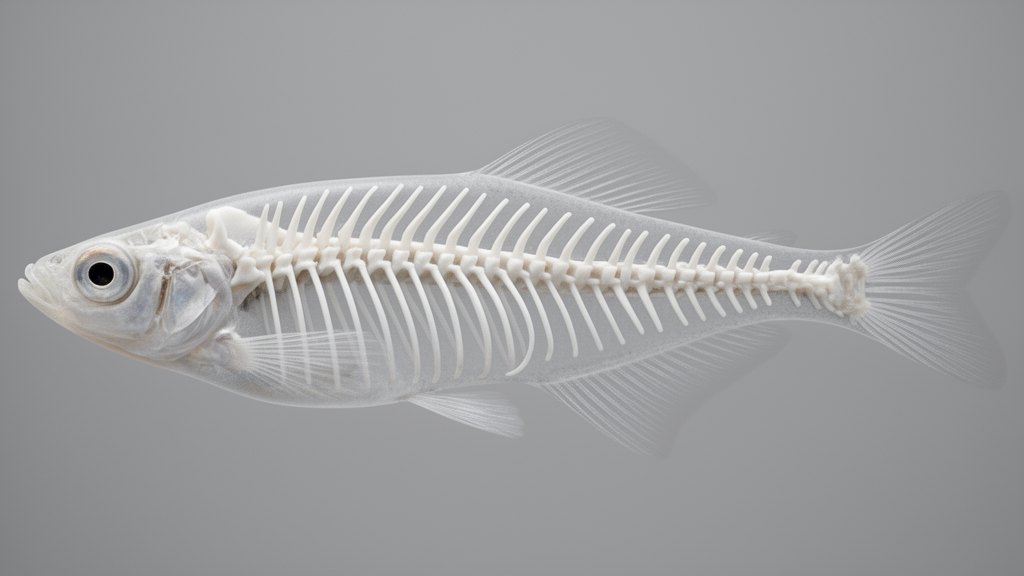
Populations of the medaka fish species complex originating from higher latitudes consistently form a greater number of abdominal vertebrae than their southern counterparts, maintaining this structural distinction even when embryos develop across different incubation temperatures. Investigating wild-derived stocks maintained under shared conditions, researchers examined skeletal traits across a broad geographic range spanning from twenty-five to forty degrees North in East Asia. The investigation revealed that the geographic trend known in ichthyology as Jordan’s rule applies specifically to the abdominal portion of the spinal column rather than the tail region. Quantitative analyses demonstrated that geographic origin explains a substantial portion of the variance in abdominal vertebral counts while exerting virtually no influence on caudal vertebrae, which instead align closely with ancestral lineage branching. Genetic mapping further uncovered distinct genomic loci associated with abdominal and total vertebral totals, providing empirical insight into the evolutionary forces and developmental mechanisms shaping morphological variation across climatic gradients.
Biologists have long observed that geographic clines shape animal morphology and physiology through local adaptation, generating systematic phenotypic patterns across latitudinal gradients. In warm-blooded vertebrates, classic eco-geographic generalizations such as Bergmann’s rule and Allen’s rule describe how temperature differences influence body dimensions and extremity proportions to optimize heat retention or dissipation. Similarly, human populations exhibit variations in skin pigmentation along latitudinal gradients as a protective adaptation against differing intensities of ultraviolet radiation. Among aquatic ectotherms, teleost fishes display well-documented latitudinal adjustments in thermal tolerance, reproductive timing, and photoperiod sensitivity. Atlantic silversides inhabiting higher latitudes experience abbreviated thermal seasons and display countergradient growth acceleration, whereas tropical reef damselfish adapt to truncated spawning windows by increasing egg production efficiency, and killifish from warmer southern latitudes bolster thermal resilience through differential expression of cellular heat shock proteins.
Among the morphological characteristics exhibiting geographic patterning in fishes, skeletal segmentation stands out for its widespread and reproducible structure. Formulated in the late nineteenth century, Jordan’s rule posits that teleost fish populations native to colder, higher latitudes typically possess more total vertebrae than related populations inhabiting warmer, lower latitudes. Multiple hypotheses have emerged to explain the potential adaptive value of this morphological cline. In the medaka complex, northern populations face shortened seasonal growing windows and require enhanced digestive or metabolic capacity, which correlates with extended intestinal tracts and a corresponding expansion of the abdominal body cavity housing visceral organs. Furthermore, because ambient temperature alters water viscosity and dynamic drag, vertebral variation may modulate axial flexibility to ensure optimal larval swimming kinematics across differing hydrodynamic regimes. Despite these functional hypotheses, the precise genetic architecture and developmental pathways governing Jordan’s rule have remained unresolved.
To investigate the genetic architecture of axial patterning without the confounding effects of immediate wild habitats, researchers focused on the medaka species group, formally designated as the Oryzias latipes species complex. This freshwater teleost assemblage encompasses four distinct taxonomic entities distributed across East Asia: Oryzias latipes native to southern Japan, Oryzias sakaizumii from northern Japan, Oryzias sinensis from western Korea and mainland China, and an undescribed sister species originating from eastern Korea. Together, their native ranges form a continuous geographic gradient across fifteen degrees of latitude. While prior field assessments identified vertebral differences in isolated populations of northern Japanese medaka, it remained uncertain whether Jordan’s rule applied systematically across the entire species complex or whether observed phenotypic differences represented plastic physiological responses to local wild thermal histories.
The study leveraged an extensive biological repository curated by the National BioResource Project Medaka in Okazaki, Japan, which has cultivated wild-derived strains as closed colonies in outdoor field environments since 1985. More than ninety strains representing diverse collection localities were maintained under standardized common garden conditions at Utsunomiya University, minimizing transient environmental discrepancies while preserving hereditary genomic diversity. In June 2023, investigators randomly collected adult specimens aged six months or older, sampling three mature males and three mature females from each strain. Individual fish were fixed in absolute ethanol and scanned using high-resolution three-dimensional micro-computed tomography at an operating tube voltage of ninety kilovolts and a current of one hundred sixty microamperes. Reconstructed volumetric renderings enabled precise counts of abdominal vertebrae, defined up to the insertion of the anal pterygiophore where the first haemal spine fuses, and caudal vertebrae terminated at the second preural centrum.
To evaluate evolutionary relationships across the sampled strains, researchers acquired whole-genome sequencing datasets generated on high-throughput paired-end sequencing platforms from ninety-four male individuals, averaging nearly forty-two gigabases of sequence per specimen. Utilizing actinopterygian orthology benchmarks, the team recovered and aligned 3,402 complete single-copy coding sequences to construct a partitioned maximum likelihood phylogenomic tree encompassing over 5.7 million base pairs. The resulting phylogenetic topology verified that the ninety wild-derived stocks cleanly segregated into four evolutionary lineages corresponding directly to the four recognized taxa within the species complex. This high-resolution tree provided the necessary evolutionary foundation for statistically distinguishing inherited phylogenetic inertia from adaptive latitudinal divergence across the geographic landscape.
Employing phylogenetic generalized least squares regression models, the authors examined log-transformed vertebral counts against the latitude coordinates of each stock’s ancestral collection locality. The models incorporated phylogenetic variance-covariance structures to avoid false correlations arising from shared evolutionary descent. The statistical evaluation revealed a pronounced, statistically significant positive correlation between sampling latitude and abdominal vertebral number across the ninety stocks. Partial coefficient of determination calculations demonstrated that ancestral collection latitude accounted for 19.1 percent of the total variance observed in abdominal vertebral counts, whereas phylogenetic tree structure explained less than one percent of this variation. Conversely, caudal vertebral counts displayed no correlation with latitude, with ancestral geography accounting for virtually zero variance while phylogenetic history accounted for 22.5 percent of the variance. Total vertebral counts showed an intermediate balance, with phylogeny accounting for 18.5 percent and latitude explaining 5.9 percent, confirming that latitudinal selection acts selectively upon the precaudal abdominal segment.
Because the outdoor repository stocks experienced seasonal water temperature fluctuations in open-air facilities, the authors conducted an embryonic rearing experiment under controlled laboratory conditions to determine whether developmental plasticity contributed to the observed geographic clines. Investigators collected early-stage embryos from ten selected wild-derived strains spanning diverse latitudes across all four species, including northern Japanese stocks such as Higashidori and Hanamaki, southern Japanese stocks such as Fuji, Ama, and Ogimi, Korean strains from Sokcho and Geoje, and continental Asian strains such as Kunming. Embryos were incubated at four tightly regulated water temperatures—twenty-two, twenty-four, twenty-six, and twenty-eight degrees Celsius—until reaching stage 33, which marks the completion of embryonic somite formation. After somite segmentation concluded, all experimental clutches were transferred to a uniform temperature of twenty-six degrees Celsius until hatching and reared to juvenile stages before skeletal visualization via Alizarin red S staining.
Microscopic evaluation of the laboratory-reared specimens confirmed that the positive association between latitude and abdominal vertebral count persisted across all four incubation temperatures within each taxonomic subgroup. The Sokcho strain from eastern Korea consistently exhibited the highest median abdominal vertebral count of thirteen, whereas the low-latitude Kunming strain from southwestern China maintained the lowest median of eleven, irrespective of embryonic rearing temperature. Nonparametric factorial analysis of variance via aligned rank transform verified that genetic strain identity exerted a highly significant influence on abdominal, caudal, and total vertebral totals. In contrast, incubation temperature produced no statistically significant effect on abdominal or total vertebral counts, significantly influencing only caudal vertebrae through a subtle reduction observed at twenty-six degrees Celsius. Unlike historical experiments reporting an inverse relationship between rearing temperature and total vertebrae, medaka in this cohort displayed negligible thermal plasticity, indicating that geographic skeletal divergence is anchored in stable genetic variation.
To localize the chromosomal regions driving this morphological variation, the team carried out a genome-wide association study across seventy-six stocks of the two closely related Japanese species, excluding continental Asian lineages to prevent confounding from deep population stratification. After filtering more than one million linkage-disequilibrium-pruned single nucleotide polymorphisms, mixed-model association testing identified two statistically significant loci surpassing genome-wide Bonferroni thresholds. For abdominal vertebral count, a significant variant emerged on chromosome 12 at position 1.58 megabases, mapped within the eighth intron of marveld2, a gene encoding a MARVEL domain-containing tight junction protein. For total vertebral count, a significant variant was pinpointed on chromosome 10 at position 21.5 megabases, located within an intergenic region approximately 193 kilobases from tenm2, which encodes teneurin transmembrane protein 2. Trait heritability estimates calculated from the genetic relatedness matrix reached 0.16 for abdominal vertebrae, 0.24 for caudal vertebrae, and 0.29 for total vertebral count.
In evaluating the functional implications of these genetic associations, the researchers exercised scientific caution regarding potential mechanistic roles. While marveld2 is known to modulate osmoregulation in Atlantic salmon and exhibits confirmed transcript expression in medaka presomitic mesoderm, its functional involvement in embryonic somite segmentation remains uncharacterized, and the underlying genotype distribution among the sampled stocks was heavily skewed, suggesting the association on chromosome 12 could represent an analytical artifact. Similarly, the chromosome 10 intergenic variant resides in a gene-sparse region lacking established segmentation factors within one hundred kilobases, as tenm2 has not been shown to participate in somite boundary formation or mesodermal patterning. Other loci adjacent to the chromosome 12 signal, including bap1 and tor4a, participate in Notch signaling pathways, but direct developmental links require functional gene editing and expression assays.
The authors contextualized their findings within existing teleost developmental biology, highlighting that vertebral development proceeds through a coordinated two-phase process: the periodic segmentation of embryonic somites followed by the sequential calcification of the notochordal sheath. While somite formation largely determines basic segment boundaries during early embryogenesis, the narrower experimental thermal range of twenty-two to twenty-eight degrees Celsius and the cessation of temperature control at the somite stage may explain why earlier studies using broader temperature ranges up to thirty-two degrees Celsius observed stronger environmental plasticity. By demonstrating that wild-derived medaka maintain distinct latitudinal gradients in abdominal vertebrae under common garden and laboratory settings, the study establishes that Jordan’s rule in the Oryzias latipes species complex is driven by genetically encoded precaudal patterning, providing an experimental framework for uncovering how selective pressures shape vertebrate skeletal evolution.
Subject of Research: Genetic basis of latitudinal variation in vertebral number in the Oryzias latipes species complex
Article Title: Genetic basis of latitudinal variation in vertebral number in the Oryzias latipes species complex
Article References: Hara, R., Ansai, S., Kamei, Y., Matsuda, M., & Kinoshita, M. (2025). Genetic basis of latitudinal variation in vertebral number in the Oryzias latipes species complex. Zoological Letters, 12(1), Article 1. https://doi.org/10.1186/s40851-025-00256-1
Image Credits: AI Generated
DOI: 10.1186/s40851-025-00256-1
Keywords: Oryzias latipes, Oryzias sakaizumii, Oryzias sinensis, Jordan's rule, latitudinal variation, vertebral count, abdominal vertebrae, caudal vertebrae, micro-CT scanning, common garden experiment, phylogenetic generalized least squares, genome-wide association study, marveld2, tenm2, somite development, teleost evolution, thermal plasticity
News Source: Drew Townsend. (November 25, 2026). Medaka Fish From Higher Latitudes Develop More Abdominal Vertebrae Across Temperatures. Scienmag.