A computational biomechanical investigation evaluating internal fixation strategies for mandibular condyle fractures indicates that double parallel titanium miniplates provide greater structural stability than single or angulated plate configurations. Conducted by researchers Kamran Hassani, Mohammad Ali Ghazi, and Siamak Khorramymehr, the numerical finite element study modeled the mechanical behavior of a fractured human jaw under simulated functional loading. Their findings revealed that fixing condylar base fractures with two parallel miniplates induced lower peak stresses, minimized mechanical strain, and restricted structural displacement across the fracture interface more effectively than alternative arrangements.
Fractures of the mandible resulting from trauma and accidents represent a frequent clinical challenge, sparking decades of debate regarding the most stable patterns for surgical reduction and internal fixation. While biomechanical principles suggest that achieving optimal fracture reduction benefits from using the largest possible fixation hardware, surgeons face anatomical and clinical limitations that necessitate reducing implant dimensions. This dynamic creates two competing engineering demands in orthopedic design: minimizing hardware size while maximizing post-surgical mechanical rigidity and bone stability under functional masticatory loads.
To investigate these competing demands, the research team developed a three-dimensional solid model derived from high-resolution computed tomography scans of a 40-year-old male patient. The digital volumetric data was segmented using Mimics software and subsequently imported into Catia to generate the solid geometry using straight triangle language data. The anatomical reconstruction specifically simulated an unfavorable condylar base fracture line, defined as a spline crossing from the lowest point of the sigmoid notch to the posterior border of the mandibular ramus.
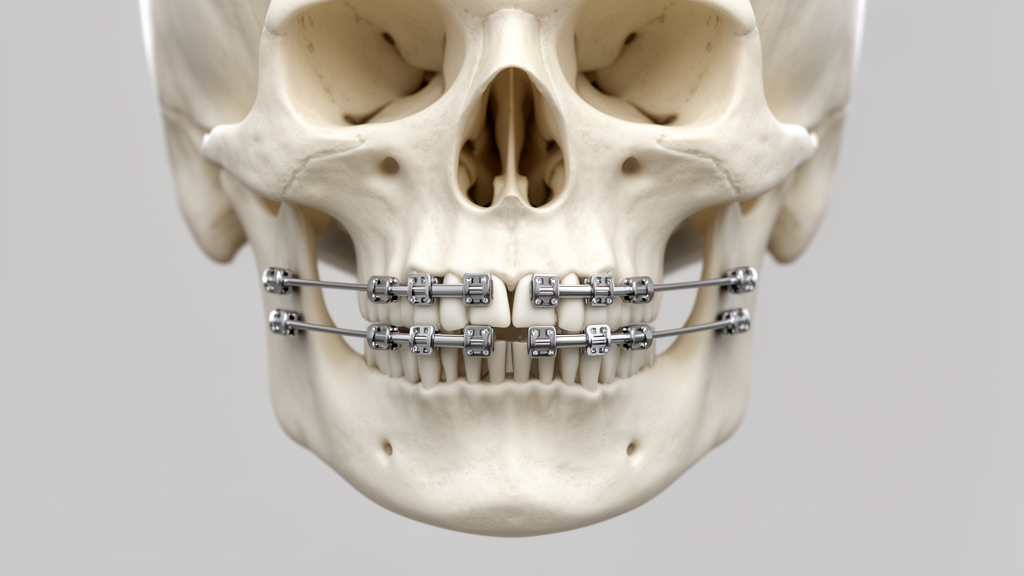
The researchers evaluated three standard surgical fixation patterns using titanium four-hole miniplates measuring 1 millimeter in thickness and ranging from 25 to 30 millimeters in length. Pattern 1 consisted of a solitary miniplate positioned across the osteotomy line; Pattern 2 utilized two parallel miniplates; and Pattern 3 employed two angulated miniplates. All solid component geometries, including the fractured mandible and fixation hardware, were imported into Abaqus simulation software for detailed numerical processing.
In establishing the computational framework, the mandibular bone was modeled with homogeneous, isotropic, and linearly elastic mechanical properties to simplify simulation parameters while maintaining numerical rigor. Fixed, bonded contact conditions were assigned to the interfaces between the bone and screws, as well as between the fixation plates and screws. Because the implanted hardware remains stationary post-operatively, the team defined an average static friction coefficient of 0.1 along the fracture interface and between the plate and cortical bone surfaces.
Due to the complex geometric curvature of the mandibular condyle and the miniplates, the authors applied an unstructured computational mesh consisting of tetrahedral solid elements suitable for intricate boundaries. Mesh independence analyses were executed across all three patterns based on peak von Mises stress criteria. Mesh convergence evaluations performed on the single-plate configuration demonstrated stop criteria within 1.6 to 3 percent, ensuring numerical accuracy without requiring excessive computational iterations.
Boundary and loading conditions were established to simulate physiological jaw function, addressing the ongoing scientific challenge of accurately quantifying in vivo masticatory forces. The inferior border of the mandible was bonded and constrained in accordance with clinical fixation parameters, while mandibular movements were restricted across the superior surfaces of the condyle in all directions. To simulate functional loading during biting and mastication, a vertical joint force of 427 Newtons was applied to the top of the condyle alongside corresponding shear forces and bending moments along the mandibular body.
Numerical results revealed distinct differences in von Mises stress magnitudes across the evaluated fixation patterns. Pattern 1 generated the highest peak stress at 80 megapascals, followed by Pattern 3 at 75 megapascals, whereas Pattern 2 produced the lowest maximum stress at 70 megapascals. Stress concentrations across all configurations localized primarily around the screw holes of the miniplates. In both two-plate setups, the superior miniplate bore substantially higher stress than the inferior plate due to its proximity to the temporomandibular joint, which experiences a clockwise moment during mastication.
Strain distribution analysis similarly favored the dual parallel configuration, yielding a maximum strain magnitude of 0.0247 for Pattern 2, compared to 0.035 for Pattern 3 and 0.056 for Pattern 1. Elevated mechanical strains concentrated near the screw holes along the fracture boundary in all models, presenting localized regions that could theoretically predispose the construct to structural failure. However, Pattern 2 exhibited a more uniform strain distribution with markedly lower localized intensity than either the single or angulated arrangements.
Displacement evaluations at the superior region of the mandible corroborated the mechanical superiority of parallel hardware placement. Peak displacements reached 5.6 micrometers in Pattern 1, 4.41 micrometers in Pattern 3, and dropped to a minimum of 3.6 micrometers in Pattern 2. All observed displacements fell well within the 150-micrometer physiological mobility limit established in maxillofacial biomechanics literature as necessary to prevent nonunion or delayed healing under functional bite forces.
The study’s findings align with prior biomechanical and experimental literature, including work by Aquilina and colleagues, who previously observed that double parallel plates provided superior rigid fixation over single and angulated configurations. Additional studies cited by the authors, including investigations by Wagner, Jie Li, and Subramanian, similarly reported that multi-plate techniques resist displacement and attenuate cortical stress more efficiently than single-plate approaches, particularly when plates run parallel rather than perpendicular or highly angled relative to anatomical stress vectors.
Despite the favorable mechanical performance demonstrated by the double parallel configuration, the authors emphasized the inherent constraints of purely computational simulations. The model’s reliance on isotropic and linearly elastic bone properties, standardized static loading vectors, and an idealized single-patient geometry highlights the necessity of further validation. The research team concluded that subsequent experimental biomechanical testing utilizing non-human and human physical specimens will be essential to corroborate these numerical predictions before translating findings directly into refined surgical protocols.
Beyond immediate surgical mechanics, the research was conducted in adherence to the ethical standards of the Declaration of Helsinki following formal approval from the Ethics Committee of Islamic Azad University, with signed informed consent secured from the patient. Clinical management of condylar injuries has long been complicated by secondary displacement, an adverse outcome that earlier clinical investigations by Koolstra and colleagues attributed to the continuous muscular pull exerted by the lateral pterygoid muscle despite the application of maxillomandibular fixation. Related clinical and demographic research by Jung and associates examined fracture patterns and population distributions, while experimental work by Arbag and colleagues evaluated the biomechanical performance of competing internal fixation techniques to guide clinical interventions.
The development of computational approaches has progressively refined how investigators evaluate these mechanical challenges. Previous finite element work by Gupta and colleagues demonstrated that utilizing two arms within double miniplates or trapezoidal plates successfully neutralizes opposing tensile and compressive strains across diverse loading cases. In related biomechanical research, Wan and associates simulated stress alterations occurring within the temporomandibular joint following mandibular repositioning. Furthermore, a systematic review examining human mandibular modeling established that defining evidence-based values for boundary conditions, applied forces, fixtures, and material properties is fundamental to ensuring valid simulations, a standard reinforced by Daqiq and colleagues through physical testing of polymeric and three-dimensional printed mandibular structures.
A primary challenge highlighted in the investigation concerns the dynamic functional demands imposed on healing facial bones. Physiological actions including chewing, biting, and talking exert continuous directional forces and bending moments across the jaw, generating relative displacement along the fracture line that can significantly delay the rejoining of fractured bone segments. The authors noted that the anatomical positioning of hardware relative to the bone fragments substantially influences stress distribution. Specifically, placing miniplates near the central region of each fractured bone component reduces the stress induced on cortical bone, while maximizing the contact surface area helps distribute mechanical stresses more uniformly and prevents localized failure around plate holes.
Hardware orientation relative to the mandibular anatomy also proved critical when contrasted with broader biomechanical literature. The findings reflect earlier research by Sadeghi and colleagues, who determined that in unfavorable horizontal mandibular fractures, plates oriented perpendicular to the fracture line sustained notably higher stress magnitudes than plates installed parallel to the inferior border of the mandible. Additionally, the team contextualized their displacement calculations against numerical modeling by Caraveo and associates, who examined low-profile three-dimensional four-by-two-hole miniplates. In that study, relative displacements under varying bite forces ranged between 3.6 and 74.9 micrometers along the X-axis, 5 to 68 micrometers along the Y-axis, and 5.6 to 82 micrometers along the Z-axis, indicating that the present study’s observed displacements of 3.6 to 5.6 micrometers remain within a consistent and plausible physical range.
Ultimately, the study underscores that dual parallel fixation directly addresses the complex mechanical environment of the condylar base, where tension, compression, and torsion act concurrently during mandibular function. By counteracting these combined loads, parallel hardware alignment optimizes load distribution, ensures greater construct stability, and supports anatomical fracture reduction across the site. In clinical evaluation, surgeons seek methods that balance rigid stabilization against the surgical necessity of minimizing foreign implant material within delicate facial anatomy. Although the finite element model provides a structured framework for understanding miniplate biomechanics and optimizing fixation patterns, the investigators emphasized that comprehensive validation requires future experimental investigations utilizing non-human and human empirical data to substantiate these numerical solutions.
Subject of Research: Biomechanical finite element analysis of internal fixation patterns for mandibular condyle fractures
Article Title: A Model for Different Internal Fixation of the Mandibular Condyle Fractures
Article References: Hassani, K., Ghazi, M. A., & Khorramymehr, S. (2026). A Model for Different Internal Fixation of the Mandibular Condyle Fractures. Biomedical Materials & Devices, 4(3), 3450-3460. https://doi.org/10.1007/s44174-025-00450-x
Image Credits: AI Generated
DOI: 10.1007/s44174-025-00450-x
Keywords: mandibular condyle fractures, internal fixation, finite element analysis, titanium miniplates, biomechanical modeling, von Mises stress, strain distribution, mandibular displacement, temporomandibular joint, Catia modeling, Abaqus simulation, double parallel miniplates, double angulated miniplates, orthopedic biomechanics, fracture fixation stability, maxillofacial surgery, stress concentration
News Source: Drew Townsend. (November 24, 2026). Parallel Miniplates Offer Superior Mandibular Condyle Stability in Finite Element Modeling. Scienmag.