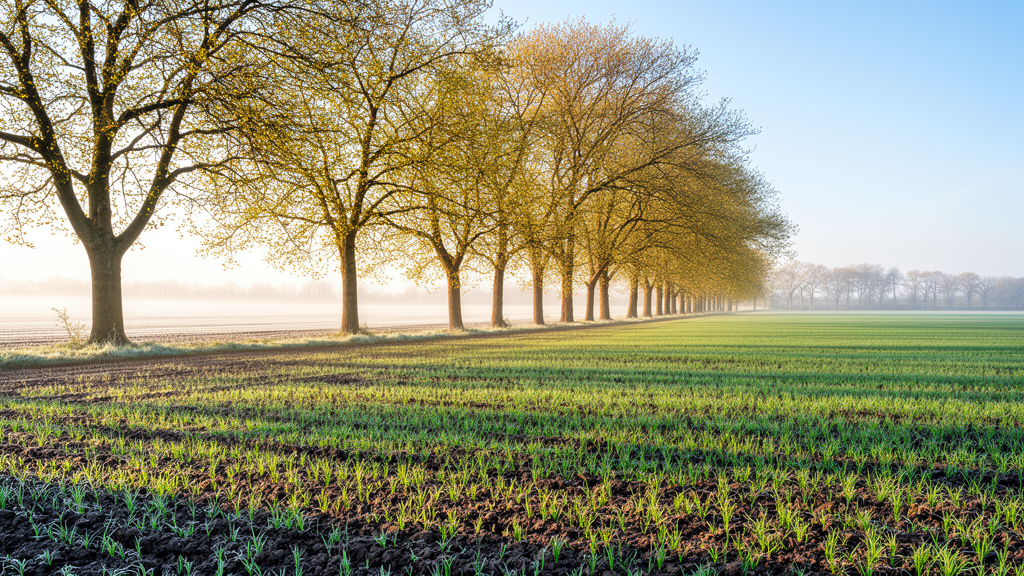
A comprehensive one-hundred-year simulation of silvoarable agroforestry in southeastern England has revealed that integrating walnut trees into arable crop fields can act as an essential climate shock absorber, shielding winter wheat and pea crops from catastrophic yield losses during vulnerable early-season phenological windows. The research, conducted by an international team of agronomists and climate modelers using the mechanistic three-dimensional Hi-sAFe model, evaluated agroforestry performance at the pioneer Wakelyns farm between 2001 and 2100 under both intermediate and very high greenhouse gas emissions pathways, designated as Representative Concentration Pathways 4.5 and 8.5. Rather than providing continuous yield enhancements during typical growing seasons, the presence of deciduous tree rows prevented severe crop collapses during acute climate stress events. These protective effects emerged primarily during early reproductive stages rather than peak summer heat, offering fresh mechanistic insights into agricultural climate adaptation.
European agricultural production faces escalating pressures from anthropogenically driven climate change, characterized by northward shifts of agro-climatic zones, greater variability in precipitation, and an increasing frequency of adverse weather extremes. Observed meteorological trends across Europe since 1989 have already decreased continental wheat and barley yields, while climate projections suggest that adverse weather events could impact at least half of the continent’s arable land every two years by 2090 under high emissions scenarios. Agroforestry, defined as the deliberate integration of woody perennials into agricultural systems, has gained recognition across international agroecological frameworks for its dual potential in carbon sequestration and environmental buffering. By modifying local microclimates, reducing soil water evaporation, and extending root structures deeper into the soil profile, tree canopies can moderate temperature swings. However, empirical and mechanistic verification of these buffering mechanisms within temperate cropping systems over multi-decadal timeframes has historically remained sparse.
To investigate these dynamics under controlled virtual conditions, the researchers focused on Wakelyns Agroforestry, an organic, twenty-three-hectare pioneer site located in the southern East Anglia region of England. Established in 1992 by Professor Martin Wolfe, the site is among the oldest and most extensively studied agroforestry research hubs in the United Kingdom, featuring diverse alley cropping configurations. The investigation centered specifically on the two-point-fifty-seven-hectare North Field, which was planted in 2001 with mixed walnut and fruit trees. For the simulation, this layout was modeled as a pure walnut system of Juglans regia due to growing commercial interest in the species. Within the simulated field, crop alleys measured fifteen meters in width between tree rows, with a six-meter-wide unmanaged grass understory strip and nine meters between trees along each north-south line, reflecting real-world field geometry.
Simulating complex biophysical interactions required parameterizing the process-based Hi-sAFe platform, which dynamically couples the established STICS crop model with a three-dimensional tree architectural module. This computational framework tracks above-ground and below-ground competition for light, water, and nitrogen alongside explicit root development and water table interactions. Model parameterization drew on extensive on-site measurements gathered at Wakelyns, including deep soil coring to four meters conducted in autumn 2022 to determine textural layers and soil hydraulic properties. A permanent water table depth was established at three-point-twenty-six meters based on well monitoring, while real dimensional metrics from seventeen mature walnut trees sampled in 2023 were used to calibrate canopy growth and regular pruning routines. The simulated arable rotation featured winter wheat followed by an alfalfa cover crop, transitioning into spring peas and subsequent grassy fallows across recurring six-year cycles.
Future meteorological inputs were derived from the Regional Atmospheric Climate Model developed by the Royal Netherlands Meteorological Institute, downscaled across the 2006 to 2100 timeline for intermediate and high emissions scenarios. These climate model projections encompass daily records of maximum and minimum temperature, relative humidity, incoming solar radiation, evapotranspiration, and precipitation. To account for inherent systematic biases in regional climate projections, the researchers applied quantile mapping calibrated against on-site meteorological measurements collected at Wakelyns between 2013 and 2015. While bias adjustments offered minimal incremental accuracy for most atmospheric parameters, they substantially improved surface wind speed fidelity. The resulting validated meteorological series was integrated into the biophysical engine to evaluate long-term interannual crop performance, comparing silvoarable alleys directly against adjacent open monoculture fields operating under identical soil, rotational, and atmospheric boundary conditions.
Under the very high emissions RCP8.5 scenario, simulated winter wheat yields exhibited a striking dynamic where agroforestry served as a decisive safeguard during acute crisis years. In standard years prior to 2080, agroforestry imposed a small average yield penalty of approximately four-point-five percent relative to open monoculture due to resource competition. However, during anomalous years characterized by severe spring weather anomalies, monoculture yields collapsed entirely while agroforestry sustained substantial harvest volumes. In the simulated year 2026, monoculture wheat plummeted to roughly two tonnes per hectare, whereas agroforestry yielded four tonnes per hectare, representing a seventy-nine percent advantage. Similarly, in 2044, monoculture plummeted to one tonne per hectare while agroforestry achieved nearly two-point-five tonnes per hectare, a one-hundred-twenty-five percent advantage. Beyond 2080, absolute wheat yields in agroforestry matched or slightly exceeded monoculture, though regression analysis indicated no statistically significant difference in overall long-term trend lines or interannual variance.
To uncover the environmental drivers governing these divergent annual responses, the investigators applied ridge regression to analyze high-dimensional interactions between agricultural system type, harvest year, and seasonal climatic variables. The wheat growing season was subdivided into four distinct temporal intervals: sowing through December, mid-winter through mid-March, early spring through late May, and early summer until harvest. The statistical analysis demonstrated that the largest interaction terms between system type and year were concentrated exclusively in Period 3, spanning March 15 to May 31. This statistical concentration indicated that the relative yield differences between agroforestry and monoculture were not decided during peak summer heat waves, but rather during late spring. Ridge regression penalized correlated independent variables, pinpointing compound interactions between maximum daily temperature, solar radiation, relative humidity, and precipitation during this specific spring window as the decisive factor.
Comparing climatic records with plant developmental timing clarified the underlying physiological mechanism. In both 2026 and 2044, Period 3 experienced abnormal combinations of high daily temperatures, elevated solar radiation, and deficient rainfall. Crucially, phenological tracking revealed that the end of Period 3 aligns closely with initial leaf emergence in walnut trees, occurring just prior to the onset of wheat flowering and grain filling. Because Hi-sAFe currently does not simulate root-driven hydraulic lift, the protective effect was mechanistically attributed to microclimatic moderation and shade from newly emerged foliage.
Simulations of spring pea crops under the same climate scenarios revealed an even broader protective response. Under RCP8.5, agroforestry conferred an average yield advantage of twenty-six-point-eight percent over monoculture across the 2005 to 2071 span, with benefits expanding in the latter half of the century. Ridge regression similarly identified Period 2, from June 1 to June 30, as the primary determinant of yield disparities, once again corresponding to the window between walnut leafing and pea reproductive development. Under the milder RCP4.5 scenario, pea yield failures occurred more frequently in both systems, yet agroforestry consistently maintained modest production in years when open monoculture yields dropped to zero.
Despite clear resilience benefits during stress events, long-term land-use efficiency measured via the Land Equivalent Ratio highlighted substantial economic hurdles for system establishment. Land Equivalent Ratio calculates the relative area required under monoculture to match the combined output of crops and tree biomass in agroforestry. Under RCP8.5, simulated silvoarable wheat required eighty years from initial tree planting to consistently achieve a ratio greater than one, while pea systems surpassed that efficiency threshold after forty years. This prolonged productivity lag reflects the original research configuration of Wakelyns, where fifteen-meter alleys and six-meter-wide grass understory strips dedicate substantial arable land to non-harvested areas while trees are young. The authors noted that commercial agroforestry layouts could accelerate land-use efficiency gains by reducing understory widths, optimizing tree planting densities, or introducing secondary understory crops such as perennial vines.
These modeling outcomes contextualize temperate agroforestry alongside broader empirical literature from tropical and continental environments, reinforcing that woody rows buffer microclimates without necessarily increasing statistical yield stability across benign seasons. Tree species whose leaf burst coincides tightly with early reproductive stages offer vital protection against spring climate shocks without imposing premature shade during early vegetative growth. While Hi-sAFe does not yet simulate tree mortality or nut harvest, these century-scale projections provide compelling evidence that strategically designed silvoarable systems protect farm enterprises from catastrophic climate downside risks, transforming how land managers evaluate agricultural resilience under global warming.
Subject of Research: Simulated microclimatic buffering of arable crops in temperate silvoarable agroforestry systems under climate change scenarios
Article Title: Agroforestry protects arable crops from climate shock during critical early-season phenological stages
Article References: Tosh, C. R., Gossell, C., Lecomte, I., Gosme, M., Eden, J. M., Hond-Vaccaro, C. D., Simonson, W., Herzog, F., & Dupraz, C. (2026). Agroforestry protects arable crops from climate shock during critical early-season phenological stages. Agronomy for Sustainable Development, 46(4), Article 59. https://doi.org/10.1007/s13593-026-01129-3
Image Credits: AI Generated
DOI: 10.1007/s13593-026-01129-3
Keywords: agroforestry, silvoarable systems, climate change adaptation, crop resilience, winter wheat, Pisum sativum, Juglans regia, Hi-sAFe model, Wakelyns Agroforestry, microclimate modification, crop phenology, land equivalent ratio, climate shock absorption, ridge regression, RACMO climate projections, representative concentration pathways, grain filling
News Source: Alan Morgan. (November 24, 2026). Agroforestry Trees Buffer Arable Crops from Early Seasonal Climate Shocks. Scienmag.