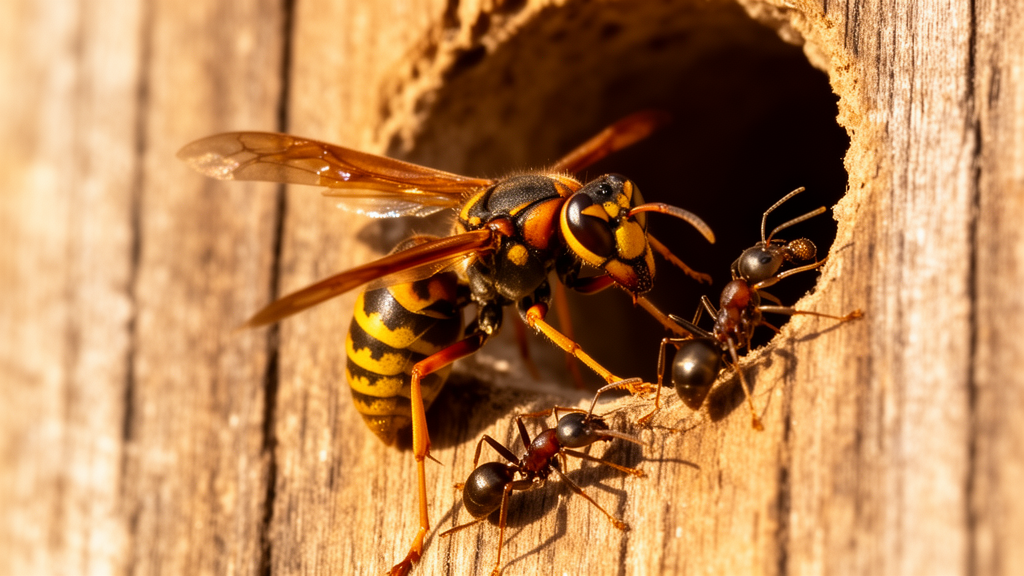
An experimental field study conducted along forest edges in central Japan demonstrates that a recently invading solitary wasp species suppresses the nesting reproduction of its native congener primarily through the preemption of nesting cavities rather than direct antagonistic displacement, while simultaneously proving far more resilient to pressure from native predatory ants. Researchers Shinji Sugiura and Misaki Tsujii deployed dozens of artificial bundle trap nests containing hundreds of bamboo canes across two forested sites in Hyogo Prefecture to clarify how native ants modulate competitive dynamics between the native potter wasp Anterhynchium flavomarginatum and the recently expanding congener Anterhynchium gibbifrons. The team observed that the invasive wasp established nests and provisioned brood cells at significantly higher frequencies than the native species throughout the reproductive season. Detailed model analyses revealed a strong negative statistical association between the brood cell production of the two species at both the individual cane and trap nest scales, confirming that nesting resources serve as an axis of intense interspecific competition. Furthermore, the experimental exclusion of foraging ants increased the emergence survival of native wasp offspring by more than twenty percentage points without providing any measurable survival benefit to the invasive wasp, indicating that the non-native insect experiences reduced biotic resistance from resident predatory insects.
Understanding the ecological mechanisms that govern successful establishment and proliferation among non-native insects is critical for clarifying how biological invasions reshape local communities. Anterhynchium flavomarginatum is widely distributed across Southeast and East Asia, maintaining long-established populations throughout mainland Japan. Conversely, Anterhynchium gibbifrons was described scientifically from specimens gathered in central Japan and initially considered an endemic taxon until museum records from South Korea dating to 1974, subsequent mainland Chinese collection records, and a rapid contemporary range expansion indicated an unintentional introduction, likely mediated by commercial bamboo timber shipments. Although adults of the invading wasp are slightly larger on average than the native wasp, substantial morphological overlap exists, and both rely on hollow cylindrical plant stems of similar diameters while actively nesting during overlapping summer windows.
The field experiment was carried out between June and October 2021 within Amida-cho, located in Takasago-shi, Hyogo Prefecture, Japan, situated at coordinates 34°48′ N and 134°47′ E at elevations between 14 and 60 meters above sea level. The study landscape encompasses a fragmented mosaic of broad-leaved deciduous woodlands, cultivated and feral bamboo groves, and adjacent agricultural fields intermixed with rural residential developments. The researchers selected two distinct study sites, designated as Kitaike and Nagao, situated approximately one kilometer apart along comparable forest edge boundaries to replicate the experimental treatments. Local meteorological data gathered from the nearby Himeji Meteorological Station, situated at an elevation of 38.2 meters at 34°50′ N and 134°40′ E, established that average monthly ambient temperatures ranged from 18.9 to 27.0 degrees Celsius over the five-month monitoring period.
To evaluate nesting preferences and interspecific interactions under controlled spatial conditions, the investigators deployed 48 specialized bundle-type trap nests constructed from dried bamboo canes, installing 24 replicate stations at Kitaike on June 14, 2021, and 24 replicate stations at Nagao on June 21, 2021. Each individual trap nest bundle consisted of exactly twelve bamboo canes tightly bound with metal wire in a compact cylindrical cluster and affixed horizontally to the trunk of a living tree or robust bamboo culm at a standardized height of 1.5 meters from the forest floor using a 900-millimeter wooden stick measuring 12 by 12 millimeters in cross section. The individual canes were cut to uniform lengths of 200 millimeters, leaving one natural internodal septum intact to serve as a sealed rear wall while opening the opposite end to provide cavity access. Each bundled trap was constructed with four canes selected from each of three defined inner diameter classes: small canes measuring an average of 6.4 millimeters, medium canes averaging 11.0 millimeters, and large canes averaging 15.7 millimeters, ensuring that equal structural resource options were simultaneously available at every sampling point.
To isolate the ecological influence of resident predatory ants on nesting choices and larval survival, the authors established a controlled exclusion experiment across the deployed stations. Half of the trap nests at each site, totaling twelve units per location, were designated as ant-exclusion treatments by applying a continuous 100-millimeter band of a non-drying sticky entomological barrier resin, Tree Tanglefoot, completely coating all four surfaces of the horizontal wooden mounting stick between the tree trunk and the suspended bundle. The remaining twelve stations at each site served as unmanipulated controls, where Tanglefoot adhesive was applied exclusively to the vertical sides and downward underside of the wooden mounting stick, leaving the upper surface completely untreated and passable to walking insects. Field researchers inspected all stations monthly through late autumn, on July 26, August 28, and September 26, 2021, reapplying sticky barrier adhesive approximately monthly to maintain exclusion integrity. Ant presence and colony formation were monitored by gently probing cane interiors with thin grass stems, while daytime activity was formally evaluated on July 26 through standardized honey-bait bioassays utilizing pure honey-soaked absorbent cotton pads monitored over three hours.
Following complete retrieval of all experimental bundles on October 24, 2021, all 576 bamboo canes were carefully split open longitudinally under controlled laboratory conditions to examine internal architectural features, count brood cells, record prepupal pigmentation, and rear developing insects to adulthood. Prepupae of the two Anterhynchium species were readily distinguished by distinctive somatic coloration, while emergent wasps, co-nesting solitary bees, and parasitoid insects were reared in isolation and classified via taxonomic keys. Because Anterhynchium flavomarginatum exhibits partial bivoltinism, producing some late-summer emerging adults alongside its primarily univoltine cohort, empty brood cells displaying diagnostic exit holes were systematically inventoried. The statistical evaluation of nesting occupancy, cell quantities, and offspring survival was executed in R version 4.5.0 using the glmmTMB modeling package. Generalized linear mixed models with binomial error structures analyzed binary nesting occurrence, survival rates, and parasitism, whereas brood cell production was analyzed using Poisson models or negative binomial formulations when overdispersion was diagnosed, incorporating study site and nested trap identities as structured random effects.
The quantitative results demonstrated a marked disparity in reproductive output between the two congeneric wasps across the study landscape. Out of the 48 total trap nests deployed, the native Anterhynchium flavomarginatum established nests in nine control bundles and nine ant-excluded bundles, representing an identical occupancy rate of 37.5 percent under both treatments. In contrast, the invading Anterhynchium gibbifrons occupied nineteen control bundles and nineteen ant-excluded bundles, reaching an identical 79.2 percent bundle occupancy rate. At the finer resolution of individual canes, comprising 288 control and 288 ant-excluded tubes, the native species colonized 16 control canes and 26 ant-excluded canes, yielding 43 and 75 brood cells, respectively. Conversely, the invasive wasp colonized 133 control canes and 149 ant-excluded canes, constructing 438 brood cells in control units and 562 brood cells in ant-excluded units. Generalized linear mixed modeling confirmed that the number of brood cells produced by the native wasp was strongly and negatively correlated with the number of cells built by the invasive wasp at both the trap nest and cane levels, whereas ant exclusion exerted no statistically significant influence on the total brood cell count of either species.
Analysis of spatial co-occurrence patterns within individual nesting tubes underscored the intense competitive preemption occurring between the two species. Out of 576 available bamboo canes, only six canes, representing approximately 1.0 percent of the total resource pool, contained brood cells belonging to both Anterhynchium flavomarginatum and Anterhynchium gibbifrons. Linear mixed modeling demonstrated that while both species nested most frequently within canes belonging to the medium diameter class, the invading Anterhynchium gibbifrons colonized canes with significantly larger mean internal diameters, averaging 11.9 millimeters in control nests and 12.1 millimeters in ant-excluded nests, compared to 10.6 millimeters and 11.1 millimeters for the native congener. Resident ant species established social colonies inside 28 control canes across ten control trap nests, showing an overwhelming nesting affinity for small-diameter canes measuring under 10.1 millimeters. Furthermore, ant workers visited 70.8 percent of control bundles during active foraging surveys, yet only two individual canes across the entire study were co-occupied by an ant colony alongside a nesting wasp, illustrating distinct spatial partitioning between ants and large solitary wasps during nest construction.
Although ant exclusion did not alter nest-site selection or brood cell production, it revealed profound asymmetries in larval vulnerability between the two wasp species. The survival of Anterhynchium flavomarginatum offspring to adult emergence was significantly lower in control trap nests exposed to ant foraging, registering at 48.8 percent, compared to 69.3 percent emergence in bundles protected by the sticky barrier, a statistically significant survival enhancement confirmed by generalized linear mixed models at the trap nest scale. In stark contrast, the survival of the invading Anterhynchium gibbifrons remained high and completely unaffected by treatment conditions, exhibiting no meaningful difference in emergence between control and ant-excluded bundles. Parasitism rates caused by native natural enemies, including the ripiphorid beetle Macrosiagon nasutum and sarcophagid and phorid flies, remained generally low across both species. However, parasitism suffered by the native wasp was positively associated with the nesting density of other native solitary wasps and bees, an indirect interaction indicating apparent competition mediated through shared parasitoid loads that did not similarly depress the invasive wasp.
Synthesizing these findings, the authors conclude that Anterhynchium gibbifrons acts as an effective exploitative competitor capable of preempting vital nesting cavities from its native relative while simultaneously escaping the lethal pressure that native predatory ants exert on native wasp offspring. Because female wasps seal each finished bamboo cane with a thick sequence of compartmentalized mud plugs, preemption of empty cavities directly limits nesting opportunities for late-arriving competitors, creating strong local suppression without necessitating violent physical encounters. The investigators caution that while these local-scale experimental arrays reveal severe reproductive suppression in artificial substrates, natural population-level declines and permanent regional exclusion cannot be directly extrapolated without extended ecological surveys of natural dead-stem resources. Furthermore, the localized ant density across the Takasago sites was comparatively modest compared to other Japanese forests, suggesting that areas harboring denser populations of arboreal ants might exert stronger biotic resistance against the invader. Nonetheless, the observed asymmetry in enemy susceptibility combined with superior cavity preemption demonstrates how solitary invasive insects can successfully disrupt native congeners during rapid range expansion.
Subject of Research: Competitive exclusion and ant-mediated biotic resistance between native and invading solitary wasps
Article Title: Competitive effects of a recently invading wasp species on a native congener in the presence of native ants
Article References: Sugiura, S., & Tsujii, M. (2026). Competitive effects of a recently invading wasp species on a native congener in the presence of native ants. Biological Invasions, 28(9), Article 206. https://doi.org/10.1007/s10530-026-03916-1
Image Credits: AI Generated
DOI: 10.1007/s10530-026-03916-1
Keywords: Anterhynchium flavomarginatum, Anterhynchium gibbifrons, biological invasions, cavity-nesting wasps, interspecific competition, resource preemption, trap nests, native ants, biotic resistance, brood cell production, adult emergence, Hyogo Prefecture, Eumeninae, bamboo canes, solitary wasps, parasitoids, glmmTMB
News Source: Drew Townsend. (November 24, 2026). Invading Wasp Outcompetes Native Congener for Nest Sites While Resisting Native Ants. Scienmag.