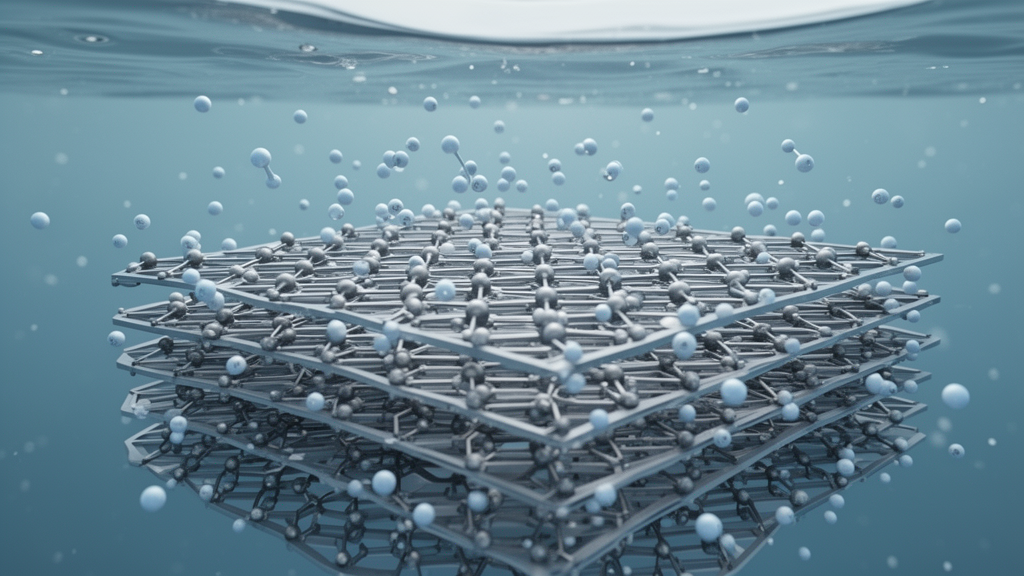
Researchers have engineered a hybrid adsorbent that couples two-dimensional MXene nanosheets with cerium-based metal-organic frameworks to selectively capture and preconcentrate fluoride from salt-rich water samples. The resulting composite materials, designated as MSCes, integrate Ce-based UiO-66 directly onto delaminated MXene sheets, producing an expanded interfacial contact area that enhances fluoride diffusion toward exposed active centers. By overcoming the mass-transfer limitations and severe ionic competition common in complex water matrices, this composite architecture maintains robust defluoridation activity across diverse environmental conditions. Titanium- and vanadium-based formulations both exhibited elevated adsorption capacities, remarkable tolerance to high ionic strength, and reliable structural stability during liquid-phase testing. The development addresses long-standing challenges in drinking water remediation, presenting an effective approach for selective fluoride decontamination and analytical sample preparation in aquatic systems containing heavy background electrolyte loads. In particular, the hybrid sorbents demonstrate practical viability for treating complex environmental solutions without suffering performance degradation.
Fluorine is an inevitable component of the biosphere and human life, occurring ubiquitously across natural environments. While controlled amounts of fluoride are routinely utilized to guard against dental caries, excess ingestion causes severe chronic conditions, including dental fluorosis and debilitating skeletal fluorosis. Consequently, the World Health Organization guidelines for drinking-water quality recommend an inorganic fluorine indicator value of 1.5 milligrams per liter, while Chinese national drinking water standards under GB 5749-2022 stipulate a threshold of 1.0 milligram per liter. Despite these regulatory standards, elevated fluoride contamination directly threatens more than 260 million individuals across 25 nations, including impacted communities within India, Pakistan, China, and the United States. Given the geographic scale and public health severity of this contamination, creating straightforward, cost-effective, and highly efficient defluoridation strategies remains an urgent global priority for safeguarding drinking water supplies and protecting vulnerable human populations.
Current methods for remediating fluoride contamination include chemical flocculation sedimentation, membrane separation, capacitive deionization, and adsorption. However, each existing technique entails clear operational drawbacks. Membrane separation is energy-intensive and highly susceptible to fouling, whereas chemical precipitation and ion exchange frequently suffer from inadequate selectivity, incomplete removal, and secondary waste generation. Adsorption remains the most viable approach due to high performance, simple operation, and modest costs. Various adsorbents have been explored, including chitosan hydrogel beads with zirconium hydroxide, tannin-modified chitosan aerogels, graphene oxide-ceria nanohybrids, and metal-organic frameworks such as UiO-66. Although cerium-based frameworks possess exceptional selectivity and high capacity for fluoride, conventional sorbents display limited capacity in saline environments. High concentrations of coexisting salts introduce strong ionic interference and mass-transfer barriers that severely diminish separation efficiency in complex water samples, underscoring the necessity of developing improved Ce-UiO-66 composite adsorbents.
To address these limitations, the research team utilized MXenes, a class of two-dimensional transition metal carbides, nitrides, and carbonitrides represented by the formula Mn+1XnTx. In this structure, M denotes an early transition metal such as titanium, vanadium, niobium, scandium, or molybdenum; X represents carbon or nitrogen; and Tx indicates hydrophilic surface groups including oxygen, hydroxyl, and fluorine. While MXenes offer favorable hydrophilicity, abundant surface groups, and high sorption potential, their insufficient density of active sites hampers standalone fluoride removal. By uniting MXenes with Ce-based UiO-66, the researchers created an engineered hybrid material that combines the distinct advantages of both components. The resulting architecture provides an enlarged interfacial area that facilitates fluoride transport to exposed binding sites, while abundant cerium centers and diminished interfacial resistance enhance fluoride capture and mechanical stability, providing a promising route for defluoridation.
The fabrication process began with commercial MAX phase ceramic precursor powders of Ti3AlC2 and V2AlC. Multilayered MXenes were produced by selectively removing aluminum atomic layers through hydrofluoric acid etching, yielding accordion-like structures verified by scanning electron microscopy. The etched materials were subsequently delaminated into single- or few-layer nanosheets using tetrapropylammonium hydroxide and ultrasonic treatment. Next, Ce-UiO-66 was grown directly in situ on the MXene nanosheets. The researchers combined 7.2 milliliters of N,N-dimethylformamide, 255.2 milligrams of terephthalic acid, 4 milliliters of 0.533 molar cerium(IV) ammonium nitrate solution, 15 milligrams of MXene, and 2 milliliters of 98 percent formic acid. The mixture was ultrasonically homogenized, magnetically stirred at 100 degrees Celsius for 20 minutes, centrifuged, washed with dimethylformamide and acetone, dried at 60 degrees Celsius, and activated under ultraviolet light in water for eight hours to obtain the finalized adsorbent.
Material characterization verified the crystalline purity and enhanced textural properties of the composites. Scanning electron microscopy confirmed that pristine Ce-UiO-66 consisted of regular crystals, while MXenes displayed few-layered nanosheet morphology. In the hybrid composites, Ce-UiO-66 nanocrystals grew in situ across the MXene surfaces, forming layered structures tightly bonded together through contact effects. X-ray diffraction patterns for Ce-UiO-66, MSCe-Ti-15, and MSCe-V-15 exhibited characteristic diffraction peaks at 7.3, 8.2, 11.6, 13.6, and 14.3 degrees, matching the (111), (200), (220), (311), and (222) planes of Ce-UiO-66 under reference card JCPDS 034-1984. Nitrogen adsorption-desorption measurements displayed typical type-IV isotherms. Brunauer-Emmett-Teller analysis demonstrated that incorporating MXene significantly increased surface area, rising from 0.8 square meters per gram in Ce-UiO-66 to 19.8 in MSCe-Ti-15 and 68.5 in MSCe-V-15, alongside corresponding pore volumes of 0.01, 0.06, and 0.04 cubic centimeters per gram.
X-ray photoelectron spectroscopy confirmed the elemental compositions and chemical oxidation states of the synthesized composites. In MSCe-Ti-15, survey spectra revealed characteristic peaks for carbon 1s at 284.1 electronvolts, titanium 2p at 457.9 electronvolts, oxygen 1s at 530.9 electronvolts, and cerium 3d at 884.7 electronvolts. High-resolution titanium 2p spectra deconvoluted into peaks at 458.6 and 464.2 electronvolts, corresponding to lattice oxygen and titanium-carbon bonds. For MSCe-V-15, peaks appeared at 284.1 electronvolts for carbon 1s, 516.5 and 525.0 electronvolts for vanadium 2p, 531.1 electronvolts for oxygen 1s, and 884.9 electronvolts for cerium 3d. Fine scanning of the vanadium 2p region revealed V 2p3/2 and V 2p1/2 doublets at 516.5 and 523.2 electronvolts assigned to tetravalent and trivalent vanadium, alongside a peak at 525.0 electronvolts reflecting pentavalent vanadium from surface oxidation of V2C to vanadium oxide species.
Systematic adsorbent optimization established that MXene mass loading directly governed defluoridation performance. Testing composites containing between 2.5 and 25 milligrams of MXene revealed that removal efficiency initially rose as MXene content increased to 15 milligrams, because higher doping expanded the contact surface area between fluoride and the adsorbent. However, loadings exceeding 15 milligrams, as evaluated in MSCe-Ti-20 and MSCe-Ti-25, led to decreased removal efficiency, indicating that excessive MXene hindered sorbent function. A similar response occurred in the vanadium series, where MSCe-V-15 exhibited the highest fluoride removal rate, while MSCe-V-25 showed the lowest. Consequently, MSCe-Ti-15 and MSCe-V-15 were chosen for detailed kinetic, equilibrium, and environmental analyses. Tests across transition metal types confirmed that both titanium and vanadium analogues provided excellent adsorption capacities, with vanadium-based composites exhibiting superior overall performance for selective fluoride extraction and preconcentration.
Adsorption kinetics demonstrated rapid fluoride capture, with MSCe-Ti-15 adsorbing 91 milligrams per gram within 45 minutes and reaching equilibrium at 100 minutes with an uptake of 110.2 milligrams per gram. Uptake on MSCe-V-15 likewise slowed as active sites became occupied, achieving equilibrium at 100 minutes with 131.5 milligrams per gram. Kinetic modeling confirmed that experimental data conformed closely to the pseudo-second-order model, yielding correlation coefficients of 0.998 for MSCe-Ti-15 and 0.997 for MSCe-V-15, compared to 0.906 and 0.960 for the pseudo-first-order model. Calculated capacities of 111.1 and 136.9 milligrams per gram aligned well with experimental results, confirming chemisorption as the primary uptake mechanism. Multi-stage intraparticle diffusion plots did not pass through the origin, exhibiting three distinct linear regions corresponding to initial external surface mass transfer, subsequent intraparticle diffusion through internal pores, and final equilibrium site occupation on adsorbent surfaces.
Adsorption isotherms evaluated across initial fluoride concentrations of 5 to 150 milligrams per liter revealed maximum equilibrium adsorption capacities of 194.6 milligrams per gram for MSCe-Ti-15 and 218.0 milligrams per gram for MSCe-V-15. Fitting results showed that the Langmuir monolayer model provided superior correlation coefficients of 0.998 and 0.991, yielding calculated maximum capacities of 222.2 and 238.1 milligrams per gram, respectively. Testing across a pH range of 2 to 11 demonstrated peak capacities of 110.5 milligrams per gram for MSCe-Ti-15 and 132.2 milligrams per gram for MSCe-V-15 at pH 3. Low pH environments promoted surface protonation and electrostatic attraction, whereas hydrofluoric acid formation below pH 3 and hydroxyl competition above pH 3 reduced uptake. In interference studies, monovalent anions including nitrate, chloride, bromide, and acetate showed minimal impact, while divalent sulfate and silicate caused slight declines following charge-to-radius affinity trends, maintaining favorable capacity even at a 1:50 molar ratio.
The hybrid composites demonstrated exceptional tolerance to hypersaline conditions, maintaining capacities of 98.3 milligrams per gram for MSCe-Ti-15 and 110.6 milligrams per gram for MSCe-V-15 even in 10 molar sodium nitrate solutions. Regeneration experiments utilizing deionized water adjusted to pH 11 with 0.1 molar sodium hydroxide confirmed excellent reusability, with materials retaining capacities of 88.3 and 103.6 milligrams per gram after ten consecutive adsorption-desorption cycles. When evaluated in tap water and Weihe River samples spiked with 30 and 50 milligrams per liter of fluoride, the adsorbents achieved removal efficiencies between 97.4 and 98.7 percent, successfully lowering fluoride levels below the 1.5 milligram per liter World Health Organization drinking water limit. Post-adsorption spectroscopic analyses revealed newly formed fluorine 1s peaks alongside binding energy shifts in titanium 2p, vanadium 2p, cerium 3d, and oxygen 1s spectra, confirming that defluoridation occurred through synergistic ion exchange, electrostatic attraction, and coordination complexation across the engineered interfaces.
Subject of Research: Selective fluoride preconcentration and removal using interfacially engineered MXene-MOF hybrid adsorbents
Article Title: Interfacially engineered MXene-MOF hybrid for selective preconcentration of fluoride in salt-rich water samples
Article References: Xia, J., Fan, H., & Zhuang, Y. (2026). Interfacially engineered MXene-MOF hybrid for selective preconcentration of fluoride in salt-rich water samples. Talanta Open, 14, Article 100693. https://doi.org/10.1016/j.talo.2026.100693
Image Credits: AI Generated
DOI: 10.1016/j.talo.2026.100693
Keywords: fluoride removal, MXene, metal-organic framework, Ce-UiO-66, MSCe, adsorption kinetics, Langmuir isotherm, water purification, high-salinity water, interfacial engineering, chemisorption, Weihe River, drinking water standards, ion exchange, X-ray photoelectron spectroscopy, pseudo-second-order model, reusability
News Source: Bethany Barker. (November 24, 2026). Engineered MXene Hybrid Adsorbents Selectively Remove Fluoride from Saline Waters. Scienmag.