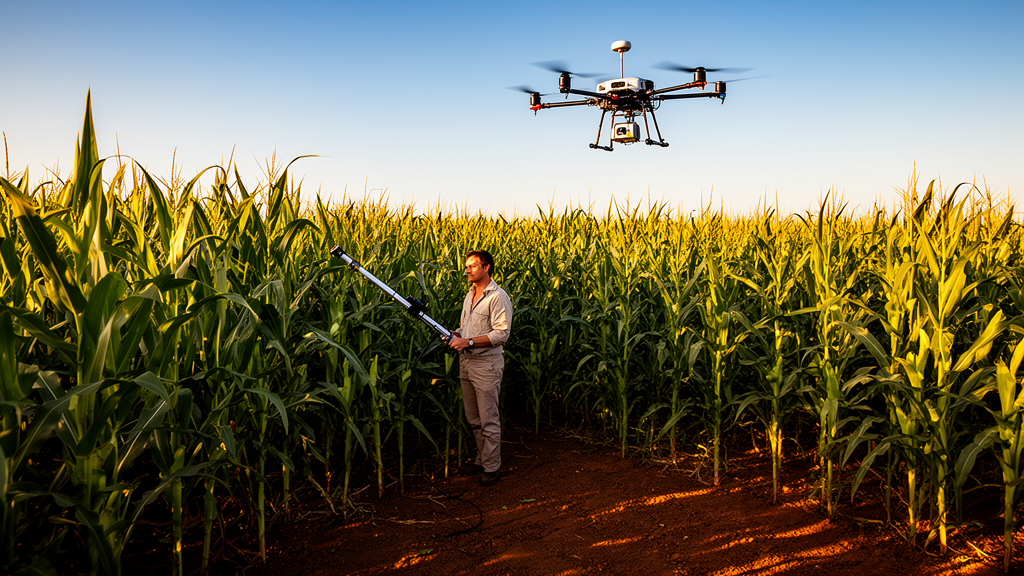
A multi-institutional team of agricultural researchers in China has established an integrated field-phenotyping and machine-learning framework demonstrating that the morphological and physiological traits most predictive of maize radiation use efficiency vary systematically with planting density. Radiation use efficiency, defined as the ratio of above-ground dry biomass accumulation per unit ground area to cumulative intercepted photosynthetically active radiation, provides a crucial physiological bridge between canopy architecture, light interception, and crop productivity. Although increasing plant population density represents a widespread agronomic strategy to increase overall grain yield per unit of arable land, dense planting fundamentally alters the canopy light environment through mutual shading and localized competition. Traditional crop evaluations have historically assessed plant architecture, leaf-level photosynthetic response, and canopy nitrogen distribution in isolation. By unifying field measurements, three-dimensional canopy reconstructions, multi-model machine learning, and sensitivity simulations, the researchers demonstrated that prediction models place shifting emphasis on different structural and photosynthetic traits as densities increase from conventional to ultra-high levels.
Soil properties in the plow layer varied distinctly between the two research stations, with Salaqi featuring a black soil having an organic matter content of 24.5 grams per kilogram, total nitrogen of 1.39 grams per kilogram, available phosphorus of 26.8 milligrams per kilogram, available potassium of 240 milligrams per kilogram, and a slightly acidic pH of 5.83 in the upper twenty-centimeter layer. In contrast, Gongzhuling presented a sandy loam profile across a thirty-centimeter depth containing 18.35 grams per kilogram of organic matter, 1.38 grams per kilogram of total nitrogen, 19.35 milligrams per kilogram of available phosphorus, 164.3 milligrams per kilogram of available potassium, and an alkaline pH of 8.12, with local common planting densities ranging from 60,000 to 67,500 plants per hectare.
To investigate genotypic and population-level responses, the experimental design utilized split-plot layouts with three biological replicates per treatment, assigning planting densities to the main plots and maize cultivars to subplots across twelve-row plots measuring ten meters in length with sixty-centimeter row spacing. In the Salaqi trial, the researchers evaluated thirty-eight distinct maize cultivars subjected to three planting density treatments consisting of 60,000, 90,000, and 120,000 plants per hectare. In the Gongzhuling trial, five maize cultivars were examined across two planting densities of 67,500 and 97,500 plants per hectare. Multi-stage field sampling protocols monitored developmental progression and structural adaptations, measuring center of gravity height, total plant height from the ground to the top of the tassel, and ear height from the ground to the base of the primary ear on destructively and non-destructively sampled plants twelve days after silking to calculate dimensionless ear coefficients and center of gravity coefficients.
Detailed stratification of the maize canopy twenty-four days after silking provided empirical data on vertical leaf area distribution by cataloging the length and maximum width of non-senescent leaves, defined as those retaining at least fifty percent green tissue area. Leaves were divided into three specific strata: a middle canopy stratum comprising the ear leaf and the single leaf directly above and below it; a lower canopy stratum consisting of the three leaves situated beneath the middle group; and an upper canopy stratum encompassing all remaining non-senescent leaves above the middle section. Across both experimental sites, analysis of variance demonstrated that planting density exerted highly significant effects on canopy geometry. In Salaqi, leaf area averaged 2,326 square centimeters in the lower canopy, 1,632 square centimeters in the middle canopy, and 1,313 square centimeters in the upper canopy, with middle and upper strata shrinking by 23.5 percent and 26.0 percent, respectively, as density escalated to 120,000 plants per hectare. Concurrently, ground-level leaf area index expanded from 4.93 to 6.79, ear-level leaf area index rose from 2.11 to 3.01, and mean tilt angles declined by seven to ten degrees.
Leaf-level physiological performance was characterized during clear conditions at silking by generating light-response curves with portable infrared gas analyzers on the ninth and thirteenth leaf positions, representing lower- and middle-canopy photosynthetic capacity, respectively. Photosynthetically active radiation was systematically stepped across twelve gradients from 1,800 down to zero micromoles per square meter per second while maintaining chamber carbon dioxide at 400 micromoles per mole. Fitting the resulting gas-exchange measurements to a non-rectangular hyperbolic model yielded specific estimates of maximum net photosynthetic rate, initial quantum efficiency, dark respiration rate, curvature factor, and light-inhibition coefficients. Measurements revealed pronounced vertical gradients: at Salaqi, maximum net photosynthesis in the thirteenth leaf averaged 33.1 micromoles per square meter per second, exceeding the ninth leaf average of 24.8 micromoles per square meter per second by 33.6 percent. However, elevating plant population density significantly depressed photosynthetic capacity across both leaf positions; increasing density from 60,000 to 120,000 plants per hectare reduced maximum net photosynthesis by 21.9 percent in the ninth leaf and 19.2 percent in the thirteenth leaf, accompanied by concurrent drops in quantum efficiency and curvature factor.
Biomass accumulation and radiation use efficiency measurements over the critical grain-filling window between twelve and twenty-four days after silking revealed divergent population-level trajectories between the two test sites. In the thirty-eight-cultivar trial at Salaqi, population radiation use efficiency increased significantly with higher density, climbing from an average of 4.51 grams per megajoule under 60,000 plants per hectare to 5.31 grams per megajoule at 90,000 plants per hectare and reaching 5.77 grams per megajoule at 120,000 plants per hectare, although the marginal increase diminished at higher plant densities. Conversely, in the five-cultivar Gongzhuling experiment, mean radiation use efficiency decreased slightly from 4.21 grams per megajoule at 67,500 plants per hectare to 4.01 grams per megajoule at 97,500 plants per hectare, with cultivar ZD958 exhibiting a 9.86 percent decline while MC812 gained 0.37 grams per megajoule. Unsupervised Gaussian mixture modeling and principal component analysis categorized genotypes into low, medium, and high radiation-efficiency groups at each density level, demonstrating substantial cluster reorganization and confirming that genotype rankings and group memberships varied substantially depending on the competitive density regime.
To evaluate predictive relationships, the researchers deployed Ridge regression, Lasso regression, and Random Forest models trained on eight key agronomic, architectural, and physiological indicators selected through correlation screening, F-statistics, and contribution scoring under five-fold cross-validation. At the lowest planting density of 60,000 plants per hectare, linear Ridge regression achieved the strongest test-set performance, delivering a coefficient of determination of 0.696 and a root mean square error of 0.566 on the original scale. At the higher densities of 90,000 and 120,000 plants per hectare, nonlinear Random Forest models proved superior, attaining test-set coefficients of determination of 0.579 and 0.691, respectively. Across all densities, lower-canopy leaf area emerged as an extraordinarily stable predictor, securing top importance scores of 1.00 at low density, 1.00 at medium density, and 0.953 at high density. However, ear-level leaf area index dominated low-density predictions with an importance weight of 22.0 percent before declining in influence, whereas high-density models incorporated broader combinations of ground-level leaf area index, lower-canopy area, and leaf light-inhibition parameters.
Three-dimensional phenotyping conducted on field-grown maize plants twelve days after silking using the multi-view stereo MVS-Pheno platform and PlantCad software reconstruction validated the geometric fidelity of digital canopy models against direct manual observations. The extracted three-dimensional morphological parameters showed tight alignment with empirical field measurements, exhibiting a coefficient of determination of 0.94 for plant height and 0.90 for total leaf area per plant. These calibrated structural models formed the basis for systematic in silico sensitivity analyses in which leaf area and initial quantum efficiency were perturbed independently in two percent incremental steps relative to baseline observations. Under both 67,500 and 97,500 plants per hectare settings, simulated radiation use efficiency responded more vigorously to morphological adjustments than to photosynthetic enhancements; each two percent increase in leaf area improved modeled efficiency by 0.080 and 0.084 grams per megajoule, respectively, compared to improvements of 0.056 and 0.051 grams per megajoule achieved per two percent increase in initial quantum efficiency.
The authors stressed that the shifting importance scores and simulation outcomes reflect predictive statistical associations and model-based sensitivities rather than direct proof of causal physiological shifts or direct biological regulation in the field. The transition from linear model superiority at low density to nonlinear Random Forest superiority at higher densities reflects differences in empirical fitting across data distributions, rather than direct evidence that crop physiological mechanisms become intrinsically nonlinear under competition. Similarly, the persistent predictive importance of lower-canopy leaf area highlights its statistical value in tracking whole-canopy light interception and diffuse radiation utilization, but it does not independently prove that retaining bottom leaves directly drives population yield gains. The researchers also noted key contextual differences between the two study sites: Salaqi in Baotou experiences a drier climate with higher incident solar radiation, whereas Gongzhuling is characterized by cooler temperatures and monsoon summer rainfall, and the two trials differed in cultivar numbers, density ranges, and soil chemistry without orthogonal controls.
In their concluding appraisal, the research team highlighted the integrated phenotyping and machine-learning framework as an exploratory tool for hypothesis generation and density-specific trait prioritization, rather than a definitive protocol for immediate commercial deployment. Traditional maize breeding has largely prioritized upper-canopy architecture to optimize direct sunlight capture; however, the model rankings suggest that lower-canopy dimensions, ear-level light interception, and photosynthetic light-response parameters warrant joint consideration depending on targeted field populations. Because the exploratory simulations and machine-learning feature profiles were developed across distinct sub-experiments, the authors concluded that wider deployment will require validation across unseen genotypes and environments, along with field testing of the proposed trait combinations. Future agronomic trials incorporating direct canopy radiation measurements, photosystem II functional assays, and genomic markers will be necessary to test whether selecting for density-adaptive trait combinations can reliably enhance field radiation use efficiency and sustain maize productivity under intensive cultivation.
Subject of Research: Density-adaptive field phenotyping and machine-learning evaluation of maize radiation use efficiency
Article Title: A field phenotyping and machine-learning framework for density-adaptive assessment of maize radiation use efficiency
Article References: Huang, G., Wang, G., Wen, W., Zhang, Y., Lu, X., Li, Y., & Guo, X. (2026). A field phenotyping and machine-learning framework for density-adaptive assessment of maize radiation use efficiency. Smart Agricultural Technology, 15, Article 102730. https://doi.org/10.1016/j.atech.2026.102730
Image Credits: AI Generated
DOI: 10.1016/j.atech.2026.102730
Keywords: maize phenotyping, radiation use efficiency, planting density, canopy architecture, machine learning in agriculture, random forest regression, ridge regression, leaf area index, photosynthetic parameters, light interception, 3D plant modeling, crop breeding, Gaussian mixture model, canopy light transmittance, dry matter accumulation, field agronomy
News Source: Alan Morgan. (November 24, 2026). Field Phenotyping and Machine Learning Identify Density-Dependent Predictors of Maize Radiation Use. Scienmag.