A comprehensive structured review synthesizing research from database inception through August 27, 2026, has examined the biological foundations, epidemiological patterns, systemic associations, and evolving clinical interventions surrounding pulp calcification and pulp canal obliteration. Published in The Saudi Dental Journal by researchers Yong Ding and Qin Ye, the synthesis addresses a longstanding challenge in endodontic practice: how to safely identify and navigate mineralized dental pulp spaces without causing irreversible structural damage to the tooth. Mineralized deposits within the pulp chamber and root canal network can drastically reduce internal visibility, complicating standard endodontic access and significantly heightening the risk of excessive dentin removal, path deviation, and lateral root perforation. To clarify best clinical practices, the authors integrated broad narrative assessments of biological and systemic factors with a focused evidence synthesis that rigorously evaluated thirty-two comparative clinical and laboratory investigations comparing conventional freehand access with modern computer-assisted static, dynamic, and robotic navigation systems.
A critical contribution of the review centers on establishing precise diagnostic boundaries among distinct pulpal mineralization entities that have historically been conflated in dental literature. Pulp calcification encompasses a spectrum of mineralized changes occurring within the dental pulp space, which manifest either as discrete, circumscribed mineralized bodies known as pulp stones or as irregular, poorly organized mineral deposits termed diffuse calcification. The authors also distinguished revascularization-associated intracanal calcification, a specialized condition characterized by localized calcific barriers or progressive canal mineralization that emerges following regenerative endodontic procedures in immature permanent teeth. While all these presentations share mineralization characteristics, the authors emphasize that they arise in fundamentally different biological environments, display contrasting histological structures, and demand distinct diagnostic interpretations.
Following non-fatal cellular stress or localized bacterial challenge, a controlled inflammatory cascade stimulates surviving primary odontoblasts to deposit reactionary tertiary dentin along the pulp boundaries. In trauma-associated pulp canal obliteration, which is documented most frequently after luxation injuries in young permanent teeth, the progressive obliteration is broadly recognized as an exuberant healing response following pulpal revascularization.
The biological nature of revascularization-associated intracanal calcification after regenerative endodontic therapy reveals a similarly intricate reparative process. Rather than orchestrating the complete reconstitution of a genuine, organized dental pulp-dentin complex, limited histological assessments demonstrate that the mineralized tissues forming within the canal space resemble bone-like structures, cementum-like deposits, and dense fibrous connective networks. Clinical and experimental data indicate that external procedural factors—including the application of ethylenediaminetetraacetic acid conditioning, calcium hydroxide intracanal medicaments, and the specific scaffolds deployed during revascularization protocols—are significantly associated with the incidence of intracanal calcification. However, the independent, isolated contributions of hydraulic calcium silicate capping barriers such as mineral trioxide aggregate and Biodentine remain uncertain. Consequently, researchers classify revascularization-associated calcification not as an unprompted biological failure, but as a complex, multifactorial outcome inherently tied to regenerative intervention protocols.
Investigating local and genetic contributors, the review evaluated how restorative restorations, orthodontic movements, and inherited variants correlate with altered pulpal architecture. Retrospective and cross-sectional imaging investigations demonstrate that teeth receiving extensive coronal restorations consistently display greater pulp-space narrowing and a higher prevalence of discrete pulp stones compared with unrestored teeth, although these observational associations do not confirm independent causal relationships. Similarly, while heavy orthodontic intrusion forces have been linked to pulpal changes, studies investigating appliance designs, force magnitudes, and active treatment durations have yielded contradictory findings. At the molecular level, candidate-gene investigations have linked single nucleotide polymorphisms in SMAD6, a negative regulator of bone morphogenetic protein signaling, to increased pulp stone susceptibility, while variations in WNT6 and WNT10A have been linked to radiographic calcification in orthodontic cohorts. Furthermore, while rare monogenic conditions involving pathogenic DSPP mutations or biallelic FAM20A mutations cause severe developmental pulp-space obliteration and enamel-renal syndrome, the authors caution that these syndromic anomalies cannot be directly extrapolated to common acquired calcification patterns observed in the general population.
Epidemiological evaluations compiled within the paper demonstrate that reported calcification rates vary extensively based on diagnostic criteria, clinical settings, and imaging technologies. A recent systematic meta-analysis cited by the authors estimated the global prevalence of pulp stones at approximately forty-six percent at the patient level, but only twenty percent when measured at the individual tooth level, with molars representing the most frequently affected tooth category. The wide numerical disparity underscores that patient-level analyses classify an entire subject as affected if a single tooth possesses calcification. In traumatized dentition, a longitudinal investigation of 637 traumatized permanent incisors identified partial pulp canal obliteration in 15.1 percent of teeth and complete obliteration in 1.4 percent. A larger meta-analytic synthesis established pooled post-traumatic obliteration rates of 27.6 percent across permanent teeth and 21.9 percent in primary teeth, with permanent root fractures and primary lateral luxations demonstrating the highest vulnerability. Furthermore, detection sensitivity is heavily governed by imaging modality: one cited study documented radicular calcification in 74.1 percent of teeth examined via panoramic radiography, yet confirmed calcification in only 32.7 percent of the same teeth when evaluated with cone-beam computed tomography.
Evaluating systemic and pharmacological dimensions, the authors underscored that reported correlations between pulpal calcification and systemic conditions remain vulnerable to significant confounding. Contradictory evidence similarly complicates pharmacological evaluations: while one retrospective case-control investigation linked chronic statin therapy with elevated pulpal calcification, a subsequent matched cone-beam computed tomography pilot study identified no statistically significant difference between statin users and unexposed controls. Long-term glucocorticoid exposure has likewise been correlated with generalized canal narrowing, but existing clinical literature cannot reliably isolate direct drug effects from the systemic pro-inflammatory diseases for which steroids are prescribed.
Addressing clinical indications, the review delivers an unequivocal clinical message: the radiographic or visual identification of pulp calcification or canal obliteration does not, by itself, represent an indication for endodontic treatment. In teeth exhibiting post-traumatic obliteration, pulpal mineralization typically represents successful tissue revascularization and ongoing biological vitality rather than tissue necrosis. In a cited long-term cohort followed between seven and twenty-two years, only 8.5 percent of traumatized incisors presenting with canal obliteration ultimately developed periapical radiolucencies. Root canal therapy is strictly indicated only when a restorable tooth presents with definitive pulpal necrosis or verified apical periodontitis.
When endodontic intervention is clinically justified, establishing a safe, conservative trajectory to the patent apical canal space constitutes the foremost procedural challenge. During chemical irrigation, the authors highlight the application of sodium hypochlorite at concentrations ranging from 1.0% to 5.25% to ensure tissue dissolution and antimicrobial decontamination. Although ethylenediaminetetraacetic acid solutions and pastes are widely utilized to provide lubrication, empirical evidence demonstrating that chelating agents soften sclerotic intraradicular dentin sufficiently to facilitate mechanical canal negotiation remains limited. Conventional freehand access remains a dependable standard when an uninterrupted, identifiable canal path is visible. However, in cases of profound calcification, freehand instrumentation becomes heavily dependent on specialized operator experience, magnification, and illumination, creating substantial hazards of off-axis gouging or root perforation. When spatial landmarks are obscured, dental navigation modalities provide structured alternatives to maintain alignment with the true anatomical canal axis.
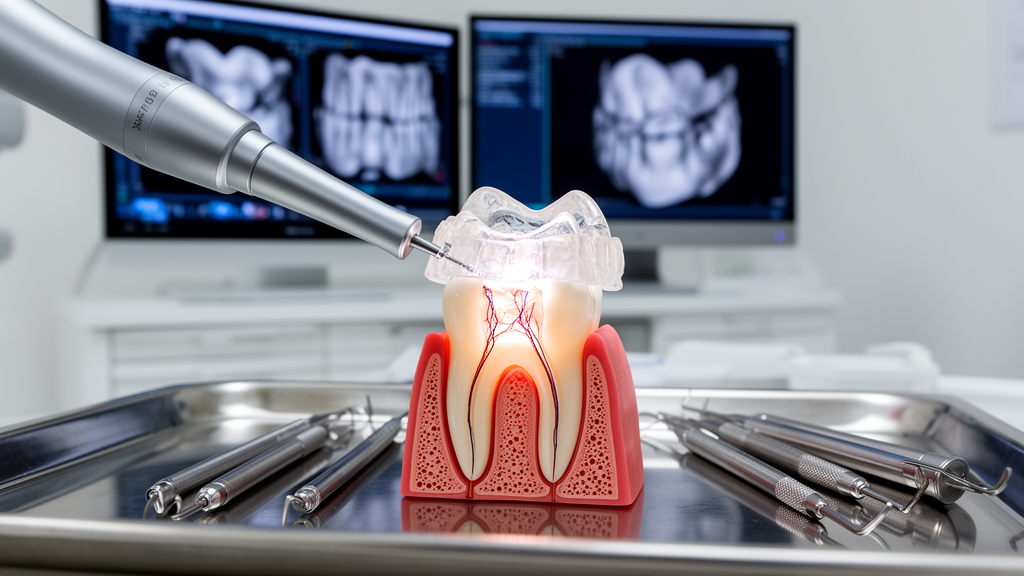
The focused synthesis critically compared static, dynamic, and robotic navigation systems against traditional freehand techniques. Static navigation utilizes cone-beam computed tomography scans combined with optical surface scans to fabricate rigid, tooth-supported 3D templates that physically constrain drill entry, depth, and angulation. Dynamic navigation eliminates static resin templates by utilizing optical motion-tracking cameras and registered reference arrays, providing the clinician with continuous, real-time visualization of drill trajectory on a digital monitor. Robotic navigation represents an emergent technological step, combining virtual trajectory planning and optical tracking with autonomous, robotically driven drilling along a pre-approved digital path under active clinician supervision.
Artificial intelligence models are also emerging as diagnostic adjuncts, exemplified by a deep-learning U-Net architecture that achieved 75.91 percent sensitivity, 68.88 percent specificity, and 72.78 percent accuracy in automated pulp calcification detection. However, the authors stress that algorithmic segmentation cannot predict canal paths across fully obliterated radicular zones where residual lumina are completely absent. If an operative deviation or root perforation does occur during access, clinician reassessment must be immediate: small internal perforations sealed promptly with mineral trioxide aggregate or hydraulic calcium silicate cements demonstrate favorable healing, whereas delayed repairs or crestal periodontal communications carry substantially reduced prognoses. In conclusion, while digital navigation provides valuable procedural control in anatomically complex calcified root canals, technological accuracy must not be equated with guaranteed long-term clinical healing. The authors advocate for future prospective, multicenter clinical trials that move beyond technical drill measurements to evaluate patient-centered comfort, tooth retention rates, procedural complications, and overall healthcare cost-effectiveness.
Subject of Research: Clinical evaluation of biological mechanisms, diagnostic criteria, and digital navigation techniques for pulp calcification and pulp canal obliteration
Article Title: Pulp calcification and pulp canal obliteration: from biological mechanisms to contemporary clinical management and digital navigation
Article References: Ding, Y., & Ye, Q. (2026). Pulp calcification and pulp canal obliteration: from biological mechanisms to contemporary clinical management and digital navigation. The Saudi Dental Journal, 38(10), Article 134. https://doi.org/10.1007/s44445-026-00253-w
Image Credits: AI Generated
DOI: 10.1007/s44445-026-00253-w
Keywords: pulp calcification, pulp canal obliteration, endodontics, static navigation systems, dynamic navigation systems, robotic navigation systems, dental pulp stones, revascularization-associated intracanal calcification, cone-beam computed tomography, regenerative endodontic procedures, root canal therapy, tertiary dentinogenesis, iatrogenic perforation, hydraulic calcium silicate, dental traumatology, guided endodontics, freehand access, dentin preservation
News Source: Ophelia Keating. (November 24, 2026). Review Evaluates Digital Navigation for Calcified Pulp and Root Canals. Scienmag.