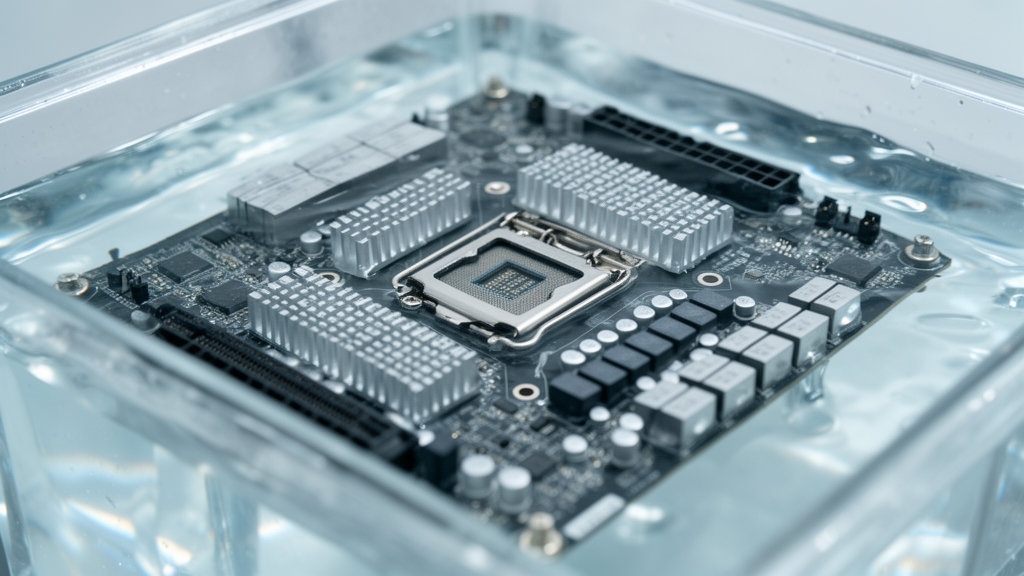
Thermal management has emerged as one of the most pressing engineering bottlenecks across advanced manufacturing sectors, particularly within high-performance data centers and lithium-ion battery energy storage systems. As processor thermal design power exceeds 700 watts to handle global data generation climbing past 175 zettabytes, conventional forced-air cooling methods, which rely on air with a specific heat capacity of only 1.006 kilojoules per kilogram-kelvin, are rapidly approaching their fundamental physical limits. Liquid immersion cooling, which submerges heat-generating electronic assemblies directly into electrically non-conductive dielectric fluids, provides substantial thermal improvements by eliminating thermal contact resistance and offering up to three hundred percent higher rack power density than air-cooled configurations. Despite these operational efficiencies, lower server component failure rates, and notable reductions in carbon footprints, industrial adoption across original equipment manufacturers has been constrained by persistent uncertainties surrounding interfacial interactions and long-term chemical compatibility between cooling fluids and submerged hardware assemblies.
To establish a systematic understanding of these operational risks, a comprehensive review published in Surface Science and Technology examines the interfacial phenomena governing structural materials, electronic components, and liquid dielectric coolants. The authors delineate the current evaluation landscape, noting that unified industry-wide testing standards tailored specifically to immersion cooling remain absent. Researchers and fluid manufacturers frequently adapt legacy test standards originally created for air-cooled electronics or conventional transformers, including ASTM D3455 for petroleum-based electrical insulating oils, ISO 1817 and GB/T 1690 for rubber vulcanizates, ASTM D130 for copper corrosion, and GB 29743.2 for electric vehicle coolants. However, these modified standards often utilize disparate accelerated thermal cycling regimes, with experimental temperatures spanning 0 to 155 degrees Celsius and durations ranging from three hours to eight months. Such extensive variation in experimental designs complicates direct comparisons across studies, highlighting the pressing necessity for standardized testing frameworks that accurately reflect real-world operating environments.
The physical and chemical processes occurring at the material-fluid boundary can be categorized into direct and indirect interfacial interactions. Direct interactions occur when the dielectric liquid directly contacts component surfaces, triggering physical swelling, polymer dissolution, environmental stress cracking, or oxidative fluid degradation. Indirect reactions arise when chemical constituents, plasticizers, or reaction byproducts leach from immersed components into the coolant, subsequently altering fluid chemistry and degrading adjacent assemblies. High-resolution surface characterization, including scanning electron microscopy, reveals that major electronic hardware demonstrates remarkable structural integrity under mild thermal conditions. Printed circuit board laminates, thick-film resistors, and ceramic or polymeric capacitors submerged in mineral oil and synthetic hydrocarbon fluids at temperatures up to 45 degrees Celsius for several months exhibit no evidence of layer delamination, crack initiation, warpage, or solder joint degradation, confirming that baseline semiconductor packaging can withstand prolonged immersion in appropriate dielectric liquids.
In contrast to the stability of primary circuit boards, auxiliary materials, surface coatings, and identification adhesives exhibit pronounced vulnerability during liquid immersion exposure. Visual and microscopic evaluations reveal that polyvinyl chloride outer jacketing on active optical cables develops extensive micro-void networks and localized particulate aggregation after immersion, driven by the outward diffusion of inorganic fillers and plasticizing compounds. Markings screen-printed onto memory modules experience significant fading following six months of immersion in mineral oil compared to air-cooled controls. Furthermore, server chassis exposed to mineral oil for eight months demonstrate complete degradation of adhesive label security, where barcode stickers detach under light contact and oil accumulation dissolves topical labeling inks.
Polymeric and plastic materials display widely varying dimensional stability when exposed to different chemical classes of immersion cooling liquids. Experimental evaluations conducted at 70 degrees Celsius demonstrate that high-performance engineering plastics, including polyether carbonate, polycarbonate, and polymethyl methacrylate, exhibit superior dimensional stability across all tested coolants, maintaining mass change rates within plus or minus 0.60 percent. Acrylonitrile butadiene styrene, polystyrene, and polyvinyl chloride also display minimal mass variations below 1.00 percent in hydrocarbon and silicone fluids. However, when exposed to synthetic ester formulations, polystyrene and polyvinyl chloride undergo severe swelling, recording mass gains of 75.88 percent and 37.10 percent respectively. Conversely, common polyolefins such as polyethylene and polypropylene show poor compatibility with hydrocarbons, esters, and cycloalkyl transformer oils, suffering mass changes exceeding 5.00 percent, while remaining stable only when submerged in silicone oils where mass alterations remain below 2.00 percent.
Elastomeric sealing materials present some of the most critical compatibility challenges for liquid-cooled hardware enclosures. Common industrial rubbers, including silicone rubber, nitrile butadiene rubber, and fluoroelastomers, demonstrate pronounced swelling behaviors and dramatic mass changes ranging from negative 3.02 percent to positive 112.48 percent when immersed in hydrocarbon, ester, and transformer oils. In extreme cases, volume expansion reaches up to 167.13 percent due to solvent absorption into the elastomeric matrix.
Thermomechanical evaluations using dynamic mechanical analysis and tensile testing provide vital quantitative metrics regarding component structural integrity over extended thermal cycles. Accelerated aging tests indicate that the Young’s modulus of printed circuit board substrates increases slightly during continuous thermal cycles, reflecting localized matrix embrittlement, yet values remain safely below the critical reference threshold of 13.1 gigapascals. Viscoelastic property measurements demonstrate that the loss factor and glass transition temperature of electronic packaging materials remain largely resilient across hydrocarbon fluids such as polyalphaolefins and synthetic hydrocarbons, matching the thermal stability of air-cooled environments.
Electrical performance measurements confirm that core electronic components maintain robust functional reliability during continuous exposure to compatible dielectric fluids. Quantitative monitoring of thick-film surface mount resistors submerged in hydrocarbon fluids at 45 degrees Celsius reveals that electrical resistance remains exceptionally stable at its nominal baseline value of 0.996 kilohms throughout extended aging cycles. Similarly, electrolytic and polymer capacitors demonstrate minimal capacitance drift under 3 percent, falling well within the allowable industry operational tolerance threshold of 20 percent. High-voltage insulation evaluations on electric vehicle motor components, including impregnating varnishes, insulating papers, and electromagnetic wires, show that breakdown voltage retention remains between 80 and 100 percent following severe cyclic thermal stressing between negative 45 and positive 155 degrees Celsius, while high-frequency impact endurance consistently exceeds 12 hours.
Evaluating changes within the immersion fluids themselves is equally essential, as chemical degradation directly impairs cooling efficiency, pumping hydraulics, and electrical isolation. Exposure to metallic surfaces under elevated temperatures catalyzes fluid degradation; copper strip corrosion tests conducted at 150 degrees Celsius for 168 hours demonstrate mild oxidation in gas-to-liquid synthetic hydrocarbons (corrosion grade 1b) and moderate tarnishing in polyalphaolefins and mineral oils, resulting in dissolved copper concentrations between 18 and 46 milligrams per kilogram. Chemical composition analyses reveal that ester-containing dielectric fluids undergo significant ester hydrolysis at elevated temperatures, generating acidic degradation products that increase total acid numbers by up to 0.72 milligrams potassium hydroxide per gram. In contrast, pure hydrocarbon fluids restrict acid number shifts to within plus or minus 0.2 milligrams potassium hydroxide per gram. Furthermore, fluid purity is paramount: reducing the chemical purity of fluorinated fluids from 97.21 percent to 93.50 percent causes significant constituent mass shifts exceeding 2.5 percent, precipitating premature compatibility failures in ceramic capacitors and chip inductors.
Long-term operational validation provides crucial empirical verification that supplements accelerated laboratory findings. In an extensive multi-year investigation tracking a commercial cloud immersion server system operating in single-phase fluorinated fluid across three to four years, overall hardware reliability aligned fully with rigorous commercial benchmarks. Stress testing, direct-current power cycles, and operating system reboot validations revealed no operational anomalies, with immersion-cooled server components exhibiting an average failure rate approximately 50 percent lower than identical air-cooled hardware. Signal integrity metrics across high-speed processor interconnects and memory buses displayed negligible deviation from factory specifications, confirming that carefully selected dielectric coolants do not impair high-frequency electrical transmission. To bridge remaining adoption gaps, the authors emphasize that the manufacturing industry must establish unified, lifecycle-based testing protocols, expand empirical field databases, and deploy multi-physics finite element and molecular dynamics simulations alongside machine learning models to accurately forecast material lifespans under continuous immersion.
Subject of Research: Interfacial material compatibility and evaluation methodologies for liquid immersion cooling in advanced manufacturing
Article Title: The interfacial interactions between materials and immersion cooling fluids for advanced manufacturing: evaluation methodology and compatibility
Article References: Zhang, X., Cai, P., Zhang, C., Wang, L., Li, S., Zeng, X., Zhang, Y., & Zhang, L. (2026). The interfacial interactions between materials and immersion cooling fluids for advanced manufacturing: evaluation methodology and compatibility. Surface Science and Technology, 4(1), Article 44. https://doi.org/10.1007/s44251-026-00141-9
Image Credits: AI Generated
DOI: 10.1007/s44251-026-00141-9
Keywords: immersion cooling, dielectric fluids, material compatibility, data center thermal management, lithium-ion battery cooling, hydrocarbon coolants, fluorinated liquids, printed circuit boards, elastomer swelling, polymer degradation, metal corrosion, dynamic mechanical analysis, acid number, dielectric breakdown voltage, interfacial interactions, accelerated aging tests, server reliability
News Source: Denise Maddox. (November 24, 2026). Review Details Material Compatibility and Reliability Limits in Immersion Cooling Fluids. Scienmag.