Adding visual deprivation via eye patches to a dual-task physical therapy program produced significantly greater improvements in postural balance than either dual-task training or conventional physiotherapy alone among adults with relapsing-remitting multiple sclerosis. The randomized controlled trial, conducted with eighty-four patients in Egypt, investigated how restricting visual input during therapeutic exercise compels the human central nervous system to recalibrate and rely on somatosensory and vestibular mechanisms. By combining sensory restriction with concurrent cognitive tasks, the clinical investigation aimed to reorganize postural control networks and reduce maladaptive visual reliance. Using the computerized Biodex Balance System, investigators recorded marked, statistically significant reductions in dynamic postural sway across overall, anteroposterior, and mediolateral stability indices after six weeks of targeted rehabilitation. These findings provide objective clinical evidence that integrating multisensory and cognitive-motor strategies into neurorehabilitation protocols yields superior equilibrium outcomes in individuals living with chronic autoimmune neuroinflammatory disease.
Multiple sclerosis is a chronic autoimmune condition targeting the central nervous system, leading to axonal inflammation, progressive demyelination, and a wide array of symptoms that reflect deficits across motor, sensory, and higher intellectual functions. In daily functional mobility, maintaining an upright posture requires executing secondary tasks while staying balanced, yet dual-tasking ability and divided attention are frequently impaired in patients with multiple sclerosis, substantially elevating the risk of falls. According to motor learning theory, solitary task exercises involve less central processing than dual-task training, which more effectively mirrors real-world functional demands and promotes concentration recovery. Concurrently, individuals affected by multiple sclerosis often exhibit excessive visual dependency for postural orientation; however, heavy reliance on visual processing can delay neuromuscular outputs required for rapid balance corrections. Introducing temporary visual deprivation techniques during balance rehabilitation can decrease this visual dependency while reinforcing reliance on somatosensory and vestibular inputs to support postural stability.
The research team noted that a scarcity of intervention studies evaluating balance performance in multiple sclerosis has left a significant knowledge gap in rehabilitative science. Prior research investigating fall reduction in multiple sclerosis remains limited; one pilot trial of forty-four patients demonstrated that twelve sessions of sensory and motor balance exercises reduced fall frequency and improved Berg Balance Scale scores. Furthermore, a single-group crossover study showed that six weeks of twice-weekly visuo-proprioceptive exercises reduced fall risk, measured by hand support duration during double-leg and single-leg stances in laboratory conditions. To address these inconsistencies and provide evidence for tailored clinical interventions that enhance patient independence, the present investigation was conducted to determine how dual-task training under visual restriction altered objective balance compared to dual-task training or conventional therapy alone, designating overall stability index improvement as the primary outcome measure alongside directional stability indices.
The clinical trial employed a three-arm, parallel-group randomized case-controlled design involving eighty-four male and female participants diagnosed with relapsing-remitting multiple sclerosis in accordance with the 2017 McDonald criteria. Recruited between July 2023 and December 2025 from a specialized multiple sclerosis clinic, all enrolled individuals were fully ambulant and receiving disease-modifying therapy during their clinical remission. Eligibility criteria required participants to be aged between twenty-five and forty years, to have remained free from clinical relapses for at least two months prior to testing, and to demonstrate normal vision and hearing upon specialist examination. Cognitive status was screened using the Arabic version of the Montreal Cognitive Assessment, where participants scored between 26 and 30 to confirm intact cognitive capacity for dual-task execution. Additionally, physical disability was evaluated on the Expanded Disability Status Scale, with scores ranging from 1 to 4 to verify independent standing ability.
Sample size determination was conducted before study commencement using G*Power software based on paired t-test calculations from prior Biodex and Berg Balance Scale data, which indicated that eighteen participants per arm, totaling fifty-four subjects, would provide ninety-five percent power at an alpha of 0.05 and an effect size of 0.5. The investigators recruited thirty additional participants to reach eighty-four total patients, allocating twenty-eight individuals to each group to compensate for potential missing data. Randomization was executed by an independent statistician utilizing random tables and stratified permuted block sequences with sequentially numbered, sealed opaque envelopes handled by staff uninvolved in recruitment or treatment. Blinding was rigorously preserved throughout the protocol: diagnostic evaluations were conducted pre- and post-intervention by an independent neurologist and a specialized physical therapist who were entirely blinded to group assignments, effectively separating evaluating testers from the clinicians administering physical therapy.
To eliminate confounding factors that could skew balance measurements, the study enforced rigorous exclusion criteria during patient screening. The authors disqualified individuals diagnosed with secondary progressive multiple sclerosis, along with patients presenting with concurrent neurological or medical disorders that impair balance, such as peripheral neuropathy, Parkinson’s disease, vestibular neuritis, or systemic lupus erythematosus. Patients with active visual or hearing impairments detected during neurological examination were excluded, as were those with orthopedic abnormalities including arthritis, claw toes, or genu valgum. The trial also excluded individuals diagnosed with psychiatric disorders or those taking pharmaceutical agents known to interfere with balance, specifically filtering out beta-blockers, antidepressants, and sedative medications. Prior to study commencement, all enrolled participants received complete disclosures concerning research objectives, procedural steps, privacy protections, and safety precautions, and each participant provided written informed consent to take part in the investigation.
Objective balance testing was performed using the Biodex Balance System Model 945-302 running software version 3.12, configured at Constant Uncertainty Level 8, which represents the unit’s least unstable dynamic testing setting. Patient height, weight, age, and demographic data were entered into the device, and comfortable, symmetrical foot positions were aligned using gridlines on the circular platform, which were precisely reproduced during post-treatment evaluations. Patients were evaluated barefoot with upper limbs relaxed at their sides, without gripping the handrails, while an attending physical therapist provided close standby assistance. A vertical screen placed thirty centimeters in front of each patient provided visual feedback to help maintain their center of gravity over the platform midpoint. After an initial practice trial to accommodate platform motion, two to three 20-second trials were recorded with ten-second rest periods, measuring overall, anteroposterior, and mediolateral stability indices in degrees, where lower scores indicate superior balance.
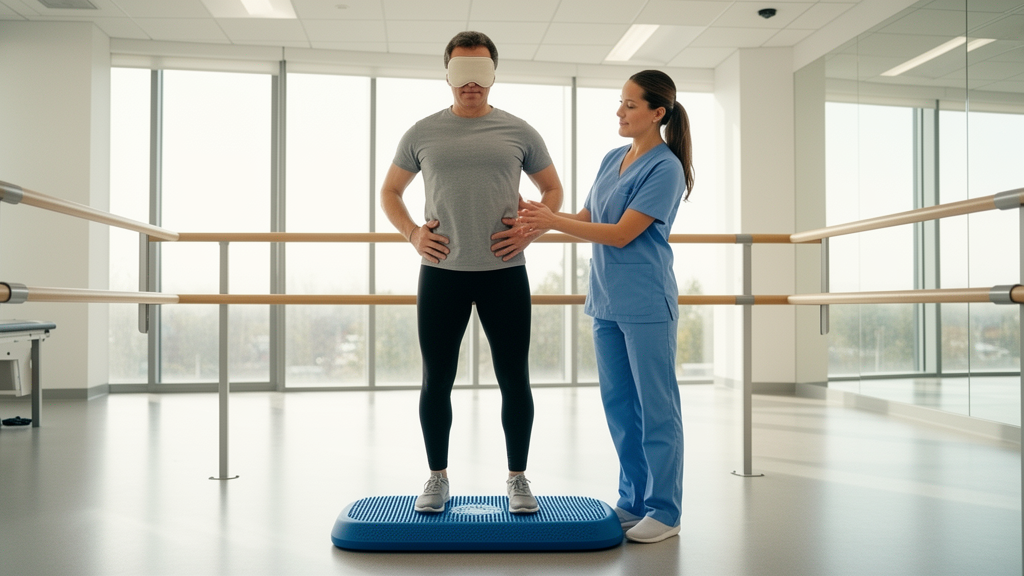
All three participant cohorts completed 45-minute treatment sessions scheduled every other day, three days per week, over a six-week duration. Control Group C received a conventional physical therapy program comprising active stretching for tight muscles, progressive strengthening for weak muscles, graduated balance exercises such as sit-to-stand transitions, dynamic marching with varied base widths, stepping, mini-squats, heel and toe raises, and walking activities. Study Group B performed this identical conventional physiotherapy program while concurrently executing cognitive working memory tasks, including reciting random numbers, spelling words backward, recalling objects, sentence completion, and forward or backward three-digit counting. Study Group A completed the identical dual-task physical therapy regimen while wearing an opaque eye patch to prevent visual input, enforcing sensory deprivation. Therapist administration was standardized across all groups, and no missed treatment sessions, participant dropouts, or adverse events occurred during the six-week intervention.
Statistical analysis in SPSS version 27 utilized mixed multivariate analysis of variance, revealing a significant treatment-by-time interaction alongside significant main effects for time and therapy. The primary outcome, Overall Stability Index, showed marked post-treatment reductions across all three groups: Group A improved from 3.60 ± 0.41 to 2.44 ± 0.32 degrees, significantly surpassing Group B (2.95 ± 0.31) and Group C (3.16 ± 0.28) with a between-group mean difference of −0.51 relative to Group B. Group B also improved significantly over Group C. In directional indices, Group A demonstrated significant post-treatment reductions in anteroposterior stability, dropping from 2.51 ± 0.54 to 1.74 ± 0.42 degrees, significantly exceeding Group B (2.03 ± 0.45) and Group C (2.34 ± 0.41). In the mediolateral stability index reflecting side-to-side stability, Group A improved from 2.05 ± 0.22 to 1.41 ± 0.21 degrees, demonstrating statistically significant advantages over Group B (1.57 ± 0.21) and Group C (1.75 ± 0.27).
Discussing these outcomes, the authors noted that combining visual deprivation with dual-task training promotes sensory reweighting, reinforces somatosensory and vestibular inputs, and activates executive brain regions associated with motor automaticity. These physiological mechanisms align with earlier findings in stroke and Parkinson’s cohorts, where vision restriction triggered vestibulospinal anticipatory postural adjustments and dual-task training improved dynamic mobility. Although these results corroborate meta-analyses supporting dual-task rehabilitation, they contrast with previous studies by Monjezi and Rooney that reported limited balance benefits, discrepancies the authors attributed to differences in methodology, sample size, and patient impairment. The researchers acknowledged key study limitations, including a modest sample size, a short one-week follow-up, lack of direct measures for dual-task cost or gait, and restriction to young patients with mild-to-moderate relapsing-remitting multiple sclerosis. Finally, study datasets remain restricted under Egyptian legislation, accessible from the corresponding author only upon reasonable request and institutional approval.
Subject of Research: Effects of visual deprivation and dual-task training on balance in multiple sclerosis
Article Title: Combined effect of visual deprivation with dual task training on balance in Egyptian patients with multiple sclerosis: a randomized controlled trial
Article References: Said Hegazy, B., Sadik Badawy, M., Mohamed Fahmy, E., Shaheen Mohammed, S., & Mohammed Alsaid, H. (2026). Combined effect of visual deprivation with dual task training on balance in Egyptian patients with multiple sclerosis: a randomized controlled trial. The Egyptian Journal of Neurology, Psychiatry and Neurosurgery, 62(1), Article 223. https://doi.org/10.1186/s41983-026-01283-1
Image Credits: AI Generated
DOI: 10.1186/s41983-026-01283-1
Keywords: multiple sclerosis, relapsing-remitting multiple sclerosis, visual deprivation, dual-task training, postural balance, Biodex Balance System, overall stability index, antero-posterior stability index, mediolateral stability index, physiotherapy, sensory reweighting, somatosensory inputs, vestibular inputs, anticipatory postural adjustments, cognitive-motor rehabilitation, Expanded Disability Status Scale
News Source: Ophelia Keating. (November 24, 2026). Visual Deprivation Enhances Dual-Task Balance Training in Multiple Sclerosis Patients. Scienmag.