A scientific investigation into aquaculture nutrition has shown that supplementing the diet of Nile tilapia fingerlings with the bacterium Bacillus subtilis ATCC 19,659 significantly improves their feed conversion ratio while maintaining excellent fish viability. The controlled experimental study, conducted by researchers evaluating sustainable microbial feed additives for Oreochromis niloticus, demonstrated that fish receiving diets enriched with this specific bacterial strain utilized their feed more efficiently than those fed unsupplemented control rations. Nile tilapia represents one of the most widely farmed freshwater fish species across the world, holding the fourth position among global tilapia farming sectors in countries such as Brazil due to its robust environmental tolerance, fast growth rate, and capacity to reproduce in captive environments. However, modern commercial aquaculture increasingly relies on intensive rearing systems characterized by high animal stocking densities and large inputs of protein-dense formulations to maximize volumetric yields. Under such crowded husbandry conditions, the continuous accumulation of metabolic nitrogenous wastes and excess organic matter can impair overall water quality, elevate chronic physiological stress levels, and leave juvenile fish vulnerable to opportunistic bacterial pathogens. In seeking proactive dietary strategies to bolster digestive performance and biological resilience without relying on therapeutic chemicals, the research team investigated how singular and combined dietary administrations of candidate microorganisms influence animal performance, gut structural integrity, pathogen inhibition, and environmental stability.
The comprehensive dietary trial specifically compared three distinct microbial strains possessing diverse physiological and biochemical characteristics: the lactic acid bacterium Lactobacillus plantarum UFSJP2, the endospore-forming bacterium Bacillus subtilis ATCC 19,659, and the yeast Candida infanticola UFSJ7A, alongside their multi-strain microbial consortium and an unsupplemented control. The lactic acid strain Lactobacillus plantarum UFSJP2 was originally isolated from the native microbial biodiversity of an artisanal cheese produced in Minas Gerais, whereas Candida infanticola UFSJ7A was obtained from an industrial textile effluent source where it was recognized as an effective biosurfactant-producing yeast capable of substantially lowering the surface tension of water. Although microbial biosurfactants have attracted widespread technological interest across pharmaceutical, cosmetic, agricultural, and industrial sectors for their natural emulsification capacity and membrane-active properties, the application of living biosurfactant-producing yeasts in finfish aquaculture diets remained previously uncharacterized. Because functional probiotic actions in aquatic animals are known to be highly strain-specific rather than universal across microbial taxa, the investigators deliberately framed the evaluation of Candida infanticola as an empirical examination of dietary potential rather than presuming pre-existing probiotic efficacy. Concurrently, Bacillus subtilis was chosen as a recognized spore-forming bacterium with demonstrated biosurfactant and bioactive metabolite synthesis, permitting a rigorous assessment of whether combining bacterial and fungal agents could yield synergistic nutritional benefits.
To guarantee that any biological differences documented during the feeding trial stemmed from biologically viable organisms reaching the fish gut, the researchers first established the viability and stability of the candidate microorganisms within the prepared feeds across storage. Pure cultures of Lactobacillus plantarum, Bacillus subtilis, and Candida infanticola were individually harvested, adjusted in sterile saline suspensions to standardized cell densities corresponding to 0.5 McFarland units, and inoculated into sterile feeds before undergoing controlled incubation and enumerations. Culturable colony-forming unit counts recovered immediately after feed processing on day zero and following seven days of routine storage confirmed that all three microbial agents retained sustained cell viability with no marked drop in culturable numbers per gram of feed. For the definitive feeding trial, diets were formulated to deliver an exact concentration of one hundred million colony-forming units per four hundred grams of dry feed for each single-strain treatment. For the combined microbial consortium regimen, all three microorganisms were incorporated simultaneously at that identical individual concentration, establishing a collective supplementation level of three hundred million colony-forming units per four hundred grams of feed, while the baseline control group received sterile physiological saline solution.
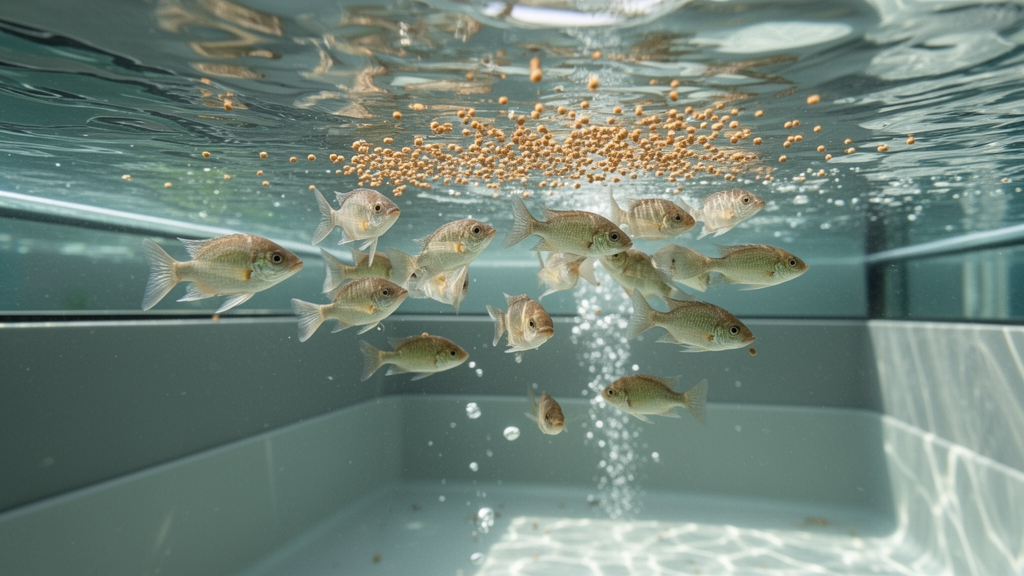
The zootechnical evaluation was executed over a thirty-one-day experimental period utilizing three hundred Nile tilapia fingerlings displaying an initial mean body mass of fourteen grams and an average total length of seven and a half centimeters. The fingerlings were distributed across thirty independent plastic tanks in a completely randomized experimental layout consisting of five experimental treatments and six biological replicate tanks per treatment, with each tank housing ten individual fish. Every tank possessed an individual volume of zero point one cubic meters and was connected to a shared indoor recirculating aquaculture system supplied continuously from a freshwater lagoon reservoir. The recirculating system maintained a continuous water turnover rate equivalent to approximately one complete tank volume renewal per hour following physical and biological filtration stages. Every experimental tank was further equipped with a thermostat-regulated submersible immersion heater and dedicated continuous aeration supplied through fine-porosity air stones connected to a centralized radial blower. Photoperiod was artificially maintained under a strict schedule of twelve hours of light and twelve hours of darkness, while daily siphoning of bottom sediments was systematically carried out to eliminate fecal casts and uneaten feed residues.
The fingerlings were fed twice every day at half past seven in the morning and half past three in the afternoon until apparent satiation was achieved in each tank. To prevent feed wastage from distorting zootechnical measurements, any unconsumed dietary pellets lingering on the surface of the water column after each meal were collected before siphoning, segregated by tank, and stored frozen at minus twenty degrees Celsius. At the conclusion of the thirty-one-day feeding phase, all recovered uneaten feed samples were thawed, placed into a forced-air drying oven at fifty-five degrees Celsius, and dried to constant dry mass. Voluntary feed consumption was calculated as the exact numerical difference between the dry weight of feed offered and the dry weight of recovered uneaten feed pellets. Animal growth variables, including final live weight, total weight gain, feed intake, feed conversion ratio, and overall fish survival, were calculated on a per-tank basis across all six replicates per treatment prior to one-way analysis of variance and Student-Newman-Keuls multiple range testing at a five percent significance threshold.
Statistical evaluation of the zootechnical data revealed that dietary supplementation exerted significant effects on feed consumption and feed conversion ratio, while final weight, net weight gain, and survival showed no statistically significant differences across dietary groups. Fish survival remained above ninety percent across all five dietary treatments throughout the entire duration of the trial, demonstrating high baseline viability and verifying that none of the supplemented microbial agents elicited toxic or pathological reactions in the host fingerlings. Voluntary feed intake differed markedly among the experimental groups: juvenile tilapia assigned to the Lactobacillus plantarum UFSJP2 diet recorded the lowest voluntary feed intake, whereas fingerlings receiving the combined three-strain microbial consortium exhibited the greatest voluntary feed consumption. Despite these distinct consumption patterns, fingerlings fed the Bacillus subtilis ATCC 19,659 diet demonstrated the lowest numerical feed conversion ratio, indicating that these fish required less dry feed mass per unit of biomass produced. The feed conversion ratio in the Bacillus subtilis group differed significantly from both the unsupplemented control and the Candida infanticola treatments, while displaying statistically equivalent efficiency to the Lactobacillus plantarum and microbial consortium groups.
Because the improved feed conversion ratio achieved by Bacillus subtilis occurred without accompanied increases in absolute body weight or weight gain over the thirty-one-day trial, the researchers underscored that enhanced digestive utilization does not inevitably manifest as immediate somatic growth over short rearing cycles. Probiotic and microbial responses are known to be governed by colonization dynamics, feeding duration, dietary nutrient composition, animal age, and specific environmental variables. Interestingly, although the multi-strain microbial consortium incorporated all three experimental microorganisms, its resulting feed conversion ratio was not superior to that achieved by Bacillus subtilis administered on its own. This finding demonstrated that combining the three microbial strains did not generate an additive or synergistic enhancement in feed utilization efficiency under the tested experimental husbandry conditions. The investigators emphasized that multi-strain formulations cannot be assumed to possess cumulative positive traits without direct validation, as co-administered microorganisms inevitably interact, compete for spatial niches, and potentially alter each other’s metabolic and physiological impacts within the gastrointestinal tract of the fish.
To explore the structural basis for these nutritional responses, the researchers performed detailed morphohistological evaluations of the anterior intestinal mucosa of the fingerlings following a twelve-hour fasting period and humane euthanasia. Intestinal segments excised two centimeters distal to the gastric region were preserved in formalin, processed through standard histological protocols, and examined under light microscopy with a forty-times objective to evaluate microvillus height across the apical, middle, and basal surfaces of forty randomly selected villi per treatment, totaling one hundred and twenty distinct measurements per treatment group. Exploratory morphometric measurements revealed that fingerlings fed diets supplemented with either Lactobacillus plantarum UFSJP2 or Bacillus subtilis ATCC 19,659 exhibited the greatest microvillus heights among all experimental groups. The authors noted that greater microvillus elongation expands the total apical absorptive surface area of the intestinal epithelium, thereby providing a greater functional interface for mucosal nutrient uptake. This structural enlargement aligned directly with the improved feed conversion ratio measured in the Bacillus subtilis treatment, although the morphometric enhancement in the Lactobacillus plantarum group did not translate into a statistically superior feed conversion ratio compared to the unsupplemented control.
In parallel with the in vivo fish trial, the investigators performed in vitro antagonistic assays to assess whether the three candidate microorganisms could directly inhibit common aquatic bacterial pathogens, specifically Aeromonas hydrophila, Francisella orientalis, and Streptococcus agalactiae. Using standardized agar well diffusion assays across technical triplicates, cell suspensions of the candidate microorganisms were inoculated into wells cut into agar media seeded with pathogen dilutions of ten to the sixth and ten to the seventh colony-forming units per milliliter. The resulting laboratory observations demonstrated that only Bacillus subtilis ATCC 19,659 established distinct, measurable zones of growth inhibition against the Aeromonas hydrophila pathogen. Neither Lactobacillus plantarum nor the biosurfactant-producing yeast Candida infanticola produced inhibition halos against any of the three tested bacterial pathogens under the adopted assay conditions, nor did Bacillus subtilis inhibit Francisella orientalis or Streptococcus agalactiae. The authors highlighted that Bacillus subtilis produces a broad array of active antimicrobial metabolites, including bacteriocins, lytic enzymes, organic acids, and bioactive lipopeptide biosurfactants. However, because these antagonism assays were conducted strictly in vitro, the researchers cautioned that the observed halo formation serves solely as evidence of antimicrobial potential rather than direct proof of enhanced in vivo disease protection during commercial fish farming.
Throughout the thirty-one-day feeding trial, physicochemical water parameters were monitored across the common recirculating aquaculture system to verify that environmental conditions remained within suitable physiological thresholds for Oreochromis niloticus. Because all thirty tanks shared a centralized reservoir following physical and biological filtration, water quality parameters were tracked descriptively to assess environmental stability rather than evaluated as independent tank-level experimental units. Daily measurements confirmed that water temperature remained stable between 27.1 and 27.8 degrees Celsius, dissolved oxygen concentrations remained comfortably above 5.0 milligrams per liter, and system pH fluctuated within the safe range of 6.5 to 9.0. Weekly chemical test kits showed that total ammonia never exceeded 0.1 milligrams per liter, while alkalinity and total hardness remained constant at 20 milligrams per liter calcium carbonate equivalent, with detectable nitrate confirming efficient closed-loop biological nitrification. The authors concluded that the stable water quality eliminated environmental confounding factors, establishing that the observed improvements in feed conversion ratio and microvillus height in Bacillus subtilis-fed tilapia reflected true dietary physiological responses rather than water fluctuations, while noting that future long-term pathogen challenge trials and economic assessments remain essential before commercial adoption.
Subject of Research: Dietary microbial supplementation and physiological performance in Nile tilapia fingerlings
Article Title: Performance evaluation of Nile tilapia (Oreochromis niloticus) fed diets supplemented with Lactobacillus plantarum, Bacillus subtilis and Candida infanticola
Article References: Penido, W. D., Livio, D. F., Tarabal, V. S., da Cruz, L. F., de Almeida Rosa Penido, A., da Silveira, G. C. M., dos Santos, L. C. A., de Araújo Dutra, D. V., Melo, M. L. D., Gomes, D. J. S., Sanches, N. M., Thome, R. G., de Araújo, T. P., Saliba, E. S., Granjeiro, P. A., Magalhães, J. T., Vasconcellos, C. H. F., & Gonçalves, D. B. (2026). Performance evaluation of Nile tilapia (Oreochromis niloticus) fed diets supplemented with Lactobacillus plantarum, Bacillus subtilis and Candida infanticola. Brazilian Journal of Microbiology, 57(1), Article 287. https://doi.org/10.1007/s42770-026-02112-6
Image Credits: AI Generated
DOI: 10.1007/s42770-026-02112-6
Keywords: Nile tilapia, Oreochromis niloticus, Bacillus subtilis, Lactobacillus plantarum, Candida infanticola, feed conversion ratio, aquaculture nutrition, intestinal morphometry, microvillus height, Aeromonas hydrophila, microbial consortium, recirculating aquaculture systems, probiotic feed additives, biosurfactant producers, in vitro antagonism, zootechnical performance, fish health
News Source: Drew Townsend. (November 24, 2026). Bacillus subtilis Supplement Improves Feed Conversion in Nile Tilapia Fingerlings. Scienmag.