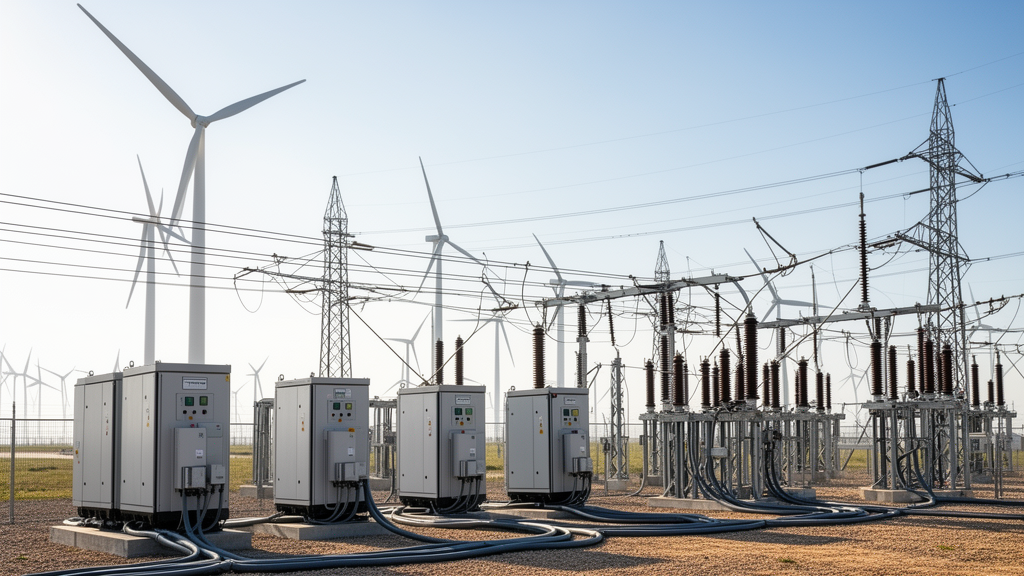
A coordinated siting strategy for multiple reactive power support devices can effectively enhance steady-state performance and suppress transient voltage fluctuations in weak sending-end power grids, according to a simulation study published in Frontiers in Energy Research. Researchers evaluated the framework using multi-scenario time-domain simulations based on an actual renewable energy base model, demonstrating that coordinated multi-device placement substantially outperforms conventional single-device configurations and improper siting schemes across diverse fault conditions.
The investigation directly addresses operational stability concerns driven by the large-scale, long-distance transmission of renewable energy. When substantial renewable generation is transmitted over long distances, power grids develop pronounced weak sending-end characteristics. In these environments, transient disturbances can easily induce severe voltage instability, creating a heightened risk of large-scale tripping among interconnected renewable energy generating units.
According to the authors, existing approaches for placing reactive power compensation equipment remain inadequate for managing these transient vulnerabilities. Conventional siting techniques exhibit notable defects, primarily because they depend on one-sided evaluation indicators and lack a multi-dimensional collaborative framework.
To overcome these technical deficiencies, the research team established a multi-dimensional voltage safety evaluation system. The proposed analytical framework incorporates three distinct assessment metrics: the multiple renewable energy stations short circuit ratio, a transient voltage fluctuation index, and a reactive power compensation trajectory sensitivity index.
Building upon this evaluation system, the researchers formulated a differentiated deployment scheme tailored to device characteristics and the broader grid hierarchy. The framework specifically coordinates two distinct classes of reactive power hardware: synchronous condensers and static synchronous compensators (STATCOM). By accounting for the distinct operational attributes of each device type and their position within the power grid structure, the strategy determines how complementary technologies should be distributed.
To address trade-offs and resolve conflicts arising among the multiple assessment metrics during site selection, the authors established a unified siting decision model. This decision model integrates the entropy weight method with the Technique for Order Preference by Similarity to Ideal Solution (TOPSIS). The combined entropy weight-TOPSIS approach provides an objective mechanism to balance competing technical criteria and rank candidate installation locations across the network.
The effectiveness of the proposed siting model was verified through multi-scenario time-domain simulations conducted on an actual renewable energy base model. Under a variety of simulated fault conditions, the coordinated multi-device strategy maintained grid voltage stability, reduced transient fluctuations, and demonstrated clear superiority over both single-device deployment schemes and improperly placed hardware configurations.
The research was conducted through a collaboration between Fang Liu, Qian Chen, and Yongjie Zhang of the State Grid Sichuan Electric Power Company in Chengdu, China, and Guiqi Liang, Fan Xie, and corresponding author Yangbin Zeng of the South China University of Technology in Guangzhou, China. Their work focuses specifically on enhancing the transient safety support capability of weak sending-end power grids that connect renewable energy stations.
The paper was published as a methods article in the Smart Grids section of Frontiers in Energy Research. The manuscript was received on 12 June 2026 and accepted on 14 September 2026 under a Creative Commons Attribution License. According to the publication notice, all claims expressed in the study are solely those of the authors and do not necessarily represent their affiliated organizations or the publisher.
Subject of Research: Coordinated reactive power support device siting in weak sending-end renewable grids
Article Title: A multi-indicator and multi-device coordinated siting strategy for enhancing transient safety support capability in weak sending-end grids with renewable energy stations
Article References: Liu, F., Liang, G., Chen, Q., Zhang, Y., Zeng, Y., & Xie, F. (2026). A multi-indicator and multi-device coordinated siting strategy for enhancing transient safety support capability in weak sending-end grids with renewable energy stations. Frontiers in Energy Research, 14, Article 1907230. https://doi.org/10.3389/fenrg.2026.1907230
Image Credits: AI Generated
DOI: 10.3389/fenrg.2026.1907230
Keywords: weak sending-end grids, reactive power support, coordinated siting, synchronous condensers, static synchronous compensators, STATCOM, transient voltage stability, renewable energy transmission, short circuit ratio, transient voltage fluctuation index, trajectory sensitivity index, entropy weight method, TOPSIS method, time-domain simulation, voltage safety evaluation, renewable energy tripping
News Source: Denise Maddox. (November 24, 2026). Coordinated Reactive Device Siting Enhances Transient Voltage Stability in Renewable Grids. Scienmag.