Aeroacoustic researchers from the Central Aerohydrodynamic Institute have developed and validated a low-order model of quadrupole sound sources to predict the acoustic radiation generated by turbulent air jets. The investigation establishes a rigorous framework based on the acoustic analogy approach, using multi-microphone acoustic measurements to calibrate model parameters and verify theoretical predictions across both the near and far acoustic fields. By analyzing empirical measurements recorded in distinct spatial zones surrounding cold turbulent jets issuing from a nozzle of diameter forty millimeters, the research team successfully evaluated the effective axial localization region of primary sound sources and determined the physical boundaries where true propagating quadrupole acoustic waves dominate over non-propagating hydrodynamic pseudo-sound pressure fluctuations. The validated formulation offers an efficient computational approach for accurately evaluating the spectral densities and spatial correlation characteristics of aerodynamic jet noise without requiring prohibitive high-fidelity numerical fluid simulations.
The theoretical foundation of the investigation relies on the classical acoustic analogy method, which formally separates the physical mechanisms governing the generation of sound perturbations from those governing their spatial propagation through the surrounding fluid medium. In this analytical framework, the non-linear equations of fluid dynamics are rearranged so that the left-hand side forms a linear wave propagation operator while the right-hand side represents an equivalent stochastic volume source distribution. The authors adopted a formulation where all terms linear in hydrodynamic perturbations are transferred to the propagation operator, whereas non-linear terms are gathered into the effective acoustic source term, consistent with the structural principles of the Goldstein and Lilley acoustic analogies. Classical jet radiation models of this type typically decompose sound into self-noise and shear-noise components; however, experimental observations of azimuthal modal harmonics frequently contradict the predicted behavior of shear noise, prompting the authors to localize equivalent quadrupole sources along the inner boundary of the mixing layer where the shear component is naturally eliminated.
To model the aerodynamic source field, the team employed the linearized Euler equations for an isentropic, cold fluid flow at moderate Mach numbers, where acoustic perturbations evolve against mean flow fields of velocity, density, and static pressure. The non-linear source term is governed by the fluctuating Reynolds stress tensor with zero trace, reflecting the intrinsic quadrupole character of turbulent jet noise generation. The source density is expanded over a basis of five linearly independent traceless quadrupole tensors, each constructed to radiate strictly into a designated azimuthal harmonic mode. By assuming statistical isotropy among these baseline quadrupole components, the stochastic amplitude fields share identical root-mean-square magnitudes and remain mutually uncorrelated at subsonic Mach numbers. This isotropy assumption substantially reduces the computational complexity of the source distribution while providing a rigorous analytical link between the fluctuating hydrodynamic Reynolds stresses and the radiated modal acoustic pressures measured outside the jet shear layer.
Wave propagation from the distributed quadrupole sources into the surrounding acoustic medium was evaluated using a locally-parallel flow approximation within cylindrical coordinates. While neglecting axial variations of the mean flow when computing Green functions for individual point sources, the model integrates these local solutions across the entire physical volume of the source region, evaluating local mean flow parameters at each successive axial jet cross-section. The sources were positioned at the outer boundary of the potential core where mean jet velocity remains uniform, an idealization that prevents spurious convective refraction while suppressing unphysical shear-noise terms. The resulting Green functions express the radiated acoustic pressure in terms of first-kind Hankel functions of modal order m and modified Bessel functions of the source radial coordinate, enabling direct evaluation of acoustic directivity through a double convolution between the Green tensors and the spatio-temporal correlation tensor of the fluctuating quadrupole field.
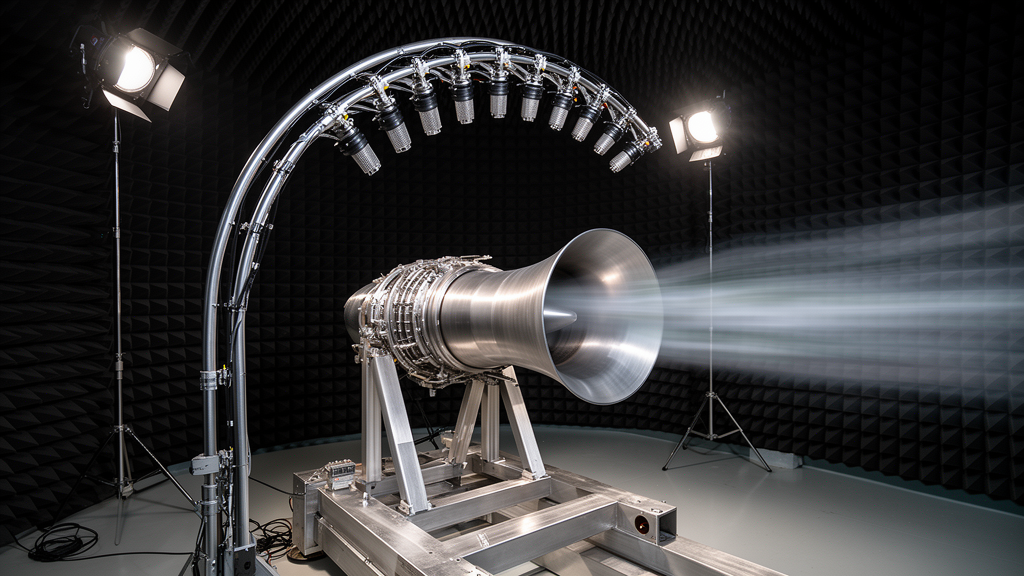
Empirical validation of the theoretical model was conducted within the anechoic chamber AC-2 at the Central Aerohydrodynamic Institute using the azimuthal decomposition technique across an extensive experimental database. The measurement strategy employed circular arrays of microphones positioned in planes strictly perpendicular to the jet center axis, decomposing synchronous acoustic pressure signals into azimuthal Fourier series components. By numerically evaluating modal Fourier coefficients through circumferential integration over discrete microphone locations, the statistical spectra and directivity patterns of individual azimuthal harmonics were isolated from the total acoustic field. The experimental campaign investigated cold air jets issuing from a nozzle with a exit diameter of forty millimeters across a comprehensive velocity range spanning from one hundred to two hundred and eighty meters per second, allowing modal radiation characteristics to be systematically analyzed as a function of the non-dimensional Strouhal number.
The experimental configuration deployed multiple multi-microphone array topologies to interrogate different physical regions of the radiating sound field. Initial far-field acoustic measurements utilized a six-microphone ring array with a radius of zero point eight five meters, providing baseline data on the spectral directivity of azimuthal harmonics m equals zero, one, and two. To evaluate the axial distribution of sound generation mechanisms, synchronous acoustic measurements were executed simultaneously on two identical six-microphone arrays with radii of zero point seven five meters spaced along the jet axis by a separation distance of zero point seven five meters. In addition, an array of smaller radius at zero point two eight five meters was deployed to test near-field directivity, while a specialized movable assembly of five six-microphone arrays scanned the immediate transition boundary between the shear layer and the external acoustic field across axial distances up to seven point five nozzle diameters.
Comparison between theoretical calculations and far-field microphone measurements revealed fundamental physical insights into the acoustic emission mechanics of individual azimuthal harmonics across non-dimensional frequencies between Strouhal zero point zero four and one point two five. The total source power for the axisymmetric mode m equals zero and first helical mode m equals one was found to scale with the seventh power of jet velocity, whereas the quadrupole source power responsible for the second azimuthal harmonic m equals two scaled with the sixth power of jet velocity. This distinct velocity scaling indicates a qualitative divergence in the underlying turbulent generation mechanisms between lower and higher modal orders. Furthermore, power ratios between harmonics confirmed that quadrupole source isotropy holds accurately for jet Mach numbers below zero point five, whereas slight departures occur at higher velocities for the second azimuthal harmonic. Across all tested velocities, the spectral source power collapsed onto a universal two-branch piecewise power-law dependence governed by the Strouhal number.
To extend the predictive capability of the quadrupole formulation into the near acoustic field, the spatial distribution of sound sources along the jet axis was determined using cross-correlation measurements obtained from the two synchronously recording microphone arrays. The maximum normalized cross-correlation between the two axial stations served as an exceptionally sensitive metric for evaluating the axial spread parameter of the source distribution function. The optimal source localization width was found to vary systematically with acoustic frequency, expanding significantly at lower Strouhal numbers and contracting closer to the nozzle exit plane as frequency increased. The empirical scatter parameter followed a clear mathematical relationship: below a Strouhal number of zero point three, the axial localization length scaled linearly with the inverse Strouhal number, whereas at higher frequencies it decayed inversely with the square root of the Strouhal number. Minor discrepancies between model and measurement arose only in regions of negligible autocorrelation where signal-to-noise ratios diminished.
The complete sound source model, incorporating the calibrated quadrupole source powers and the frequency-dependent axial localization parameters, was rigorously validated against near-field acoustic measurements recorded on the six-microphone array situated at a radial distance of zero point two seven five meters. Across the entire experimental envelope spanning jet velocities from one hundred and twenty to two hundred and eighty meters per second and Strouhal numbers up to one point two five, the calculated directivity curves of azimuthal harmonics m equals zero, one, and two exhibited close agreement with empirical data. Because this near-field array was located outside the spatial domain where model parameters were originally calibrated, the high level of correspondence confirms that the low-order quadrupole model successfully encapsulates the essential physical processes governing the conversion of hydrodynamic turbulent energy into radiated sound.
Finally, the researchers established the spatial limits of applicability for the quadrupole model by examining high-resolution acoustic data gathered along the boundary between propagating sound and non-propagating hydrodynamic pseudo-sound. Using three concentric conical sets of microphone arrays positioned at radial offsets between zero point zero three two and zero point zero seven seven meters from a jet operating at one hundred and thirty-seven meters per second, the data demonstrated that hydrodynamic fluctuations generated by convecting vortex structures dominate the inner pressure field at low frequencies. However, because pseudo-sound pressure decays exponentially with increasing radial distance from the jet axis while genuine acoustic waves diminish according to an algebraic power law, the spectral cutoff frequency where quadrupole sound radiation begins to dominate shifts progressively toward lower Strouhal numbers as distance increases. These findings precisely demarcate where acoustic analogy models can be reliably employed for aerodynamic noise prediction and acoustic near-field characterization.
Subject of Research: Aeroacoustic modeling and multi-microphone validation of turbulent jet sound radiation
Article Title: Validation of a Quadrupole Model of Sound Radiation of a Turbulent Jet Based on Multi-Microphone Acoustic Measurements
Article References: Kopiev, V. F., Chernyshev, S. A., Faranosov, G. A., & Korobov, A. A. (2024). Validation of a Quadrupole Model of Sound Radiation of a Turbulent Jet Based on Multi-Microphone Acoustic Measurements. Acoustical Physics, 70(5), 850-864. https://doi.org/10.1134/s1063771024602814
Image Credits: AI Generated
DOI: 10.1134/S1063771024602814
Keywords: aeroacoustics, turbulent jet noise, quadrupole sound sources, acoustic analogy, azimuthal decomposition technique, microphone arrays, sound radiation, near-field acoustics, far-field directivity, pseudosound fluctuations, Strouhal number, Reynolds stress tensor, Green functions, anechoic chamber testing, axial source distribution, shear flow noise, spatial cross-correlation
News Source: Denise Maddox. (November 24, 2026). Microphone Array Measurements Validate Quadrupole Acoustic Model for Turbulent Jet Noise. Scienmag.