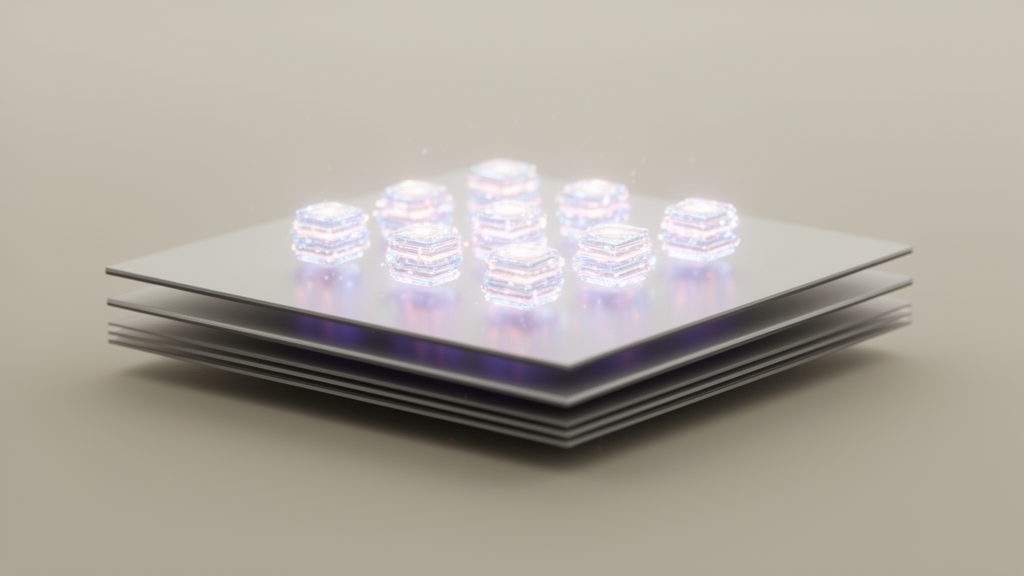
Semiconducting monolayers and few-layer two-dimensional materials hold widespread promise for miniature optoelectronic circuitry, yet their direct employment in light-emitting and sensing architectures remains fundamentally restricted by low intrinsic optical absorption, modest photoluminescence quantum yields, and pronounced vulnerability to surface defects. To address these operational constraints without disrupting the pristine crystalline lattice of host monolayers, materials scientists have advanced hybrid designs combining two-dimensional sheets with zero-dimensional nanostructures. In an extensive comprehensive evaluation published in Chemical Physics Impact, researchers Enas Daoud, Manar Abdulameer, Rekha M M, Subhashree Ray, Talal Aziz Qassem, T. Krithiga, Renu Sharma, Prakhar Tomar, and Shayan Mahmoodi systematized the interfacial mechanisms, structural parameters, and photophysical outcomes governing heterostructures constructed from MXene quantum dots. Derived from layered transition metal carbides and nitrides, these nanoscale fragments inherit metallic or semimetallic electronic properties from parent phases while simultaneously demonstrating quantum confinement, broad spectral absorption, and diverse surface terminations that enable non-destructive control over exciton dynamics.
The physical rationale behind these composite architectures relies on dimensional complementarity, an assembly framework wherein materials possessing distinct spatial confinement regimes generate emergent electronic properties across clean noncovalent boundaries. Atomically thin two-dimensional platforms supply laterally extended platforms characterized by well-defined band structures and strong in-plane covalent bonding, whereas zero-dimensional quantum dots contribute spatially confined electronic states alongside exceptionally high surface-to-volume ratios. In MXene quantum dot configurations, the planar geometry of the underlying two-dimensional host maximizes interfacial surface contact, allowing dense and controllable coupling governed by van der Waals forces, electrostatic attraction, and hydrogen bonding. Unlike traditional bulk semiconductor heterostructures or epitaxially grown multilayers, these assemblies avoid the strict requirements of epitaxial lattice matching, effectively circumventing strain accumulation and structural dislocation networks. Consequently, the operational electronic landscape of the resulting hybrid can be tuned independently through dot size, composition, and chemical functionalization while keeping the structural framework, lattice symmetry, and layer thickness of the host two-dimensional crystal intact.
Synthesis protocols establish the foundational nanoscale geometry and chemical functionality that dictate subsequent interfacial behavior. In representative preparations of Ti3C2Tx quantum dots derived from bulk Ti3AlC2 MAX phase powders, selective chemical etching removes aluminum layers using an in-situ etchant generated from lithium fluoride and hydrochloric acid under ambient conditions. Continuous magnetic stirring at 500 revolutions per minute over twenty-four hours drives simultaneous exfoliation and mechanical fragmentation, followed by repeated centrifugation-based washing until reaching a neutral pH, drying, redispersion in deionized water, and subsequent supernatant harvesting. This mild liquid-phase route preserves transition-metal carbide core integrity while establishing oxygen, hydroxyl, and fluorine surface terminations that impart high colloidal dispersibility and surface affinity. Structural characterization via transmission electron microscopy reveals crystalline, near-spherical particles exhibiting typical lattice spacings of approximately 0.27 nanometers and narrow lateral size distributions centered near 5 nanometers, while atomic force microscopy verifies ultrathin topographies spanning one to four nanometers, corresponding to single or few atomic layers.
Spatial confinement within these sub-ten-nanometer fragments alters the electronic profile of the parent MXene, introducing discrete energy states and an effective bandgap that diverge sharply from bulk metallic behavior. Ultrasmall dots exhibit intensified quantum confinement alongside wider energy level separations, while increased proportions of undercoordinated edge atoms create localized electronic states with tailored carrier-trapping signatures. As lateral dimensions expand, quantum dots exhibit weaker confinement and transition toward continuous, bulk-like electronic densities. Concurrently, surface terminations such as hydroxyl, oxygen, and fluorine groups occupy basal and peripheral coordination sites, directly modifying work functions, local bond polarities, and surface potentials. These structural attributes provide an adaptable toolkit for interfacial engineering, enabling researchers to modulate local band offsets and Fermi levels across noncovalent junctions without introducing dopants into the underlying host.
When combined with two-dimensional semiconductors, MXene quantum dots enhance photoluminescence primarily by expanding optical absorption cross-sections and opening auxiliary excitation pathways. Monolayer semiconductors frequently demonstrate limited light harvesting due to their sub-nanometer physical thickness, even though their excitonic binding energies remain exceptionally strong. Integrating zero-dimensional MXene quantum dots introduces dense photon-absorption centers that capture radiation across ultraviolet and visible spectra, bypassing the light-harvesting bottleneck of isolated atomic sheets without increasing composite physical profile. Under high-energy illumination, quantum dots selectively absorb incoming photons and funnel excitation energy into adjacent monolayer states through interfacial dipole-dipole interactions, significantly elevating the steady-state population of electron-hole pairs available for radiative recombination.
This cooperative excitation mechanism operates prominently through non-radiative resonance energy transfer, where photoexcited MXene quantum dots serve as energy donors that feed excitons into neighboring two-dimensional acceptors without requiring charge carriers to cross the interface. Because energy transfer preserves local charge neutrality within each subsystem, it avoids creating charge-separation traps or electrical injection defects. In experimental monolayer tungsten disulfide systems paired with Ti2N quantum dots and graphitic carbon nitride quantum dots, optical excitation at 300 nanometers generated a 15-fold amplification in tungsten disulfide photoluminescence emission. This amplification was absent under photon energies falling below the quantum dot bandgap, confirming that enhanced emission originates from auxiliary absorption and directional energy transfer rather than structural modification of the sulfide monolayer. Time-resolved spectroscopy corroborates this pathway, documenting a lifetime drop in Ti2N quantum dots from 1.06 to 0.60 nanoseconds upon hybrid assembly alongside a fourfold quenching of donor emission, consistent with resonant exciton transfer into the straddling type-I band structure of the tungsten disulfide host.
In parallel with energy migration, interfacial charge transfer governs carrier dynamics depending on interfacial band alignment, relative Fermi levels, and defect distributions. When quantum dots interact with two-dimensional semiconductors in staggered type-II band configurations, built-in electric fields promote spatial carrier separation, driving photogenerated holes across the junction to suppress immediate geminate recombination. Such charge redistribution can enhance emission by neutralizing charged native defects, passivating trap sites, and extending the lifetime of radiative excitons in the host semiconductor. However, excessive or strongly unidirectional carrier extraction can deplete radiative electron-hole populations, inducing substantial photoluminescence quenching. Effective hybrid engineering consequently demands precise alignment of interfacial energy levels to ensure charge transfer passivates non-radiative pathways without removing emissive carriers.
Beyond electronic coupling, MXene quantum dots can amplify local electromagnetic fields and modify interfacial dielectric environments. Preserved metallic or semimetallic characteristics enable quantum dot assemblies to exhibit localized plasmon-like oscillations under illumination, concentrating incident electromagnetic radiation around the hybrid interface. In monolayer tungsten disulfide heterostructures supported by Ti3C2Tx quantum dot arrays, excitation power-dependent photoluminescence demonstrates non-linear emission enhancement at room temperature under laser intensities scaling from 0.3 to 190 microwatts. At elevated excitation densities, carrier detrapping and plasmonic field activation suppress deep non-radiative pathways, while the low-dielectric quantum dot interlayer reduces screening and strengthens light-matter interaction. At cryogenic temperatures of minus 190 degrees Celsius, this intense interfacial coupling supports higher-order many-body excitations, including trions and biexcitons, demonstrating how spatial dot density governs complex quasiparticle dynamics.
Zero-dimensional MXene architectures also exhibit robust non-linear optical responses and broad-spectrum emission. Ti3C2 quantum dots with lateral dimensions of approximately 13 nanometers and thicknesses of two atomic layers produce stable, two-photon-induced white photoluminescence under 800-nanometer pulsed near-infrared excitation, exhibiting a quadratic power dependence with a linear slope of unity. Transient absorption measurements resolving excited-state absorption bands between 480 and 710 nanometers reveal carrier relaxation components spanning approximately 3 picoseconds for optical phonon cooling, 120 picoseconds for non-radiative trapping, and 3 nanoseconds for radiative recombination. Concurrently, environmental investigations confirm that surrounding chemical media dynamically regulate emission color: Ti3C2Tx quantum dots emit broad white photoluminescence in dimethyl sulfoxide but shift to blue emission in dimethylformamide and ethanol. Furthermore, specialized optical configurations utilizing V2C quantum dots in random scattering media have achieved simultaneous multi-band optical gain across visible wavelengths, producing coherent white lasing driven by localized non-linear feedback and surface defect passivation.
Despite substantial progress across laboratory settings, translating MXene quantum dot hybrids into commercial photonic components requires resolving significant challenges in structural uniformity, reproducible surface termination, and long-term environmental robustness. Non-radiative trap states arising from unpassivated edge defects, uncontrolled aggregation during liquid-phase deposition, and ambient oxidation can introduce competing non-radiative decay channels that erode photoluminescence quantum yield. The researchers emphasize that bridging these limitations requires integrating predictive computational modeling with targeted synthetic passivation, such as post-synthetic ligand exchange, controlled annealing, and optimized polymer encapsulation. By establishing quantitative relationships between surface terminations, interfacial band alignment, and non-equilibrium carrier transport, coordinated interfacial engineering will enable the scalable deployment of MXene-based 2D/0D hybrid platforms across high-efficiency white-light emitters, ultraviolet photodetectors, nanoscale modulators, and multifunctional environmental sensors.
Subject of Research: Interfacial engineering of photoluminescence in two-dimensional and zero-dimensional MXene quantum dot hybrid materials
Article Title: Engineering photoluminescence in MXene quantum dot–based 2D/0D hybrids: interfacial design, mechanisms, and applications
Article References: Daoud, E., Abdulameer, M., M, R. M., Ray, S., Qassem, T. A., Krithiga, T., Sharma, R., Tomar, P., & Mahmoodi, S. (2026). Engineering photoluminescence in MXene quantum dot–based 2D/0D hybrids: interfacial design, mechanisms, and applications. Chemical Physics Impact, 13, Article 101134. https://doi.org/10.1016/j.chphi.2026.101134
Image Credits: AI Generated
DOI: 10.1016/j.chphi.2026.101134
Keywords: MXene quantum dots, two-dimensional materials, photoluminescence engineering, energy transfer, charge dynamics, quantum confinement, tungsten disulfide, titanium carbide, titanium nitride, surface terminations, plasmonic enhancement, two-photon luminescence, exciton stabilization, heterostructures, optoelectronics, ultraviolet absorption, nonradiative recombination
News Source: Katie Riggs. (November 24, 2026). MXene Quantum Dots Enhance Light Emission in Two-Dimensional Semiconductor Heterostructures. Scienmag.