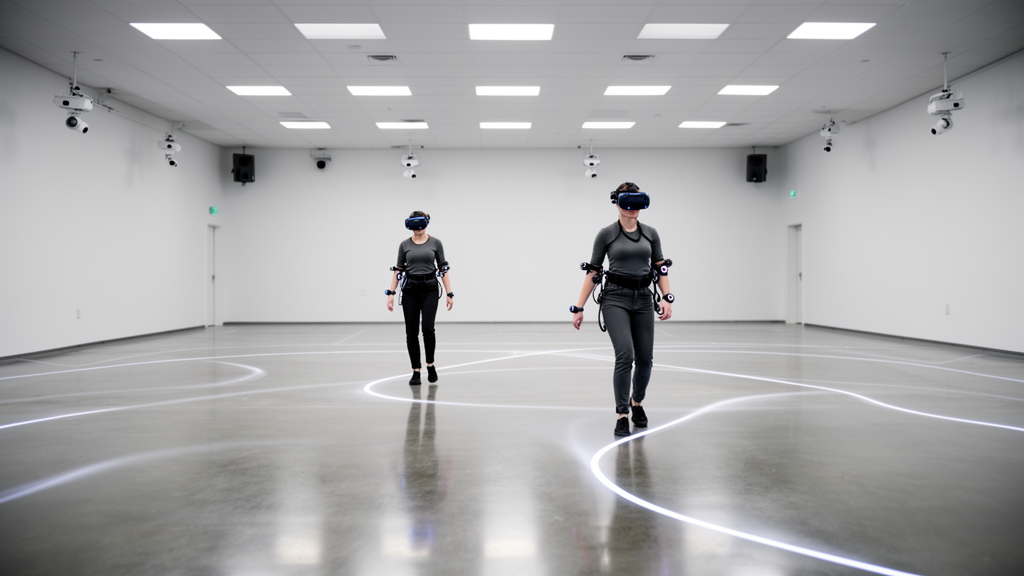
Locomotion within virtual environments faces an enduring spatial mismatch because tracking boundaries in physical rooms are typically much smaller than the vast virtual spaces intended for exploration. Redirected walking techniques address this limitation by injecting subtle, imperceptible spatial manipulations—such as rotation, translation, and curvature gains—into a user’s viewpoint so that their physical path is redirected away from walls and obstacles while preserving the perception of continuous movement in virtual reality. To coordinate redirection in crowded setups, researchers have developed a prediction-driven adaptive artificial potential field method known as PD-APF. Described in research published in the Journal of King Saud University Computer and Information Sciences, the method integrates short-term user trajectory forecasting with a confidence gate and potential-field mechanics to improve walking continuity across both single-user and multi-user configurations in constrained physical tracking environments.
Conventional redirected walking architectures that rely on artificial potential fields typically compute steering vectors reactively, taking into account only the user’s instantaneous physical position relative to boundary elements and nearby co-located individuals. While traditional artificial potential fields are structurally simple and responsive to immediate obstacles, their strictly reactive behavior presents distinct operational bottlenecks when multiple participants share confined physical spaces. When a walking trajectory exhibits a rapid, sustained momentum toward a room boundary or another individual, reactive potential fields only exert corrective repulsion after the hazard has manifested within the current local geometry. In practice, this latency often precipitates abrupt steering interventions, irregular trajectory oscillations, and frequent reset events such as freeze-and-turn procedures that interrupt natural exploration flow and disrupt embodied presence.
To overcome the shortcomings of purely reactive steering, the investigative team—comprising Zhongyu Chen, Liqun Kuang, Fengguang Xiong, Shichao Jiao, Rong Zhao, Hongxin Xue, and Xie Han—formulated the PD-APF control framework. The system functions as a hybrid feed-forward and feedback architecture that blends proactive motion anticipation with the safety guarantees of reactive spatial boundaries. The algorithmic engine comprises three tightly coupled modules: an attention-based location prediction network named ALPNet, an adaptive prediction-confidence weighting mechanism, and a prediction-enhanced potential-field calculation loop. Rather than functioning as an isolated or post-processed trajectory estimator, the predictive model injects anticipated positions directly into the potential-field equations, allowing steering commands to begin curving trajectories before boundary or interpersonal proximity thresholds become acute.
The predictive component of the architecture, ALPNet, employs an encoder-attention-decoder recurrent framework constructed from long short-term memory units. Operating over a sliding historical trajectory window of nine time steps, the network isolates informative temporal motion features across horizontal two-dimensional coordinate positions sampled in a shared tracking-space coordinate system. Crucially, ALPNet avoids compressing temporal context into a single static feature vector across its forecasting span. Instead, the model computes step-wise normalized attention weights that evaluate the relevance between the hidden states of the recurrent encoder and the evolving decoder state at each forecast interval. This step-dependent context vector allows the network to assign greater weight to salient past trajectory adjustments, producing a future trajectory sequence whose near-term coordinate estimate serves as the feed-forward anchor for steering calculations.
Because human locomotion in immersive spaces can change unexpectedly, relying unconditionally on motion forecasting introduces significant control vulnerability. To preserve physical safety, PD-APF incorporates a confidence gate that dynamically adjusts the weight granted to predicted positions based on rolling residual accuracy. The system tracks up to five completed prediction residuals within an online memory buffer, computing the Euclidean deviation between previous one-step forecasts and realized physical positions. If recent prediction residuals remain low, an exponential decay function assigns a high confidence coefficient to the feed-forward terms. Conversely, when abrupt turns or erratic paths inflate forecasting errors, or immediately following an evasive reset event when historical residuals are purged, the confidence gate automatically drops toward zero, smoothly transitioning the control output back to reactive potential-field behavior.
The fusion of predictive and reactive forces takes place within both the guidance target correction and the potential field’s spatial evaluation equations. An instantaneous guidance target is interpolated with the forecasted user position using the scalar confidence gate, orienting the target toward the anticipated path when predictions remain dependable. Furthermore, the overall artificial potential field combines attractive forces toward the adjusted target with repulsive fields governing room boundaries, neighboring participants, and local user density distributions. In the feed-forward branch of the controller, these repulsive components evaluate physical constraints using the predicted future position rather than current coordinates, creating an anticipatory safety buffer around the moving user while the feedback branch maintains baseline obstacle avoidance anchored at current physical positions.
The synthesized potential field generates a resultant two-dimensional steering force that is mapped into redirection commands using a fixed gain-mapping matrix. This matrix allocates specific gains across translational, rotational, and curvature channels, operating with calibrated gain multipliers of 1.0 for translation, 1.2 for rotation, and 0.6 divided by the square root of two for curvature steering. Trajectory sampling and control updates were synchronized at a fixed frequency of 10 Hz throughout the experimental pipeline. Operating within this discrete-time loop, the computational overhead of the combined ALPNet inference and field evaluation averaged 3.2 milliseconds per update cycle on a platform equipped with an Intel Core i7-12700K processor, an NVIDIA RTX 3080 graphics processing unit, and 32 gigabytes of random-access memory, with neural inference accounting for approximately 75 percent of the per-step execution time.
Systematic validation of the PD-APF framework was conducted using a Unity-based virtual reality simulation environment across five square physical tracking footprints: 5 by 5 meters, 10 by 10 meters, 15 by 15 meters, 20 by 20 meters, and 25 by 25 meters. Within these environments, user loads were varied from one to eight simulated individuals, repeating each experimental configuration across 100 trials to collect arithmetic means of key performance metrics. Evaluation criteria centered on the average walking distance between resets, which reflects locomotion continuity, alongside the average reset count, which quantifies the incidence of disruptive boundary collisions. Comparative benchmarks included classical steer-to-center guidance, reactive artificial-potential-field redirection, target-aware potential fields, weighted potential repulsion, and contemporary forecasting-based algorithms including F-RDW and predictive multi-user artificial potential fields.
In single-user simulations, PD-APF achieved the greatest average walking distance between resets across all five spatial scales and recorded the lowest reset count in four of the five tested footprints. In tightly constrained 5 by 5 meter environments, PD-APF extended the average distance between resets from 6.71 meters under weighted potential repulsion to 7.03 meters—representing an improvement of approximately 4.77 percent—while decreasing average reset counts from 537.12 to 508.21. In the 20 by 20 meter single-user scenario, PD-APF attained an average walking distance of 1565.41 meters and an average reset count of 1.29, outperforming the weighted potential repulsion baseline of 1491.22 meters and 1.38 resets, the F-RDW baseline of 1434.56 meters and 1.46 resets, and the predictive multi-user potential field baseline of 987.65 meters and 2.43 resets.
The operational benefits of anticipatory steering became especially evident under multi-user interactions, where dynamic conflicts between moving individuals compound fixed perimeter constraints. In the representative 20 by 20 meter simulation involving two concurrent users, PD-APF increased the average walking distance between resets from 1179.31 meters to 1283.12 meters relative to the weighted potential repulsion baseline, achieving an 8.80 percent improvement in walking continuity. Simultaneously, the average reset count dropped by 16.5 percent, falling from 2.00 to 1.67 resets per run. Under identical two-user conditions, F-RDW achieved 1024.56 meters with 2.05 resets, whereas the predictive multi-user artificial potential field registered 1196.34 meters with 1.84 resets, demonstrating that unmoderated forecasting models lack the stability provided by confidence-gated force integration.
Complementary ablation studies conducted within the 20 by 20 meter two-user simulation isolated the explicit contributions of the underlying algorithmic mechanisms. When the step-wise attention component was excised from ALPNet, relying solely on recurrent hidden representations, the average walking distance between resets decreased from 1283.12 meters to 1216.45 meters, while the reset count rose from 1.67 to 1.86. Removing the adaptive confidence gate and substituting a static fusion weight produced a more pronounced performance degradation, reducing average walking distance to 1198.73 meters and increasing resets to 1.92. These ablation findings confirm that the observed performance enhancements stem directly from the integrated coupling of attention-based sequence modeling, confidence-regulated blending, and potential-field feedback rather than unconstrained trajectory extrapolation.
To substantiate simulation findings under physical locomotion conditions, the researchers conducted real-walking field experiments utilizing Pico 4UE head-mounted displays in a dedicated indoor tracking space. Fifty-two volunteer participants carried out target-collection navigation tasks structured under single-user, two-user, and four-user experimental conditions. In single-user field tests, PD-APF lowered the average reset count from 1.17 under weighted potential repulsion to 1.03—a reduction of approximately 12.0 percent—while extending the distance between resets from 247.76 meters to 251.53 meters, securing a peak total walking distance of 335.93 meters and collecting an average of 6.71 target markers. Multi-user trials echoed this trend: in two-user field trials, resets decreased from 1.79 to 1.62 while distance between resets grew from 126.45 meters to 131.24 meters, and in four-user trials, resets decreased from 2.08 to 1.93 while distance between resets expanded from 113.51 meters to 119.63 meters.
The study notes specific technical bounds and operational scopes for interpreting these results. The navigation advantages of PD-APF concentrate primarily in medium-sized and tightly constrained spaces where boundary hazards and user convergence occur frequently enough to expose reactive latency. In expansive 25 by 25 meter spaces where resets are inherently infrequent, performance differences across methods narrow toward the physical ceiling imposed by finite trial lengths. Furthermore, the trajectory forecasting network relies strictly on historical spatial coordinates without incorporating eye tracking, user gaze dynamics, or semantic intention indicators. Because field evaluations were analyzed through aggregate objective navigation metrics rather than individual-level statistical modeling or subjective scales of presence, simulator sickness, and perceptual comfort, the authors emphasize that objective reductions in physical resets demonstrate navigational continuity without establishing formal claims regarding subjective user experience.
Subject of Research: Prediction-driven artificial potential field redirected walking in constrained physical spaces
Article Title: A prediction-driven adaptive artificial potential field method for multi-user redirected walking in constrained physical spaces
Article References: Chen, Z., Kuang, L., Xiong, F., Jiao, S., Zhao, R., Xue, H., & Han, X. (2026). A prediction-driven adaptive artificial potential field method for multi-user redirected walking in constrained physical spaces. Journal of King Saud University Computer and Information Sciences, 38(10), Article 1056. https://doi.org/10.1007/s44443-026-01501-z
Image Credits: AI Generated
DOI: 10.1007/s44443-026-01501-z
Keywords: redirected walking, artificial potential fields, virtual reality, trajectory prediction, multi-user locomotion, collision avoidance, attention mechanism, long short-term memory, confidence gating, head-mounted displays, motion control, spatial tracking, navigation algorithms, feed-forward control, reset reduction, adaptive steering
News Source: Denise Maddox. (November 24, 2026). Predictive Artificial Potential Fields Reduce Resets in Multi-User Redirected Walking. Scienmag.