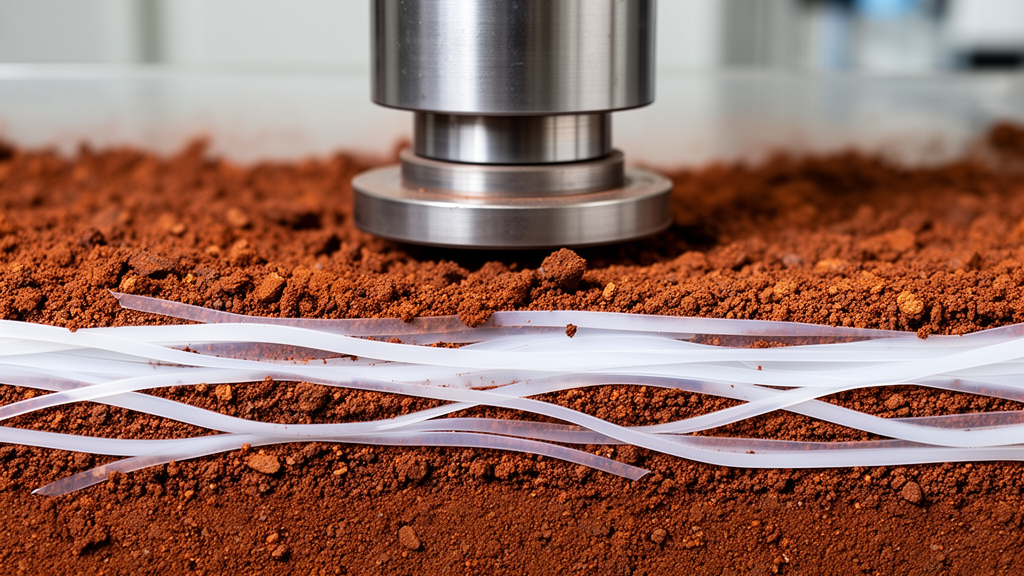
A geotechnical investigation has demonstrated that incorporating discarded polyvinyl chloride advertising banners into compacted lateritic soil can substantially improve compressive strength, post-peak ductility, and load-bearing capacity, but the magnitude of these engineering benefits depends directly on the compaction method applied during preparation. Conducting laboratory evaluations on lateritic soil sourced from northern Thailand, researchers Kitisak Vongsook and Aroondet Boonsung analyzed the mechanical response of soil specimens prepared under both Standard Proctor and Modified Proctor compaction standards. Their experimental program revealed that the inclusion of waste vinyl sheet layers yielded contrasting outcomes depending on the compaction regime. Under Standard Proctor compaction, the insertion of vinyl sheets failed to produce any measurable gain in compressive strength and actually resulted in slight reductions in peak resistance. In contrast, under Modified Proctor compaction, identical vinyl sheet reinforcement produced progressive increases in unconfined compressive strength of up to 34.2 percent, alongside substantial increases in penetration resistance that allowed soaked specimens to surpass established engineering thresholds for roadway subbase construction.
Compacted geomaterials serve as fundamental structural components across civil engineering projects, functioning as structural fills, embankment foundations, and supporting layers beneath flexible and rigid pavement structures. The long-term performance and service life of these infrastructure systems depend fundamentally on the mechanical characteristics of the compacted soil, particularly its resistance to deformation, stability under moisture variations, and overall bearing capacity. When pavement layers are constructed using native soils that exhibit inadequate shear resistance or suffer from insufficient compaction effort, roadway foundations become vulnerable to subgrade rutting, excessive settlement, and the progressive accumulation of permanent plastic deformation under repeated vehicle loads. These deficiencies accelerate pavement deterioration, leading to early road failures and imposing heavy economic burdens on highway authorities through recurring maintenance operations. Addressing the structural instability of compacted soils, particularly when exposed to seasonal wetting and prolonged saturation, consequently represents an enduring challenge in transportation geotechnics.
To overcome the mechanical limitations of subgrade soils that do not satisfy structural specifications, civil engineers frequently implement mechanical stabilization techniques such as heavy compaction or introduce chemical binders such as lime and Portland cement. Although chemical and mechanical stabilization methods remain widely accepted in construction practice, they frequently entail substantial financial costs, prolonged construction schedules, and rigorous field quality control requirements. An established mechanical alternative involves placing geosynthetic materials within soil layers to provide lateral tensile confinement, redistribute applied traffic stresses, and optimize load transfer efficiency across the soil matrix. Continuous planar reinforcement materials, in particular, establish interface shear resistance that enhances overall system capacity. However, commercially manufactured geosynthetics can represent an expensive expenditure for small-scale infrastructure initiatives and resource-constrained regions. Consequently, researchers have increasingly evaluated non-standard materials and industrial byproducts, including discarded plastics, tire fibers, and organic residues, to identify cost-effective alternatives that combine mechanical reinforcement with beneficial waste diversion.
Discarded advertising banners fabricated from polyvinyl chloride represent an intriguing candidate for soil reinforcement due to their planar geometry and tensile durability. Manufactured extensively for temporary commercial promotions, these flex banners generate large volumes of solid waste that typically end up in municipal landfills or incineration facilities because practical recycling pathways remain limited. Unlike discrete, discontinuous waste inclusions such as chopped fibers or shredded plastic strips, advertising vinyl banners possess a continuous planar architecture analogous to conventional geosynthetic membranes. The material evaluated by the investigators consisted of a thin, highly flexible PVC sheet reinforced internally with a synthetic fiber grid, exhibiting an average thickness of 0.35 millimeters and an areal density ranging between 347 and 354 grams per square meter, with a mean of 351 grams per square meter. Standardized tensile testing conducted in accordance with ISO 10319:2024 revealed marked mechanical anisotropy governed by fiber orientation. In the Machine Direction, the vinyl material exhibited an average tensile strength of approximately 12.6 kilonewtons per meter and an elongation at peak of 10.6 percent. In the Cross Direction, tensile strength averaged 6.9 kilonewtons per meter with an elongation of 5.4 percent, demonstrating that the primary manufacturing axis provided approximately 1.8 times greater tensile resistance.
The base geomaterial utilized throughout the experimental program was a natural lateritic soil obtained from Uttaradit Province in northern Thailand, exhibiting a Plasticity Index of 9.6 and a specific gravity of 2.74, reflecting the presence of dense, iron- and aluminum-bearing mineral phases characteristic of weathered tropical profiles. Mechanical gradation tests established that 63.0 percent of the soil mass passed the No. 4 sieve and 43.2 percent passed the No. 200 sieve, confirming a broad distribution of both coarse and fine fractions. Standard Proctor compaction tests conducted according to ASTM D698 established an optimum moisture content of 15.0 percent and a maximum dry unit weight of 17.80 kilonewtons per cubic meter, achieved by compacting soil in three equal lifts with 25 hammer blows per lift. In comparison, Modified Proctor compaction tests performed under ASTM D1557 yielded an optimum moisture content of 10.0 percent and a maximum dry unit weight of 19.05 kilonewtons per cubic meter, utilizing five lifts at 25 blows per lift. Soil specimens were prepared at their respective optimum moisture contents across both unreinforced control configurations and reinforced setups incorporating one or two circular vinyl sheets cut to fit the mold dimensions with a one-millimeter clearance.
Axial compression performance was evaluated through Unconfined Compressive Strength tests conducted according to ASTM D2166 on cylindrical specimens subjected to a continuous strain rate of 1.0 percent per minute. Two-way analysis of variance identified a highly significant interaction between the compaction method and reinforcement level, confirming that the structural impact of the vinyl sheets was contingent upon the soil state. Under Standard Proctor compaction, the baseline compressive strength of unreinforced soil was 295.00 kilopascals, which slightly decreased to 288.00 kilopascals with one vinyl layer and 284.80 kilopascals with two layers, representing minor but statistically significant strength reductions of 2.4 percent and 3.5 percent, respectively. Conversely, under Modified Proctor compaction, unreinforced soil achieved a baseline strength of 519.00 kilopascals, which expanded to 613.00 kilopascals with a single vinyl layer, an increase of 18.1 percent, and climbed to 696.00 kilopascals with two vinyl layers, representing a 34.2 percent gain. The researchers emphasized that because the two compaction procedures varied molding moisture content and dry density simultaneously, the observed strength divergence cannot be attributed solely to compaction energy but reflects the combined state of the compacted matrix and its mechanical interaction with the planar sheets.
Analysis of the compressive stress-strain response demonstrated that the presence of waste vinyl sheets exerted a more pronounced influence on deformation capacity and failure mode than on initial stiffness. The secant modulus calculated at 50 percent of peak compressive strength did not exhibit systematic improvements with reinforcement; under standard compaction, stiffness declined from 29,300 kilopascals in unreinforced specimens to 22,300 kilopascals in two-layer specimens, while under modified compaction, stiffness shifted from 55,700 kilopascals unreinforced to 45,000 kilopascals with one layer before returning to 55,500 kilopascals with two layers. However, axial strain at peak strength increased consistently across both regimes, shifting from 1.38 percent to 1.63 percent under standard compaction and from 1.13 percent to 1.77 percent under modified compaction. Post-peak monitoring showed that while unreinforced specimens failed abruptly through localized shearing and central core disintegration, the reinforced specimens maintained structural cohesion after peak loading, developing multiple distributed axial fractures. This transition from brittle crushing to ductile, progressive cracking indicated that the continuous vinyl sheets effectively engaged during post-peak deformation to bridge developing shear planes and maintain structural integrity.
The penetration resistance of the reinforced lateritic soil was evaluated through California Bearing Ratio testing carried out according to ASTM D1883 under both unsoaked and saturated conditions. In unsoaked testing, the addition of vinyl sheets produced steady, substantial gains in bearing ratio under both preparation methods. Under standard compaction, the unsoaked bearing ratio rose from 20 percent in unreinforced controls to 28 percent with one vinyl layer and 36 percent with two layers, representing improvements of 40 percent and 80 percent, respectively. Under modified compaction, unsoaked values climbed from 45 percent for the control to 57 percent with one layer and reached 69 percent with two layers, corresponding to percentage increases of 26.7 percent and 53.3 percent. Statistical analysis confirmed significant main effects for both compaction effort and reinforcement quantity without a significant interaction under unsoaked conditions. Across all configurations, Modified Proctor compaction produced bearing ratios approximately 1.9 to 2.25 times higher than Standard Proctor compaction, reflecting the superior initial density and tighter particle packing achieved under greater compaction effort.
To evaluate performance under adverse field drainage conditions, specimens were subjected to a 96-hour water immersion period under a 4.54-kilogram surcharge before CBR penetration testing. Saturation caused severe strength degradation across every tested configuration, with the Reduction Ratio of soaked to unsoaked bearing capacity ranging between 0.350 and 0.474, indicating that specimens retained only 35.0 to 47.4 percent of their unsoaked bearing values due to matrix softening and loss of matric suction. Nevertheless, specimens compacted under Modified Proctor conditions maintained significantly higher soaked bearing capacity than those prepared under Standard Proctor compaction. While all specimens compacted under standard effort failed to satisfy the minimum soaked bearing requirement of 25 percent established by the Department of Rural Roads for road subbase materials, specimens prepared under modified effort achieved soaked bearing ratios of 27 percent with one vinyl sheet and 30 percent with two sheets, thereby exceeding the subbase qualification threshold. The single-layer modified configuration demonstrated the highest overall moisture retention ratio at 0.474, highlighting that a single vinyl sheet provided substantial moisture resilience without additional gains from a second sheet.
Although these laboratory findings demonstrate that repurposed advertising vinyl sheets can meaningfully upgrade lateritic soil toward subbase-grade bearing performance under modified compaction, the authors outlined critical engineering boundaries and practical limitations. Because the experimental program did not isolate compaction energy from dry unit weight and moisture variations, nor directly measure interface shear, pullout resistance, or internal sheet strain, the observed mechanical improvements remain empirical rather than fully validated microscopic mechanisms. Furthermore, the tests evaluated short-term static loading on a single lateritic soil type and a single commercial vinyl product, without controlling for sheet fiber orientation during specimen fabrication. Real-world implementation would require addressing unresolved long-term considerations, including cyclic vehicle loading, dynamic fatigue, creep deformation, installation damage from aggregate compaction, and seasonal wetting-drying cycles. Environmental and economic questions surrounding sheet cleaning requirements, additive leaching, and lifecycle durability also remain open, confirming that while waste vinyl sheets offer considerable promise for soil stabilization, comprehensive field trials and environmental assessments are essential prior to roadway adoption.
Subject of Research: Mechanical performance of waste vinyl sheet-reinforced lateritic soil under contrasting compaction conditions
Article Title: Compaction-dependent performance of waste vinyl sheet-reinforced lateritic soil for pavement applications
Article References: Vongsook, K., & Boonsung, A. (2026). Compaction-dependent performance of waste vinyl sheet-reinforced lateritic soil for pavement applications. Journal of King Saud University – Engineering Sciences, 38(8), Article 62. https://doi.org/10.1007/s44444-026-00138-7
Image Credits: AI Generated
DOI: 10.1007/s44444-026-00138-7
Keywords: waste vinyl sheets, lateritic soil, soil reinforcement, compaction conditions, Modified Proctor compaction, Standard Proctor compaction, California Bearing Ratio, Unconfined Compressive Strength, pavement subbase, polyvinyl chloride banners, stress-strain behavior, geotechnical engineering, tensile anisotropy, soaked CBR, post-peak stress retention, subgrade stabilization, road infrastructure
News Source: Denise Maddox. (November 24, 2026). Waste Vinyl Sheet Reinforcement Improves Lateritic Soil Strength Under Modified Compaction. Scienmag.