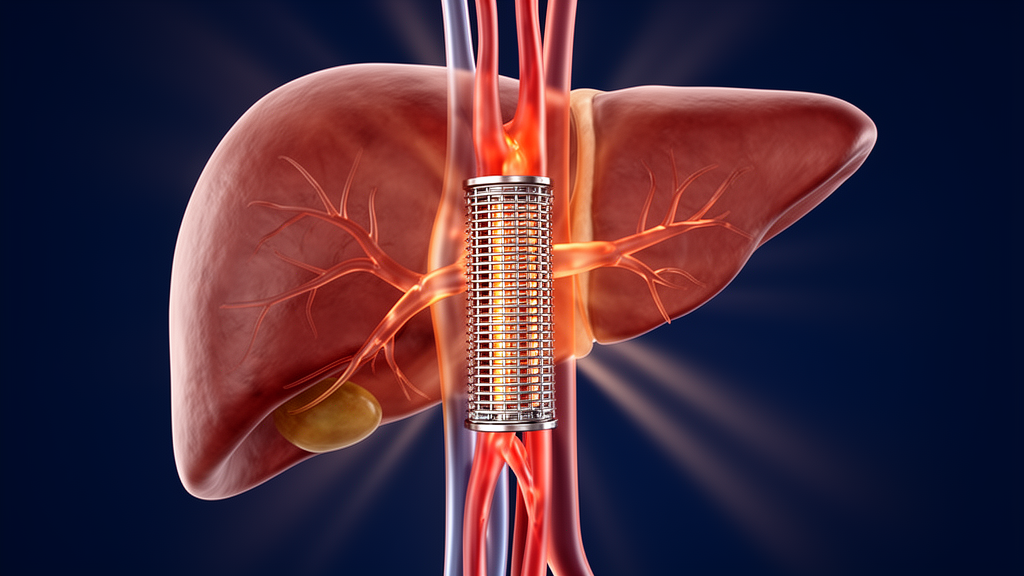
In patients with liver cirrhosis presenting with acute variceal bleeding, pre-emptive transjugular intrahepatic portosystemic shunt placement within seventy-two hours of admission substantially reduces all-cause mortality and rebleeding compared to standard medical and endoscopic therapy, according to an updated systematic review and meta-analysis of randomized controlled trials. Across six randomized controlled trials encompassing 424 adult participants, the intervention produced a forty-six percent relative risk reduction in all-cause mortality and a seventy-one percent relative risk reduction in rebleeding. The statistical synthesis demonstrated absolute risk reductions of 14.9 percent for all-cause death and 28.4 percent for recurrent hemorrhage, yielding corresponding numbers needed to treat of approximately seven and four. These findings, derived strictly from randomized controlled trials, provide robust evidence that early portal decompression confers significant survival advantages and stabilizes portal hemodynamics in selected high-risk cirrhotic patients experiencing acute variceal hemorrhage.
Acute variceal bleeding represents one of the most critical and life-threatening complications of portal hypertension in individuals diagnosed with cirrhosis, carrying reported mortality rates between fifteen and twenty percent despite contemporary improvements in standard medical management. Standard clinical management protocols typically involve a tripartite approach combining vasoactive pharmacotherapy, prophylactic antibiotic administration, and endoscopic band ligation. Nevertheless, outcomes vary considerably among patient subgroups, with mortality rising sharply to twenty-one percent in cirrhotic patients with concurrent myocardial injury compared to 11.6 percent in broader cohorts with esophagogastric bleeding. Mortality disproportionately affects individuals suffering from advanced liver dysfunction and moderate-to-severe esophageal varices, where conventional endoscopic and pharmacological regimens frequently fail to secure durable hemostasis. International guidelines recommend rapid risk assessment and timely treatment escalation based on liver function and the severity of portal hypertension to curb severe bleeding complications. Historically, transjugular intrahepatic portosystemic shunt procedures were reserved primarily as salvage rescue interventions for refractory hemorrhage unresponsive to first-line pharmacotherapy and endoscopy, but evolving clinical evidence has prompted a fundamental reconsideration of its early application before recurrent bleeding occurs.
The procedural mechanism of a transjugular intrahepatic portosystemic shunt relies on establishing an intrahepatic, low-resistance vascular channel that mechanically decompresses the portal venous circulation, achieving rapid, profound, and sustained reductions in portal pressure. Pre-emptive shunt placement, specifically designated as insertion within seventy-two hours of the index bleeding episode, seeks to avert early therapeutic failure in high-risk patients, such as those with Child-Pugh class C cirrhosis scoring up to thirteen points or Child-Pugh class B cirrhosis presenting with active bleeding at endoscopy. While earlier randomized controlled trials and observational studies reported survival benefits and reduced rebleeding, prior systematic reviews frequently combined randomized controlled trials with observational registries, leaving their clinical conclusions vulnerable to substantial selection bias and unmeasured confounding. Furthermore, earlier reviews frequently grouped heterogeneous shunt strategies together, amalgamating pre-emptive, elective, and salvage procedures, which diluted the relevance of the pooled estimates for acute bleeding episodes. Crucially, older meta-analyses predated the GAVAPROSEC trial, missing modern randomized evidence focused on gastric variceal bleeding with larger sample sizes and high-quality designs.
To overcome the methodological limitations of prior syntheses, investigators conducted a systematic review and study-level meta-analysis strictly adherent to the Cochrane Handbook for Systematic Reviews of Interventions and the Preferred Reporting Items for Systematic Reviews and Meta-Analyses guidelines, with a registered protocol. Comprehensive bibliographic searches were conducted across MEDLINE, Embase, the Cochrane Central Register of Controlled Trials, and ClinicalTrials.gov from database inception through January 2026. The search strategy paired keywords and controlled vocabulary covering acute variceal bleeding, portal hypertension, and pre-emptive shunts, complemented by manual reference screening. Eligible studies were restricted exclusively to randomized controlled trials evaluating adult cirrhotic patients with acute variceal bleeding who were assigned to pre-emptive shunt placement within seventy-two hours versus standard medical and endoscopic therapy. Studies involving nonrandomized designs, pediatric or animal cohorts, elective or salvage shunts, or overlapping trial cohorts were systematically excluded. Literature screening, multi-domain Cochrane Risk of Bias 2 evaluations, and standardized data extractions were independently performed by multiple reviewers, with disagreements resolved through consensus or consultation with senior investigators.
From an initial retrieval of 4218 bibliographic citations, duplicate removal left 3741 unique records, of which 3633 were excluded during title and abstract screening. Full-text evaluation of 108 candidate publications identified six eligible randomized controlled trials published between 2004 and 2025. These trials, conducted by Monescillo in 2004, Garcia-Pagan in 2010, Lv in 2019, Dunne in 2020, Escorsell in 2023, and Cervoni in 2025, encompassed 424 total patients, with 229 allocated to pre-emptive shunt placement and 195 assigned to control therapy. Baseline severity of underlying liver disease spanned mild to moderate hepatic impairment across trials, with mean Model for End-Stage Liver Disease scores typically clustering between 14 and 17, and mean Child-Pugh scores ranging from 7.3 to 9.8. Patient cohorts were predominantly male, ranging from 63 to 91 percent across trial arms, with mean ages spanning 48 to 64 years. Follow-up monitoring extended from one to two years across the included investigations. Methodological assessment revealed that four trials maintained low risk of bias across all evaluable domains, while one trial raised concerns regarding randomization and one earlier trial demonstrated higher risk regarding intervention deviations and selective outcome reporting.
Statistical pooling utilizing random-effects models in Review Manager demonstrated clear superiority of early shunt decompression for both designated primary endpoints. All-cause mortality across the six trials was significantly reduced among recipients of pre-emptive shunts compared with patients receiving standard medical care, yielding a pooled risk ratio of 0.54 with a ninety-five percent confidence interval of 0.39 to 0.76. Subgroup analyses demonstrated that the survival benefit remained consistent irrespective of variceal anatomical bleeding subtype or location, showing an interaction p-value of 0.52, and across varying degrees of baseline hepatic decompensation, with an interaction p-value of 0.93. Rebleeding risk, evaluated across six trials totaling 423 patients, was markedly suppressed by pre-emptive shunt placement, generating a pooled risk ratio of 0.29 with a ninety-five percent confidence interval of 0.16 to 0.55. Similar to survival, this protective effect against recurrent bleeding remained stable across variceal bleeding types, with an interaction p-value of 0.19, and across degrees of liver disease severity, with an interaction p-value of 0.62. Funnel plot assessments for publication bias could not be formally undertaken because the ten-study threshold per outcome was not reached.
In addition to primary survival and rebleeding benefits, pre-emptive portal decompression conferred substantial protection across multiple critical secondary endpoints linked to decompensated cirrhosis. The synthesis revealed that pre-emptive shunts significantly reduced the incidence of new or worsening ascites, generating a risk ratio of 0.51 with a ninety-five percent confidence interval of 0.35 to 0.74. Hepatorenal syndrome was likewise decreased markedly, yielding a risk ratio of 0.37 with a ninety-five percent confidence interval of 0.15 to 0.92. Spontaneous bacterial peritonitis experienced a seventy-five percent relative risk reduction, producing a risk ratio of 0.25 with a ninety-five percent confidence interval of 0.08 to 0.81. Liver-related mortality fell significantly among shunt recipients, with a risk ratio of 0.56 with a ninety-five percent confidence interval of 0.34 to 0.94, while overall serious adverse events dropped significantly, showing a risk ratio of 0.72 with a ninety-five percent confidence interval of 0.59 to 0.88. Crucially, the incidence of post-procedural hepatic encephalopathy did not differ significantly between intervention and control arms, demonstrating a pooled risk ratio of 1.01 with a ninety-five percent confidence interval of 0.72 to 1.43.
These meta-analytic findings reinforce and contextualize observations from prior systematic reviews while providing greater methodological rigor. An individual patient data meta-analysis by Nicoara-Farcau and colleagues in 2024 similarly reported increased survival, superior bleeding and ascites control, and no elevated encephalopathy risk with pre-emptive shunts in high-risk patients. However, earlier reviews had not reached complete consensus; a 2020 Cochrane systematic review by Simonetti and colleagues judged evidence certainty for survival and rebleeding to be very low, while a 2022 analysis by Hussain and coworkers found that pooled trial data did not reach statistical significance for mortality. Furthermore, the 2024 American Association for the Study of Liver Diseases Practice Guidance cited an individual randomized trial that showed lower rebleeding but no significant survival benefit, underscoring ongoing clinical debate.
A critical contribution of the present meta-analysis is its inclusion of contemporary randomized trial data, most prominently the GAVAPROSEC trial, which incorporated patients presenting with fundal and non-gastroesophageal varices type 1 bleeding. Prior clinical guidance, including statements from Baveno VII, had classified pre-emptive shunts in gastric variceal hemorrhage as a designated research priority due to the paucity of randomized evidence in isolated gastric varices. By incorporating randomized cohorts encompassing isolated gastric varices and gastroesophageal varices type 2, this analysis quantifies a robust reduction in rebleeding within this specific subpopulation, providing rigorous evidence that broadens the applicability of pre-emptive intervention beyond classic esophageal bleeding sites. Furthermore, restricting synthesis strictly to randomized controlled trials originating from geographically diverse centers across Europe and Asia bolsters both internal validity and generalizability. By capturing broader systemic sequelae including hepatorenal syndrome and bacterial peritonitis alongside conventional bleeding metrics, the investigation documents the extensive systemic consequences of sustained portal decompression across clinically meaningful endpoints.
The authors outline several methodological limitations that temper the interpretation of their findings. The aggregate sample size of 424 participants across six randomized controlled trials remains relatively modest, which constrains statistical power for rare adverse outcomes and limits the granularity of subgroup analyses. Moderate observed heterogeneity likely stems from procedural variations, differences in shunt timing within the seventy-two-hour window, and varying patient inclusion thresholds between trials. Furthermore, the included trials predominantly enrolled individuals with alcohol-related liver disease, which provides methodological homogeneity for that etiology but limits direct extrapolation to nonalcoholic etiologies. Because trials did not consistently report outcomes stratified by underlying cirrhosis causes, etiology-specific pooled synthesis was precluded, leaving open questions regarding differential responses in viral or metabolic etiologies. Additionally, the meta-analysis excluded health-economic endpoints, preventing cost-effectiveness determinations relative to recurrent endoscopic interventions, and most trial observations concluded within one to two years, leaving long-term outcomes less fully defined.
Subject of Research: Pre-emptive transjugular intrahepatic portosystemic shunt for acute variceal bleeding in cirrhosis
Article Title: Pre‐Emptive TIPS for Acute Variceal Bleeding: A Systematic Review and Meta‐Analysis of Randomized Controlled Trials
Article References: Ismail, W. M. I. B. W., Chalamalasetti, S., Iqbal, F., Garg, K., Purohit, A., Kannan, H. J., Botsa, K., Al Khatib, B., Sulaiman, Y., Abdalrazak, A., Safiullah, M., Alsubari, A. M. A., Bhat, A., Zar, M. A., & Jalal, P. K. (2026). Pre‐Emptive TIPS for Acute Variceal Bleeding: A Systematic Review and Meta‐Analysis of Randomized Controlled Trials. International Journal of Hepatology, 2026(1), Article 3244544. https://doi.org/10.1155/ijh/3244544
Image Credits: AI Generated
DOI: 10.1155/ijh/3244544
Keywords: pre-emptive TIPS, transjugular intrahepatic portosystemic shunt, acute variceal bleeding, cirrhosis, portal hypertension, all-cause mortality, rebleeding risk, hepatic encephalopathy, ascites, hepatorenal syndrome, spontaneous bacterial peritonitis, randomized controlled trials, systematic review, Child-Pugh score, MELD score, gastric varices, esophageal varices
News Source: Ophelia Keating. (November 24, 2026). Pre-Emptive TIPS Cuts Mortality and Rebleeding in Acute Variceal Bleeding. Scienmag.