Researchers have developed and validated an animal-free in vitro bioassay utilizing an adapted human megakaryoblastic leukemia cell line to evaluate the biological potency of recombinant human erythropoietin. Standardized under International Council for Harmonisation guidelines, the new cell-based protocol provides a reliable alternative designed to advance progressive 3Rs animal reduction strategies.
Natural erythropoietin is an acidic glycoprotein with a molecular mass of approximately 30 to 34 kilodaltons, synthesized primarily in renal peritubular cells and minorly in hepatocytes. Recombinant therapeutic products produced in Chinese hamster ovary or baby hamster kidney expression systems display complex N-linked carbohydrate structures and terminal sialic acid residues that critically govern circulatory clearance, creating structural heterogeneity across commercial preparations.
To construct an effective in vitro testing system, investigators conditioned the cytokine-dependent human megakaryoblastic leukemia cell line UT-7 to thrive exclusively on erythropoietin. Originally cultured in alpha-MEM containing heat-inactivated fetal bovine serum and five nanograms per milliliter of granulocyte-macrophage colony-stimulating factor, the parental stock was divided into two distinct lineages. One subline was maintained in parallel culture as a control under supplier-specified conditions, while the test subline was adapted in Iscove’s modified Dulbecco’s medium supplemented with ten percent fetal bovine serum, glutamine, antibiotics, and ten nanograms per milliliter of reference erythropoietin. Both lineages were sub-cultured two to three times weekly at cell densities between 40,000 and 1,000,000 cells per milliliter across six months. Cell viability remained consistently above 85 percent as determined by the Trypan Blue exclusion technique, with continuous negative screening for mycoplasma contamination. Flow cytometric verification of CD13 and CD15 surface markers confirmed that the hematopoietic phenotype remained stable throughout the long-term culture period.
The molecular basis for enhanced sensitivity was confirmed through Western blot analysis and flow cytometry assessing receptor abundance. Lysates prepared from conditioned cells at two, three, and six months revealed a progressive upregulation of erythropoietin receptor protein, appearing as a characteristic doublet band when probed with specific monoclonal antibodies. Normalization against actin loading controls and densitometric quantification showed that receptor levels increased steadily before reaching a stable pattern at six months, whereas parallel control cells maintained on GM-CSF exhibited only trace signals. Surface receptor presentation was subsequently evaluated using flow cytometry after six months of culture. Intact cells from the adapted subline exhibited a markedly higher percentage of surface receptor-positive cells alongside elevated mean fluorescence intensity compared to the control population. This substantial expansion of plasma membrane receptors provided the biological mechanism required for heightened sensitivity to erythropoietin, establishing an optimal cellular foundation for high-precision analytical potency testing.
Comparative bioassays conducted across the conditioning timeframe verified that receptor upregulation directly amplified cellular proliferation. Proliferative responses to serial dilutions of standard erythropoietin revealed modest distinctions between the two lineages after two months of conditioning, showing an increase in proliferation ratio of 207.57 percent versus 194.34 percent, representing a relative difference of 13.22 percent. Functional divergence became pronounced by the third month, displaying a 54.05 percent relative advantage. After six months, the conditioned subline demonstrated a 387.21 percent proliferation increase compared to 122.42 percent in the control line, yielding a striking 264.78 percent relative response difference. Extended adaptation experiments beyond six months produced comparable proliferation rates, confirming that the adaptive response had reached a definitive plateau. Working cell banks were subsequently generated and cryopreserved in liquid nitrogen, establishing reliable, highly stable stocks with consistent phenotypic characteristics and reproducible biological performance for comprehensive ICH-compliant validation exercises and routine pharmaceutical batch testing.
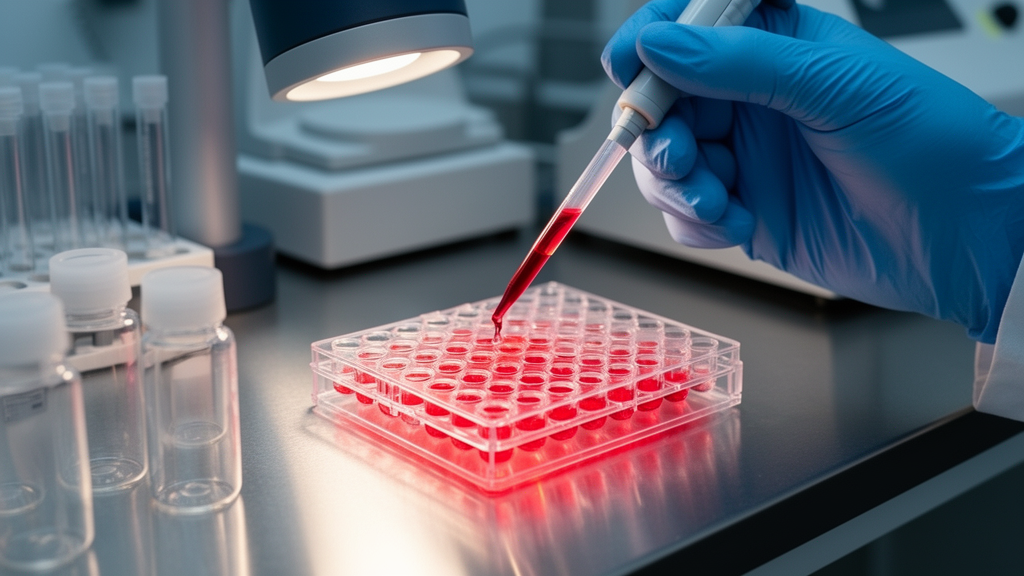
The validated quantitative bioassay is performed in 96-well microplates utilizing fluorometric viability quantification. Adapted cells are seeded at a density of 11,000 cells per well in RPMI 1640 basal medium containing one percent heat-inactivated fetal bovine serum. Samples and reference preparations are evaluated across a nine-point, two-fold serial dilution series ranging from 0.975 to 0.0038 international units per milliliter, with each dilution plated in duplicate alongside dedicated blank and untreated control wells. Plates are incubated for 48 hours at 37 degrees Celsius with five percent carbon dioxide before receiving CellTiter-Blue reagent for overnight incubation spanning 13 hours. Fluorescence emission is quantified on a microplate reader at 530 nanometers excitation and 590 nanometers emission wavelengths. Statistical processing in CombiStats software employs a four-parameter logistic regression model evaluated by analysis of variance Chi-square testing, enforcing compendial validity criteria requiring significant regression (p ≤ 0.01) and absence of non-linearity or non-parallelism (p > 0.01).
Analytical specificity was challenged against a diverse panel of cytokines and structural controls to verify that cellular proliferation was strictly receptor-mediated. Exposure to unrelated growth factors—including interleukin-2, interleukin-5, and vascular endothelial growth factor—produced flat, unresponsive curves lacking any dose-dependent trajectory. While granulocyte-macrophage colony-stimulating factor induced strong proliferation, its response curve was quantitatively and qualitatively distinct from the erythropoietin profile. Structural discrimination was assessed using an in-house thermal-stressed erythropoietin preparation heated to 90 degrees Celsius for one hour; this degraded sample exhibited a severely attenuated response corresponding to approximately ten percent potency. Furthermore, comparative evaluations between European chemical reference substance and biological reference preparation standards demonstrated equivalent, superimposable potency profiles once concentrations were aligned. These comprehensive validation findings confirmed that the bioassay selectively detects biologically active, intact erythropoietin molecules without interference from non-target inflammatory cytokines or thermally denatured protein aggregates, fully satisfying strict regulatory specificity criteria.
Accuracy assessed using biological reference preparation working standards at the 100 percent nominal target concentration of 2000 international units per milliliter achieved an overall mean recovery of 97.10 percent, with individual daily sessions ranging from 87.58 to 104.28 percent and a 95 percent confidence interval of 93.32 to 100.86 percent. A one-sample Student’s t-test demonstrated no statistically significant difference from the theoretical value (p = 0.169), comfortably satisfying the predefined 80 to 120 percent recovery criterion. Linearity and dynamic range investigated across five nominal levels spanning 50 to 150 percent of target concentration demonstrated a highly significant regression across 21 observations (p = 2E-16). The resulting regression line, described by the equation y = -10.86 + 1.09x, achieved a coefficient of determination of 0.98, with every observation falling within the 95 percent prediction interval.
Precision profiling demonstrated acceptable variability across diverse sample types, while identifying opportunities to optimize routine testing formats. Potency distributions satisfied normality assumptions across all assays, as confirmed by Shapiro-Wilk testing (p > 0.05). Variance component analysis revealed that intra-session repeatability represented the principal source of overall variability. Commercial erythropoietin preparations produced in human embryonic kidney cells and erythropoietin zeta fulfilled acceptance thresholds, exhibiting intermediate precision relative standard deviations of 14.0 percent and 12.1 percent, respectively. To enhance analytical precision, investigators evaluated multi-plate configurations, determining that averaging three plates per session reduced intermediate precision from 14.0 percent to 8.1 percent for human embryonic kidney preparations and from 10.6 percent to 6.2 percent for biological reference standards, whereas adding a fourth plate provided negligible benefit. Robustness testing challenging cell passages 13, 17, and 18, hormone incubation duration (44 hours), and substrate incubation intervals (6, 7, and 8 hours) confirmed overall resilience, although a 6-hour substrate incubation yielded one sub-threshold recovery of 76.92 percent, establishing crucial operational boundaries.
This validated UT-7 proliferation bioassay provides a practical, animal-free methodology advancing the progressive reduction of animal testing in biopharmaceutical release testing. Because cell proliferation directly captures receptor engagement—the indispensable physiological trigger for in vivo biological action—the bioassay provides meaningful functional insight into product quality. However, because in vitro proliferation does not replicate hepatic clearance or pharmacokinetic half-life determined by terminal sialylation, the authors emphasize that this method is intended as a complementary analytical tool rather than an outright replacement for compendial rodent models during initial drug approval. Full regulatory transition will require comprehensive collaborative validation studies between official medicines control laboratories and commercial manufacturers across diverse recombinant preparations.
Subject of Research: In vitro potency bioassay development for recombinant human erythropoietin
Article Title: Development and validation of a UT-7-based in vitro bioassay for potency evaluation of recombinant human erythropoietin
Article References: Gonnella, F., Carocci, A., Gaggioli, A., D’angiò, A., Ghizzani, V., Pasquini, L., Marino, F., Ascione, A., & Luciani, F. (2026). Development and validation of a UT-7-based in vitro bioassay for potency evaluation of recombinant human erythropoietin. Talanta Open, 14, Article 100684. https://doi.org/10.1016/j.talo.2026.100684
Image Credits: AI Generated
DOI: 10.1016/j.talo.2026.100684
Keywords: recombinant human erythropoietin, rHuEPO potency, UT-7 cell line, in vitro bioassay, erythropoietin receptor, cell proliferation assay, 3Rs principles, European Pharmacopoeia, ICH Q2(R2) validation, CellTiter-Blue, four-parameter logistic model, intermediate precision, bioassay repeatability, erythropoiesis, hypoxia-inducible factor, protein glycosylation, erythropoietin zeta, medicines quality control
News Source: Bethany Barker. (November 24, 2026). Validated Cell-Based Assay Measures Erythropoietin Potency Without Requiring Animal Testing. Scienmag.