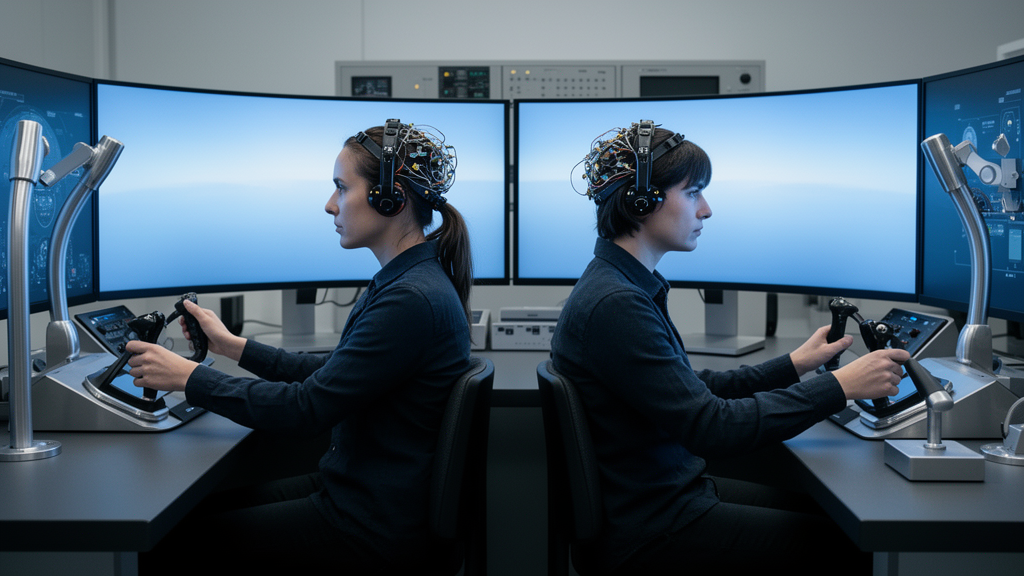
A dual-loop neuro-adaptive simulation designed for human–AI teaming reduced mean response latencies by 55.6 percent compared with standard visual alerts during controlled flight simulator evaluations. Investigating how the timing and modality of automated assistance constrain human performance in high-pressure settings, researchers coupled pilot-facing haptic guidance with an engineer-facing communication semaphore. The architecture integrates synchronized neuro-telemetry with multi-agent proximal policy optimization to dynamically regulate support, establishing simulator-level mechanism plausibility without asserting operational field effectiveness.
To evaluate the neural interface independently, the authors assessed electroencephalogram decoding across twenty-five leave-one-pilot-out cross-validation folds. The testing pipeline incorporated 2,880 held-out windows per fold, totaling 72,000 held-out windows overall. Rather than treating individual processing windows as independent statistical units, inference was aggregated across pilots. The decoder achieved a mean held-out accuracy of 89.29 percent, bounded by a 95 percent confidence interval of 88.26 to 90.32 percent, alongside a macro-F1 score of 0.879 with a 95 percent confidence interval from 0.869 to 0.889.
Controller attribution was established through matched pair-level evaluations across twenty-five experimental dyads. The experimental protocol systematically compared five operational conditions: baseline visual alerts, fixed haptic guidance, rule-based haptics triggered directly by electroencephalogram thresholds, telemetry-only multi-agent reinforcement learning without neural inputs, and the complete neuro-informed reinforcement learning framework. This structured hierarchy isolated the distinct performance contributions generated by physical haptic feedback versus adaptive machine learning policies.
The benchmarked reaction times demonstrated progressive, step-by-step reductions across each successive controller configuration. Mean latency dropped from 485.3 milliseconds under visual alerts to 321.2 milliseconds with fixed haptics, and further declined to 277.5 milliseconds when applying rule-based electroencephalogram triggers. Stripping neural data from the policy optimizer yielded an intermediate latency of 262.1 milliseconds, whereas the fully integrated neuro-adaptive policy produced the fastest mean response time of 215.8 milliseconds.
A paired bootstrap analysis of the contrast between the full neuro-adaptive system and baseline visual alerts yielded a 95 percent confidence interval spanning a 54.3 to 57.0 percent reaction-time reduction. These matched comparisons confirmed that the observed speed advantages stemmed from closed-loop policy coordination rather than the tactile modality alone. Assistance timing across conditions was tracked through condition-independent Communication-Timing Violations and semaphore-specific Semaphore Non-Compliance metrics.
The authors reported important evidentiary boundaries and analytical constraints across the simulation data. Confirmatory communication effect sizes were omitted from the findings because summary metrics displayed zero between-dyad variation and granular event-level logging covered only an experimental subset. The resulting evidence demonstrates feasibility strictly within a synthetic simulator and matched hybrid replay environment, maintaining unambiguous distinctions between participant-derived physiological inputs, simulated outputs, hybrid replays, and counterfactual models.
Subject of Research: Dual-loop neuro-adaptive simulation for human-AI teaming
Article Title: Dual-loop neuro-adaptive simulation for human–AI teaming: EEG-based CNN–LSTM decoding and MAPPO-controlled haptic and communication gating
Article References: Juárez, R., Hernández-Fernández, A., de Barros-Camargo, C., & Molero, D. (2026). Dual-loop neuro-adaptive simulation for human–AI teaming: EEG-based CNN–LSTM decoding and MAPPO-controlled haptic and communication gating. Neural Computing and Applications, 38(23), Article 907. https://doi.org/10.1007/s00521-026-12563-5
Image Credits: AI Generated
DOI: 10.1007/s00521-026-12563-5
Keywords: neuro-adaptive simulation, human-AI teaming, electroencephalography, multi-agent proximal policy optimization, haptic guidance, communication semaphore, reaction time, leave-one-pilot-out validation, convolutional neural networks, long short-term memory, hybrid replay, communication-timing violations, semaphore non-compliance, telemetry decoding, simulator feasibility, paired bootstrap confidence intervals
News Source: Denise Maddox. (November 24, 2026). Dual-Loop Neuro-Adaptive Simulator Cuts Dyad Reaction Times in Controlled Testing. Scienmag.