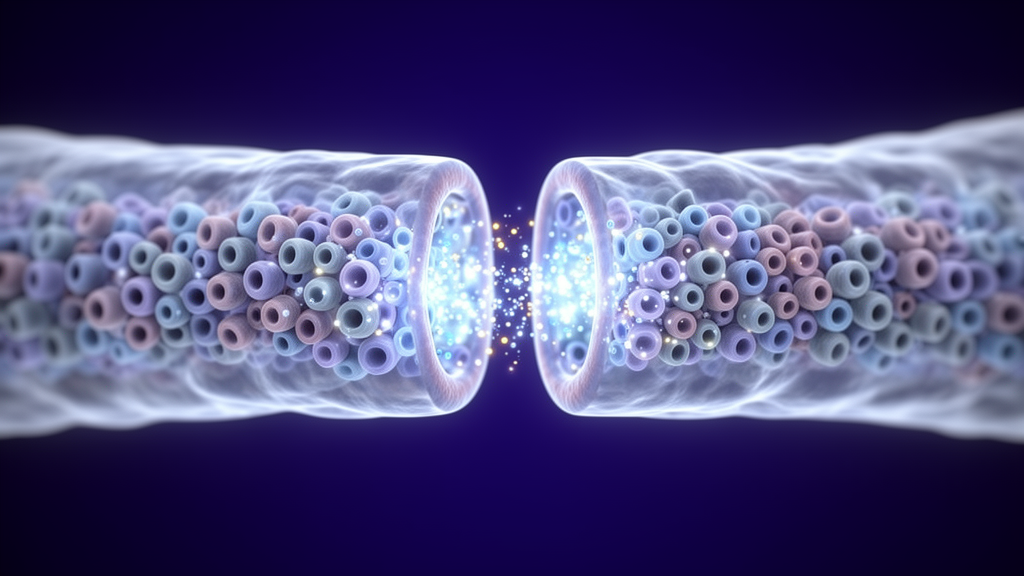
Electrical synapses mediated by gap junctions allow direct communication between neurons, yet the biophysical rules governing their response to rhythmic inputs have historically been deduced from simplified linear approximations. In a theoretical study published in Biological Cybernetics, researchers Andrea Bel, Ulises Chialva, and Horacio G. Rotstein investigated how intrinsic cellular properties shape electrical transmission across paired nodes. Using biophysically grounded conductance-based mathematical models, numerical simulations, and dynamical systems tools, the authors demonstrated that when neurons operate beyond passive linear limits, electrical coupling depends dynamically on both the directly stimulated cell and the receiving cell. This finding contrasts sharply with classical linear circuit models, which predict that the frequency-dependent transmission of oscillatory signals is dictated exclusively by the receiving node and the junctional conductance, regardless of the upstream cell attributes or the amplitude of incoming signals.
In neurobiology, the functional strength of electrical connectivity between two adjacent cells is traditionally quantified using the steady-state coupling coefficient. In standard electrophysiological protocols, this metric is evaluated by injecting a constant direct-current step into a directly stimulated pre-junctional cell and recording the resulting voltage deflection in the indirectly activated post-junctional cell. The coupling coefficient is calculated as the ratio of the steady-state voltage change in the receiving cell relative to the stimulated cell. In idealized linear systems and passive membranes, this ratio remains strictly bounded between zero and one, increasing monotonically with gap junction conductance while decreasing as post-junctional leak and ionic conductances grow. Under these steady-state linear conditions, the properties of the stimulated cell exert no influence on the coupling ratio, establishing an asymmetric transmission efficiency where electrical transfer proceeds more effectively from high-conductance to low-conductance cellular compartments than in the reverse direction.
Because biological neural circuits are continuously subjected to rhythmic, time-varying synaptic inputs spanning wide frequency bands, static coupling metrics fail to capture the full spectrum of signal processing. To address dynamic regimes, the researchers extended the coupling coefficient to time-dependent periodic signals by formalizing two frequency-dependent metrics: the amplitude coupling coefficient profile and the phase-difference coefficient profile. The amplitude coupling profile represents the quotient of the steady-state voltage response amplitude of the post-junctional node over that of the pre-junctional node as a function of input frequency. The phase-difference profile tracks the phase shift between the periodic voltage responses of the two connected units. By decomposing transmission into amplitude scaling and phase lag across frequencies, this analytical framework permits detailed investigation into how electrical synapses selectively filter, amplify, or synchronize rhythmic activity across interacting neural elements.
When evaluated in classic passive cells lacking active voltage-gated ionic channels, the mathematical formulation confirms that the amplitude coupling profile behaves strictly as a low-pass filter. For such passive nodes, signal transfer decreases monotonically as the oscillation frequency rises, while the phase-difference profile increases monotonically, indicating a progressively larger temporal lag between the two cells. In these linear configurations, increasing gap junction conductance amplifies the coupling ratio and flattens the amplitude curve, whereas increasing post-junctional membrane conductance attenuates transmission and steepens filtering. Crucially, across all purely linear configurations, whether involving one-dimensional passive cells or two-dimensional linear resonators, both the amplitude quotient and phase difference depend entirely on the biophysical parameters of the post-junctional node and the intervening junctional conductance. The intrinsic biophysical properties of the pre-junctional cell and the input amplitude remain mathematically decoupled from the transmission metrics.
To investigate how active membrane conductances reshape these filtering profiles, the authors analyzed two-dimensional linearized models incorporating physiological resonant and amplifying currents. Active biological membranes frequently exhibit intrinsic resonance, characterized by band-pass filtering where voltage responses peak at a non-zero resonant frequency, as well as phasonance, where the phase shift crosses zero at a non-zero phasonant frequency to produce leading-lagging phase transitions. Cellular resonance requires the coordinated interplay of fast positive feedback currents that amplify voltage deflections and slower negative feedback currents that oppose voltage shifts. In the linear resonator network, the amplitude coupling profile transitioned from a low-pass filter to a band-pass filter exhibiting distinct coupling resonance, while the phase-difference profile produced coupling phasonance. Systematic parameter sweeps revealed that increasing the post-junctional resonant conductance attenuated coupling amplitude and shifted the resonant peak toward higher frequencies, whereas lengthening the resonant gating time constant shifted preferred frequencies downward and sharpened coupling peaks.
Because linearized models inherently obscure the contribution of the stimulated cell, the authors expanded their analysis to nonlinear biophysical models using quadratization methods. Through Taylor series expansions around the extrema of subthreshold voltage nullclines, quadratized models capture parabolic voltage-dependent nonlinearities characteristic of Hodgkin-Huxley systems containing persistent sodium currents and slow restorative currents. In quadratic networks, the amplitude coupling profile and phase-difference profile became sensitive to the input amplitude and the biophysical attributes of both the pre-junctional and post-junctional cells. Numerical simulations of paired quadratic nodes demonstrated that altering the pre-junctional cell parameters produced marked shifts in both coupling curves. These pre-junctional dependencies were most pronounced at lower frequencies and within the resonant frequency band, where large voltage excursions allowed dynamic trajectories to explore regions of steep parabolic nonlinearity rather than remaining confined to quasi-linear neighborhoods around fixed points.
The study specifically contrasted two distinct biophysical configurations common in mammalian central neurons: a model combining persistent sodium currents with hyperpolarization-activated mixed-cation currents, and an alternate model combining persistent sodium currents with slow potassium M-currents. While both systems feature the interaction between a fast amplifying current and a slow resonant current, their underlying gating kinetics operate through opposite voltage dependencies. The hyperpolarization-activated mixed-cation current activates upon membrane hyperpolarization and exerts a depolarizing influence, creating a concave-down voltage nullcline, whereas the slow potassium current activates upon depolarization and exerts a hyperpolarizing influence, producing a concave-up voltage nullcline. When excitability remained low and dynamics stayed in a quasi-linear regime, both resonant currents attenuated the coupling coefficient profile. However, when elevated baseline currents moved cells into nonlinear regimes near spike thresholds, the two currents diverged markedly: increasing mixed-cation conductance amplified the coupling profile and lowered the resonant frequency, whereas increasing slow potassium conductance attenuated coupling and raised the resonant frequency.
The modeling framework also yielded unexpected collective behaviors in heterogeneous networks where pre-junctional and post-junctional cells possessed differing resonant properties. When two dissimilar quadratic resonators were coupled electrically, the resulting amplitude coupling profile exhibited antiresonance, characterized by a sharp transmission trough at an intermediate frequency, while the phase-difference profile displayed antiphasonance. Because individual two-dimensional quadratic neurons cannot produce antiresonance or antiphasonance on their own—a dynamical feature requiring at least three-dimensional single-cell phase space—these troughs represent emergent network phenomena. They arise from the frequency-dependent dynamic interference between the distinct filtering properties of the two connected nodes. Furthermore, switching the direction of signal injection between the two heterogeneous nodes dramatically altered whether transmission was dominated by post-junctional tuning or shaped by bidirectional interactions, demonstrating that structural asymmetry interacts directly with cellular nonlinearities to dictate directional filtering.
To explore morphological complexity, the authors extended their two-node architecture to two-compartment models of spatially extended neurons, such as somato-dendritic structures. In compartmental formulations, electrical connectivity becomes inherently asymmetric because junctional conductance is scaled inversely by the relative surface area fraction of each participating compartment. Mathematical derivations showed that for linear compartmental nodes, the coupling coefficient and phase difference are scaled by the post-junctional compartment area fraction, transforming coupling equations through an effective conductance ratio. In nonlinear two-compartment models, geometric asymmetries interacted synergistically with intrinsic resonant conductances. When oscillatory inputs were delivered to a small compartment coupled to a larger compartment, the resulting filtering and phase profiles differed substantially from the reverse configuration. These findings illustrate that spatial geometry directly modulates the operating point of voltage-dependent channels, thereby altering frequency-dependent signal propagation along the somato-dendritic axis.
All numerical simulations in the study were conducted in MATLAB using a fourth-order Runge-Kutta integration scheme with a time step of 0.01 milliseconds, with smaller steps verifying numerical precision. The authors noted several boundary conditions defining their theoretical scope. The analysis was conducted in deterministic regimes in the absence of channel, synaptic, or background membrane noise, and focused primarily on subthreshold oscillatory states rather than full-blown action potential generation. In biological tissue, stochastic channel fluctuations and background synaptic conductances would introduce variability into coupling profiles through transient dynamical pathways. Additionally, the study utilized current-clamp representations; while linear systems exhibit identical impedance profiles under voltage-clamp and current-clamp conditions, nonlinear quadratic systems are known to manifest distinct responses between recording modes. The investigators emphasized that the theoretical predictions, particularly the cooperative amplification driven by persistent sodium and mixed-cation currents, remain readily testable in vitro using dynamic clamp techniques to couple living neurons to simulated conductances.
Ultimately, the work establishes that electrical synapses are not static, unidirectional low-pass filters, but rather dynamic, bidirectional communication channels whose filtering properties are governed by the interplay of cellular nonlinearities, active ionic conductances, and geometric asymmetry. By demonstrating the conditions that produce maximal coupling amplitude at preferred resonant frequencies and zero-phase synchronization at phasonant frequencies, the findings provide a mechanistic foundation for understanding rhythmic signal transmission, dendritic integration, and coincidence detection in electrically coupled circuits. Future research will need to examine how these frequency-dependent coupling rules scale in larger networks containing multiple inputs and complex topologies, as well as clarify how subthreshold electrical resonance translates into spike transmission precision in physiological neuronal assemblies.
Subject of Research: Frequency-dependent electrical coupling and resonance in nonlinear neuronal networks
Article Title: Frequency-dependent coupling in response to oscillatory inputs in minimal networks of electrically coupled nodes: Gap junction networks and spatially extended neurons
Article References: Bel, A., Chialva, U., & Rotstein, H. G. (2026). Frequency-dependent coupling in response to oscillatory inputs in minimal networks of electrically coupled nodes: Gap junction networks and spatially extended neurons. Biological Cybernetics, 120(3-4), Article 22. https://doi.org/10.1007/s00422-026-01047-3
Image Credits: AI Generated
DOI: 10.1007/s00422-026-01047-3
Keywords: electrical synapses, gap junctions, coupling coefficient, neuronal resonance, phasonance, band-pass filter, low-pass filter, persistent sodium current, hyperpolarization-activated current, slow potassium current, conductance-based models, quadratization, compartmental models, oscillatory inputs, phase shift, dynamic clamp, subthreshold oscillations
News Source: Drew Townsend. (November 24, 2026). Neuronal Nonlinearities Make Electrical Coupling Depend on Both Connected Cells. Scienmag.