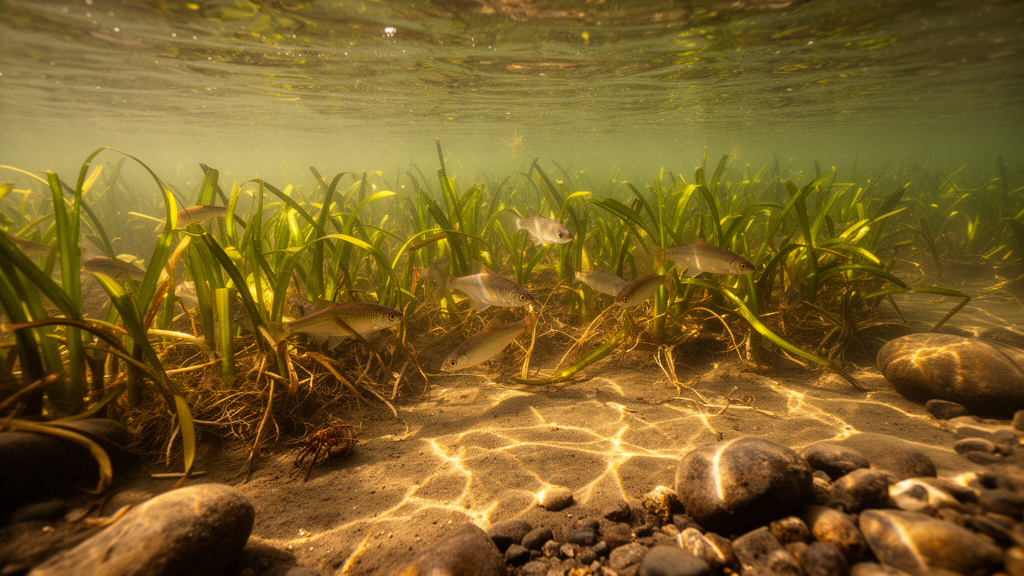
In the lower São Francisco River basin of northeastern Brazil, dense floating and submerged vegetation mats provide a crucial ecological buffer that maintains stable dietary resource availability for resident fish communities across distinct climatic phases, even as the mathematical architecture of their food webs undergoes a fundamental seasonal reorganization. A field investigation published in Aquatic Ecology demonstrates that while the overall variety of prey consumed by small-bodied fishes does not change significantly between wet and dry periods, the structural configuration of predator-prey feeding networks transitions from a highly organized, nested hierarchy during high-water months into an unstructured, diffuse interaction web during dry conditions. Led by researchers Milena Gonçalves-Silva, Daniela Cristina Oliveira Rosa, Marcos Vinícius Teles Gomes, and Marcelo Fulgêncio Guedes Brito, the empirical study clarifies how submerged habitat complexity insulates freshwater consumers from hydrological extremes while exposing underlying functional vulnerabilities driven by human river alterations.
Within the lower reaches of the São Francisco River, extensive stands dominated by water hyacinth, Eichhornia crassipes, and Brazilian waterweed, Egeria densa, establish extensive structural surfaces within the shallow littoral zones. These complex underwater architectures facilitate the retention of particulate organic matter, elevate local dissolved oxygen concentrations, and provide vital physical shelter that shields smaller aquatic organisms from larger riverine predators. Crucially, the extensive surface area presented by these macrophyte patches functions as a living substrate for microbial biofilms and periphytic algae, while fostering dense colonies of aquatic invertebrates such as Chironomidae larvae and Odonata nymphs, creating rich, localized feeding grounds for diverse assemblages of small freshwater fishes.
To evaluate how alternating hydrological cycles dictate the flow of biological energy within these vegetated refuges, the research team conducted systematic field surveys across four distinct sampling stations established along the main river corridor between the municipalities of Propriá in Sergipe and Porto Real do Colégio in Alagoas. This geographical expanse of the lower São Francisco watershed features a semi-arid climatic regime wherein precipitation regimes govern distinct hydrological periods, marked by an expansive wet phase lasting from March through July and an extended dry interval extending from August through February. The investigators deliberately selected the four research stations to capture contrasting degrees of local human impact and riparian landscape preservation; two monitoring locations were situated immediately adjacent to urban settlements with deforested riverbanks and elevated solar radiation, whereas the remaining two sites occupied more rural reaches bounded by grasses, sparse scrub, and remnants of native marginal flora.
Standardized biological surveys spanned an entire annual cycle from April 2015 through March 2016, utilizing consistent bimonthly netting sessions to monitor fish community composition across both hydrological conditions. At each station during every sampling campaign, field collectors completed four sequential hauls along the littoral margin using a ten-meter seine net featuring a fine five-millimeter mesh size deployed at a standard water depth of approximately seventy centimeters. Over the twelve-month sampling timeline, the scientific crew captured a total of 11,666 individual fish representing 33 distinct species, comprising 6,716 specimens captured throughout the wet season and 4,950 individuals obtained during the dry season. The ecological assemblage exhibited an overwhelming structural dominance of miniature taxa, with 86 percent of all examined individuals measuring four centimeters or less in standard length, dominated numerically by small-bodied characins including Compsura heterura, Characidium zebra, Hemigrammus brevis, Hemigrammus marginatus, and Megalamphodus micropterus.
Following field collections, laboratory technicians meticulously evaluated the dietary habits of the gathered fish fauna by performing detailed stomach content dissections on up to five representative adult specimens per species from each sampling site and collection round. Food contents recovered from filled digestive tracts were magnified, systematically cataloged to the lowest feasible taxonomic resolution, and clustered into twelve discrete ecological food categories whose volumetric proportions were precisely measured through standardized volumetric protocols. The dietary categories were further classified according to their primary environmental origin, differentiating autochthonous resources generated directly within the aquatic river channel from allochthonous subsidies derived from terrestrial riparian environments. To ensure statistical reliability and robust network modeling, analytical accumulation and rarefaction curves verified dietary sampling sufficiency, restricting food web computations exclusively to fish species represented by at least five individuals containing fully identifiable stomach items.
Quantitative evaluations of feeding diversity revealed that prey richness remained virtually unchanged across hydrological intervals, contradicting initial hypotheses that the influx of wet-season terrestrial materials would broaden fish diets. Across the examined fish assemblages, mean prey richness reached 2.01 ± 1.17 distinct categories per sample during the wet phase and 1.93 ± 1.01 categories per sample during the dry phase, demonstrating no statistically meaningful divergence under a nonparametric Wilcoxon rank-sum test with a test statistic of W = 47,040 and a significance value of p = 0.584. Permutational multivariate analysis of variance showed that relative volumetric prey composition differed significantly between seasons (F = 9.47, p = 0.001), yet the underlying effect size proved remarkably slight, explaining merely two percent of the total compositional variance (R2 = 0.02), while multivariate dispersion testing confirmed homogeneous internal dietary variation across periods (F = 0.17, p = 0.686).
The continuous stability of dietary composition across both hydrological phases was fundamentally anchored by an uninterrupted reliance on autochthonous aquatic resources sustained within the macrophyte beds, rather than external terrestrial contributions. Filamentous periphytic algae adhering to plant surfaces, fine benthic detritus, microcrustaceans, and immature aquatic insect larvae constituted the primary bulk of ingested biomass in both seasons, with algae ranking as the single most frequently consumed dietary resource. In contrast, allochthonous food items, including wind-blown terrestrial arthropods and fallen terrestrial plant fragments, represented minor, infrequently exploited dietary components across the entire assemblage. The structural buffering of Eichhornia and Egeria beds effectively detached littoral consumers from flood-driven pulses of terrestrial food, providing a consistent internal reservoir of autochthonous primary production that supported algivorous, detritivorous, and invertivorous fishes irrespective of external seasonal rainfall.
To evaluate how these dietary interactions were organized at a broader community level, the authors constructed quantitative, weighted bipartite interaction matrices for each hydrological period, mapping predator species nodes against prey categories based on relative volumetric consumption. The structural properties of the resulting seasonal food webs were assessed using weighted NODF algorithms to quantify nestedness and the Louvain clustering algorithm to compute modularity, which measures the degree of compartmentalization into discrete feeding cliques. Empirical network metrics were rigorously benchmarked against null models using the vaznull algorithm, which generated 999 randomized interaction networks that maintained observed connectivity constraints while randomizing interaction strengths. Structural configurations yielding absolute Z-scores exceeding 1.65 were categorized as displaying statistically significant non-random ecological architecture, distinguishing genuine biological organization from stochastic interaction patterns.
Network analysis demonstrated that the wet-period food web adopted a pronounced, statistically significant nested architecture driven by generalist fish species that established broad ecological connections across diverse trophic tiers. In this nested arrangement, highly adaptable omnivorous predators, led by Psalidodon fasciatus and Astyanax lacustris, maintained the highest number of interactive links by incorporating extensive mixtures of algae, microinvertebrates, and insect fragments into their diets. These dominant generalists were supported during high water by taxa such as Bryconops cf. melanurus and Hemigrammus marginatus, creating an interconnected trophic core. Under this nested regime, more specialized or less abundant consumers, such as Myleus micans, Curimatella lepidura, and juvenile piscivores, primarily exploited subsets of the dietary items consumed by generalists, establishing a resilient network architecture capable of absorbing external perturbations through shared functional pathways.
Conversely, the dry-period food web broke down into an unstructured configuration that exhibited neither statistically significant nestedness nor distinct modular clustering when contrasted against randomized null expectations. Although generalists such as Psalidodon fasciatus, Astyanax lacustris, and Hemigrammus brevis remained common, the physical shrinkage of the aquatic environment during low-water months fundamentally disrupted hierarchical feeding interactions. As river volumes declined, macrophyte stands contracted and concentrated into denser patches, which physically impeded fish movement, restricted open foraging pathways, and altered natural encounter frequencies between predators and microhabitats. Rather than segregating into well-defined, modular dietary niches to minimize competition as conventional theory predicts during resource scarcity, the fish assemblage experienced diffuse, uncoordinated feeding interactions where localized micro-environmental conditions and stochastic feeding encounters governed individual diets.
These structural findings emphasize that while macrophyte beds provide crucial stability against natural seasonal drought, the fish communities of the lower São Francisco River remain functionally vulnerable to escalating anthropogenic pressures that disrupt littoral ecosystems. Upstream hydroelectric impoundments have altered natural discharge regimes, dampened flood pulses, and exacerbated saline intrusion from the Atlantic Ocean, while extensive agricultural clearing has eliminated protective riparian forests and destabilized riverbanks. Compounding these physical disruptions, non-native fish species such as Oreochromis niloticus and Metynnis lippincottianus increasingly compete with native characins, alongside expanding populations of salt-tolerant euryhaline marine species like Awaous tajasica and Caranx species. The authors emphasize that preserving native macrophyte beds and restoring degraded riparian buffers represent indispensable management priorities for sustaining the trophic complexity, ecological connectivity, and long-term functional resilience of Neotropical riverine ecosystems.
Subject of Research: Seasonal trophic network dynamics and dietary patterns of macrophyte-associated fish assemblages in the lower São Francisco River
Article Title: Trophic responses of macrophyte-associated ichthyofauna to seasonality in a Neotropical river
Article References: Gonçalves-Silva, M., Rosa, D. C. O., Gomes, M. V. T., & Brito, M. F. G. (2026). Trophic responses of macrophyte-associated ichthyofauna to seasonality in a Neotropical river. Aquatic Ecology, 60(4), Article 123. https://doi.org/10.1007/s10452-026-10365-4
Image Credits: AI Generated
DOI: 10.1007/s10452-026-10365-4
Keywords: Aquatic Ecology, São Francisco River, ichthyofauna, trophic networks, aquatic macrophytes, Eichhornia crassipes, Egeria densa, nestedness, modularity, autochthonous resources, hydrological seasonality, Psalidodon fasciatus, Astyanax lacustris, Characiformes, predator-prey interactions, dietary composition, bipartite networks, riparian conservation
News Source: Drew Townsend. (November 24, 2026). Macrophyte Beds Anchor River Fish Diets Across Changing Hydrological Seasons. Scienmag.