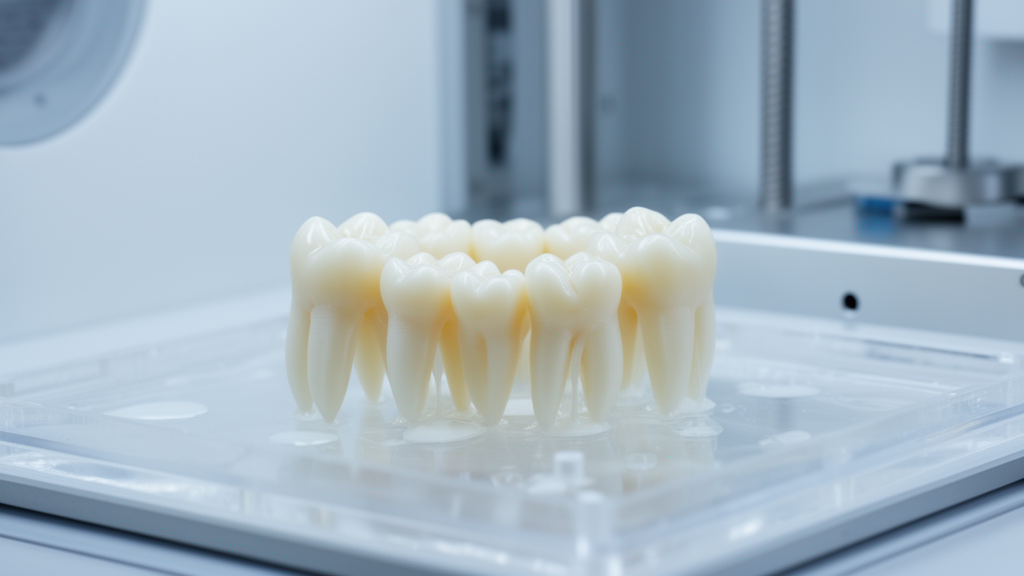
In a new in vitro study published in the Digital Dentistry Journal, researchers found that digital light processing (DLP) additive manufacturing produced complete denture teeth with significantly lower occlusal surface geometric deviations than subtractive milling. The study, conducted by Mehmet Buğra Türkcan, Erdal Eroğlu, and Kadir Kıran, examined how manufacturing method, arch segmentation, and tooth-set size influence the accuracy of CAD/CAM complete denture teeth. By quantifying these variables, the team aimed to provide manufacturing benchmarks that could inform the development of digital denture protocols. The findings suggest that DLP-printed specimens generally reproduced the designed occlusal morphology more closely than milled counterparts, although the specific magnitude of these differences depended on the combination of factors tested.
The research employed a balanced 2 × 2 × 3 factorial design to investigate the interactions between manufacturing method, manufacturing configuration, and tooth size. The manufacturing method factor compared DLP additive manufacturing with milling, while the configuration factor contrasted integrated one-piece arches with three-segment assemblies. Tooth size was categorized into small, medium, and large sets. The primary outcome variable was the three-dimensional geometric deviation of the functional occlusal surface relative to the CAD reference, expressed as the root mean square (RMS) value. This metric allowed the researchers to measure the extent to which the manufactured occlusal surfaces matched the digital design, without evaluating the absolute positional accuracy of the teeth within the dental arch.
To generate the reference designs, the team digitized a maxillary edentulous model using a laboratory scanner and imported the data into exocad software. They created complete denture designs using the Generic Lingualize tooth library, generating small, medium, and large tooth sets. The total volumes of the integrated one-piece and segmented designs were comparable within each tooth size group, ensuring that geometric volume increased progressively from small to large sets. For the segmented specimens, the tooth arch was divided into three components: an anterior segment extending from canine to canine, and right and left posterior segments comprising connected premolar and molar teeth. This configuration allowed for a comparison between a continuous arch and shorter, anatomically defined structures.
The manufacturing process involved distinct workflows for each method. For milling, the STL files were imported into MillBox CAM software and processed to generate toolpaths. The teeth were fabricated by dry milling using a five-axis M20 milling unit and prepolymerized PMMA discs. For DLP manufacturing, the designs were oriented with supports placed exclusively on the apical surfaces to avoid interference with the functional occlusal surfaces. The specimens were manufactured using a photopolymer resin and a DentaFAB Sega DLP printer, followed by washing in ethanol and post-polymerization in a light-curing unit. Each workflow used a material system compatible with its respective manufacturing principle, meaning the comparison reflected the performance of the tested workflow-material combinations rather than the isolated effect of the technology or material.
Scanning and deviation analysis were performed using a single operator and a calibrated laboratory scanner. Integrated one-piece arches were scanned once to generate a single STL file, while segmented specimens were scanned separately for each of the three segments. The reference and test STL files were aligned using a best-fit method to minimize rigid-body translational and rotational differences. The analysis focused on the predefined functional occlusal surfaces, including cusp tips, ridges, fossae, grooves, and marginal ridges, while excluding cervical and basal surfaces. For segmented specimens, the RMS values of the three segments were combined into one arch-level outcome using an equal-weight quadratic mean, ensuring that each anatomical segment contributed equally to the composite result.
The statistical analysis revealed that the overall three-way ANOVA model was highly significant, explaining 98.1% of the variance in RMS values. Significant main effects were observed for manufacturing method, manufacturing configuration, and tooth size. Among the interactions, the manufacturing method by manufacturing configuration and tooth size by manufacturing configuration interactions were statistically significant, as was the three-way interaction. In contrast, the manufacturing method by tooth size interaction was not significant. These results indicated that the effect of one factor on RMS deviation varied depending on the levels of the other two factors, necessitating an interpretation based on simple-effects comparisons rather than main effects alone.
In the Bonferroni-adjusted simple-effects comparisons, DLP specimens exhibited significantly lower RMS values than milled specimens within the same manufacturing configuration and tooth size. Similarly, segmented manufacturing resulted in significantly lower RMS values than integrated one-piece fabrication within each manufacturing method and tooth size combination. The lowest mean RMS value was observed in the small, segmented DLP group, measuring 0.0443 mm, while the highest was found in the large, integrated one-piece milling group, at 0.1371 mm. These differences highlight the potential for DLP printing to achieve higher geometric fidelity in complex occlusal surfaces, particularly when combined with segmented configurations and smaller tooth sets.
The study also found that RMS values increased progressively from small to large tooth sets within each manufacturing method and configuration combination. This pattern suggests that the geometric extent of the fabricated structure may influence the accumulation of dimensional changes during manufacturing. The authors noted that increasing the size of the structure could alter polymerization-related changes, support behavior, or toolpath length in milling. The significant three-way interaction further supported the idea that digital manufacturing should be evaluated as a system, where tooth-set size and segmentation jointly influence occlusal surface accuracy.
Several limitations were acknowledged in the discussion. The study evaluated only one DLP workflow, one milling workflow, one scanner, and one CAD tooth library, which limits the generalizability of the findings. The comparison of manufacturing methods was confounded by the use of different material systems, a photopolymer resin for DLP and prepolymerized PMMA for milling. Additionally, each arch or segment was scanned once, and scanning repeatability was not quantified, meaning that scanning error could not be separated from manufacturing error. The study also did not assess functional loading, denture movement, or patient outcomes, focusing instead on the geometric accuracy of the occlusal surfaces.
The authors emphasized that statistical significance should be distinguished from clinical importance. The differences in mean RMS between one-piece and segmented specimens ranged from 0.0131 to 0.0368 mm, which are differences between surface-deviation summaries rather than measurements of interocclusal gaps or displacement after assembly. A clinically meaningful threshold for this RMS endpoint was not established, and the small differences may have negligible impact in vivo. The independent alignment of segments removes rigid-body translation and rotation, meaning that the lower segmented RMS values reflect the manufacturing configuration and assessment strategy rather than superior absolute arch accuracy after bonding.
Future research should investigate different photopolymer and PMMA systems within their respective manufacturing technologies and examine the effects of printing, post-polymerization, and milling parameters. To determine the net value of segmentation, one-piece and segmented assemblies should be evaluated after standardized bonding using a common coordinate system that preserves intersegment translation and rotation. Clinical investigations incorporating functional loading and patient-centered outcomes are needed before a routine indication for three-segment fabrication can be established. The current findings provide a quantitative basis for comparing manufacturing workflows and investigating strategies that preserve planned occlusal morphology, but further validation is required to relate these surface differences to denture function.
Despite these limitations, the study offers valuable insights into the factors affecting the accuracy of digital complete denture teeth. By demonstrating that DLP printing and segmented configurations can yield lower occlusal deviations, the research provides a foundation for optimizing CAD/CAM workflows. The detailed factorial design and rigorous statistical analysis allow for a nuanced understanding of how manufacturing variables interact to influence geometric accuracy. As digital dentistry continues to evolve, such studies will be essential in guiding the development of protocols that balance manufacturing efficiency with clinical precision.
Subject of Research: Comparison of occlusal surface accuracy in milled and DLP-printed complete denture teeth
Article Title: Occlusal surface accuracy of milled and DLP-printed complete denture teeth: Effects of arch segmentation and tooth-set size
Article References: Türkcan, M. B., Eroğlu, E., & Kıran, K. (2026). Occlusal surface accuracy of milled and DLP-printed complete denture teeth: Effects of arch segmentation and tooth-set size. Digital Dentistry Journal, 4(1), Article 100137. https://doi.org/10.1016/j.ddj.2026.100137
Image Credits: AI Generated
DOI: 10.1016/j.ddj.2026.100137
Keywords: Digital Dentistry, CAD/CAM, DLP Printing, Subtractive Manufacturing, Complete Dentures, Occlusal Surface, Geometric Accuracy, Arch Segmentation, Tooth-Set Size, Root Mean Square Deviation, Photopolymer Resin, Prepolymerized PMMA, In Vitro Study, Factorial Design, Dental Prosthetics
News Source: Ophelia Keating. (November 24, 2026). DLP Printing Yields More Accurate Denture Teeth Than Milling. Scienmag.