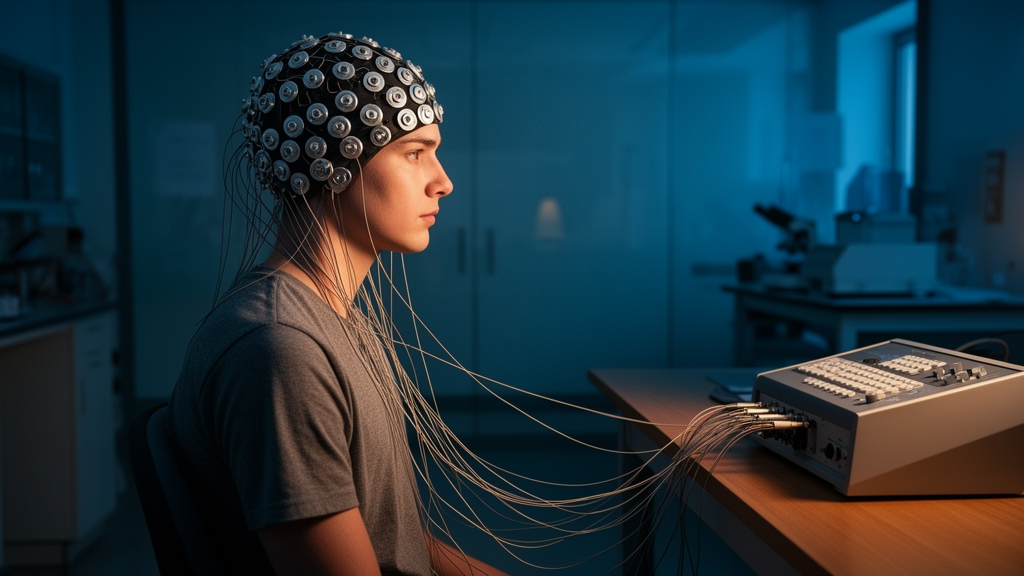
A comprehensive electroencephalographic investigation has demonstrated that distinct oscillatory signatures in the human brain uniquely correspond to the broad dimensions of internalizing and externalizing psychological dysfunction. Reporting in the journal Personality Neuroscience, an investigative team examined how spectral power within the four to seven hertz theta frequency band at the midfrontal scalp electrode Fz behaves during separate cognitive phases of a Stop-Signal Task. Across a community cohort of one hundred forty-six adult participants evaluated using dimensional personality metrics, the investigators observed that theta reactivity generated in response to motor errors was positively correlated with higher-order internalizing symptom severity. Conversely, theta oscillations elicited during acute goal conflict were negatively correlated with externalizing symptoms. These electrophysiological relationships extended continuously across clinical thresholds into nominally healthy score distributions, suggesting that midfrontal theta reflects fundamental neurocognitive control processes that vary continuously across the population rather than demarcating discrete diagnostic categories.
Contemporary psychiatric classification schemes, such as the approximately three hundred diagnostic categories cataloged in the Diagnostic and Statistical Manual of Mental Disorders, have long provided clinical utility but struggle to accommodate widespread diagnostic comorbidity and shared transdiagnostic vulnerabilities. To address these nosological limitations, modern psychiatric research increasingly utilizes hierarchically structured dimensional models that aggregate co-occurring symptoms into broad spectra. Statistical analyses of co-occurring conditions typically resolve into higher-order domains, prominently featuring internalizing and externalizing dimensions. Internalizing encompasses mood and anxiety conditions, including major depressive disorder, generalized anxiety disorder, social anxiety, and panic disorder, which share clinical features of heightened negative affect and emotional distress. Externalizing encompasses disorders characterized by behavioral disinhibition, impulsivity, and social antagonism, including attention deficit hyperactivity disorder, antisocial personality disorder, and substance use disorders. Because these spectra capture shared variance across traditional categorical diagnoses, discovering their underlying neural substrates offers a direct method for identifying general mechanisms of psychopathology.
Prior neurophysiological research has established midfrontal theta rhythms as candidate neural markers for executive cognitive control and monitoring. Oscillations within the four to seven hertz band typically elevate in amplitude when individuals encounter novelty, negative performance feedback, conflicting response tendencies, or committed errors. Theoretical models conceptualize this frontal midline theta activation as a universal alarm mechanism signaling that goals are shifting or that ongoing behavior requires focused attention and cognitive control. However, historical literature suggested an apparent paradox in psychiatric cohorts: midfrontal theta reactivity is frequently reported as hyper-reactive in internalizing conditions such as anxiety and obsessive-compulsive manifestations, whereas it appears hypo-reactive in externalizing disorders marked by impulsivity and behavioral disinhibition. Because earlier studies examined these conditions in isolated clinical cohorts using diverse tasks and evoked potential metrics like the N2 and error-related negativity, researchers had not concurrently tested whether opposing theta dynamics operate within the same individuals across both psychological domains.
To investigate these questions within a unified framework, the researchers recruited a diverse community sample that was intentionally oversampled for externalizing symptomatology through targeted advertisements. From an initial enrollment of two hundred eighteen adult participants, the researchers applied rigorous exclusionary criteria to preserve data fidelity. Forty-seven participants were removed due to excessive electroencephalographic movement artifacts, an attrition rate heightened by task-related fidgeting among individuals exhibiting severe externalizing and hyperactivity symptoms. An additional twenty-five participants were excluded after exhibiting inconsistent or deviant response profiles on validity scales of the Minnesota Multiphasic Personality Inventory-3. The final analyzed sample comprised one hundred forty-six participants, including sixty-three males and eighty-three females, with a mean age of thirty-six years and an age range spanning from eighteen to fifty-six years. Structured clinical interviews verified that forty-nine percent of this final cohort met diagnostic criteria for at least one DSM-5 externalizing condition, including attention deficit hyperactivity disorder, conduct disorder history, antisocial personality disorder, alcohol use disorder, and cannabis use disorder, while the remaining half served as controls.
All participants completed an established computerized Stop-Signal Task designed to systematically elicit both goal conflict and action errors under controlled experimental conditions. In this paradigm, participants viewed visual arrow cues and were instructed to deliver rapid left or right mouse clicks during standard Go trials. Interspersed unpredictably within three blocks containing ninety-nine Stop trials and two hundred ninety-six Go trials, an auditory stop signal sounded after arrow onset, instructing participants to withhold their motor response. The task implemented adaptive staircase algorithms that dynamically adjusted the delay between the visual cue and the auditory stop signal. Early and late delays made motor inhibition exceptionally easy or exceedingly difficult, respectively, while a medium delay staircase actively tracked a fifty percent inhibition success rate by shifting thirty milliseconds after each response. This medium delay created a condition of maximal goal conflict where the drive to execute a rapid click directly competed with the demand to withhold the action.
High-density electroencephalography was continuously recorded from eighteen scalp locations referenced to CPz, utilizing an Advanced Neuro Technology system with impedance maintained below ten kilo-ohms. Sensor data were subsequently re-referenced to mastoid channels, digitally filtered between one and thirty-six hertz, and submitted to independent component analysis to eliminate ocular artifacts with greater than ninety percent statistical similarity. To isolate pristine spectral power, the researchers extracted one-and-a-half-second epochs centered separately on stop-signal presentations and mouse click executions, discarding any trials containing voltage fluctuations exceeding seventy microvolts. Applying overlapping Hanning windows and fast Fourier transformations allowed the researchers to derive normalized, log-transformed spectral power specifically within the four to seven hertz band, focused on five-hundred-millisecond post-stimulus windows. Crucially, baseline neural activity from preceding Go trials was subtracted from paired Stop trials, effectively eliminating general sensory, motor, and non-inhibitory cognitive processes to produce clean differential indices of conflict and error.
The computation of the conflict contrast relied on subtracting the average Stop-Go power differential observed during early and late delay trials from the power differential observed during medium delay trials. This subtraction effectively isolated the neural reactivity unique to the high-conflict state described in the neuropsychological theory of the behavioral inhibition system, which peaks when competing response goals are evenly matched. Conversely, the action error contrast evaluated trials centered on the motor click itself, subtracting correct Go trial clicks from incorrect Stop trial clicks where the participant failed to suppress their response. Because motor output occurred across both sides of this contrast, the resulting difference score isolated the specific cognitive process of recognizing and processing an erroneous action. Participants were required to contribute a minimum number of valid trials across experimental blocks to ensure that derived theta metrics represented stable, trait-like neurobiological measurements rather than fleeting experimental noise.
Behavioral metrics indicated that the study cohort exhibited distinctive response characteristics consistent with oversampling for disinhibited and hyperactive behaviors. Participants demonstrated longer reaction times on Go trials and achieved lower percentages of successful motor inhibition across all delay conditions compared to historical normative samples. Seven participants completely failed to inhibit their motor responses on any Stop trials throughout the testing session. However, because these individuals maintained greater than eighty percent accuracy on standard Go trials, they demonstrated compliant engagement with the task. Furthermore, because mathematical derivation of the required electrophysiological contrasts did not depend on correct Stop trial executions, these participants were fully retained in the neurophysiological analyses. Analysis of psychopathology scores on the Minnesota Multiphasic Personality Inventory-3 confirmed that the sample possessed substantial variance and elevated baseline levels in both internalizing and externalizing domains, ensuring adequate statistical power to evaluate individual differences.
Correlation analyses confirmed the primary hypotheses regarding functional segregation between midfrontal oscillatory dynamics and psychological trait spectra. Log-transformed error theta power at electrode Fz displayed a statistically significant positive correlation with the Emotional and Internalizing Dysfunction scale of the MMPI-3. In contrast, goal-conflict theta power at Fz demonstrated a statistically significant negative correlation with the Behavioral and Externalizing Dysfunction scale. Secondary personality assessments utilizing Carver and White scales showed that conflict theta was negatively correlated with the Behavioral Activation System total score, whereas the positive correlation between error theta and the Behavioral Inhibition System scale did not retain statistical significance following Bonferroni correction for multiple testing. The correlation between conflict theta and error theta at the Fz electrode was weak and non-significant, underscoring that these two midfrontal oscillatory responses operate as functionally independent electrophysiological processes despite occupying the same canonical frequency band and scalp location.
To establish whether these neural relationships were confined to the midline Fz sensor or distributed across broader cortical networks, the investigators conducted principal component analyses incorporating Stop-Go theta differences from all eighteen recording electrodes. Parallel analysis determined that goal-conflict theta was best described by a single primary component, which exhibited prominent factor loadings across a central-frontal electrode cluster encompassing F3, Fz, F4, C3, Cz, and C4. In contrast, error-related theta resolved into a two-component structure, with its primary component loading most heavily onto a distinct anterior-frontal cluster spanning Fp1, Fpz, Fp2, F3, Fz, and F4. When individual factor scores from these major spatial components were correlated against psychopathology scales, they mirrored the midline findings: the central-frontal conflict component correlated negatively with externalizing dysfunction, while the anterior-frontal error component correlated positively with internalizing dysfunction.
Multiple regression analyses confirmed that the observed associations between spectral power and psychopathology were driven by unique, unshared statistical variance. Although internalizing and externalizing symptom dimensions exhibited a significant positive intercorrelation of zero point forty-four within the sample, entering both scales simultaneously into regression models demonstrated that conflict theta uniquely predicted externalizing dysfunction, whereas error theta uniquely predicted internalizing dysfunction. Age did not account for these neurophysiological relationships. Furthermore, grand-averaged spectral power demonstrated marked differences in baseline morphology: conflict theta yielded a positive mean power of zero point seventeen log microvolts squared, whereas error theta exhibited a mean near zero at zero point zero zero seven log microvolts squared accompanied by a much larger standard error of zero point sixty-eight, highlighting that individual differences in dimensional psychopathology emerge from meaningful biological variation rather than gross baseline amplitude shifts.
The study provides compelling empirical evidence that midfrontal theta oscillations represent heterogeneous neurocognitive operations that map onto distinct axes of psychiatric vulnerability. The finding that externalizing problems associate with blunted conflict theta aligns with conceptual models of deficient anticipatory control and reduced sensitivity to competing behavioral contingencies, whereas internalizing problems associate with heightened neural reactivity to committed mistakes. Because the observed associations varied continuously across participants, spanning nominally healthy individuals to those with severe clinical diagnoses, the findings reinforce dimensional frameworks of psychopathology that reject rigid categorical boundaries. The researchers noted that the specific oversampling of externalizing traits, combined with the motoric nature of the Stop-Signal Task, may explain why error theta did not exhibit the hypo-reactivity previously reported in externalizing samples performing perceptual flanker or oddball tasks. Ultimately, these results illustrate that parsing rhythmic theta activity into specific cognitive operations offers a robust empirical bridge connecting human electrophysiology to modern transdiagnostic psychiatry.
Subject of Research: Electroencephalographic midfrontal theta activity and dimensional psychopathology spectra
Article Title: Midfrontal theta reactivity to conflict and error are linked to externalizing and internalizing respectively
Article References: Neo, P. S. H., Shadli, S. M., McNaughton, N., & Sellbom, M. (2024). Midfrontal theta reactivity to conflict and error are linked to externalizing and internalizing respectively. Personality Neuroscience, 7, Article e8. https://doi.org/10.1017/pen.2023.10
Image Credits: AI Generated
DOI: 10.1017/pen.2023.10
Keywords: midfrontal theta, Stop-Signal Task, dimensional psychopathology, internalizing dysfunction, externalizing dysfunction, electroencephalography, goal conflict, action error, MMPI-3, behavioral inhibition system, behavioral activation system, cognitive control, event-related oscillations, transdiagnostic psychiatry, spectral power, principal component analysis, psychiatric comorbidity
News Source: Glenn Wilkins. (November 24, 2026). Distinct Midfrontal Theta Brain Waves Index Internalizing and Externalizing Psychiatric Dimensions. Scienmag.