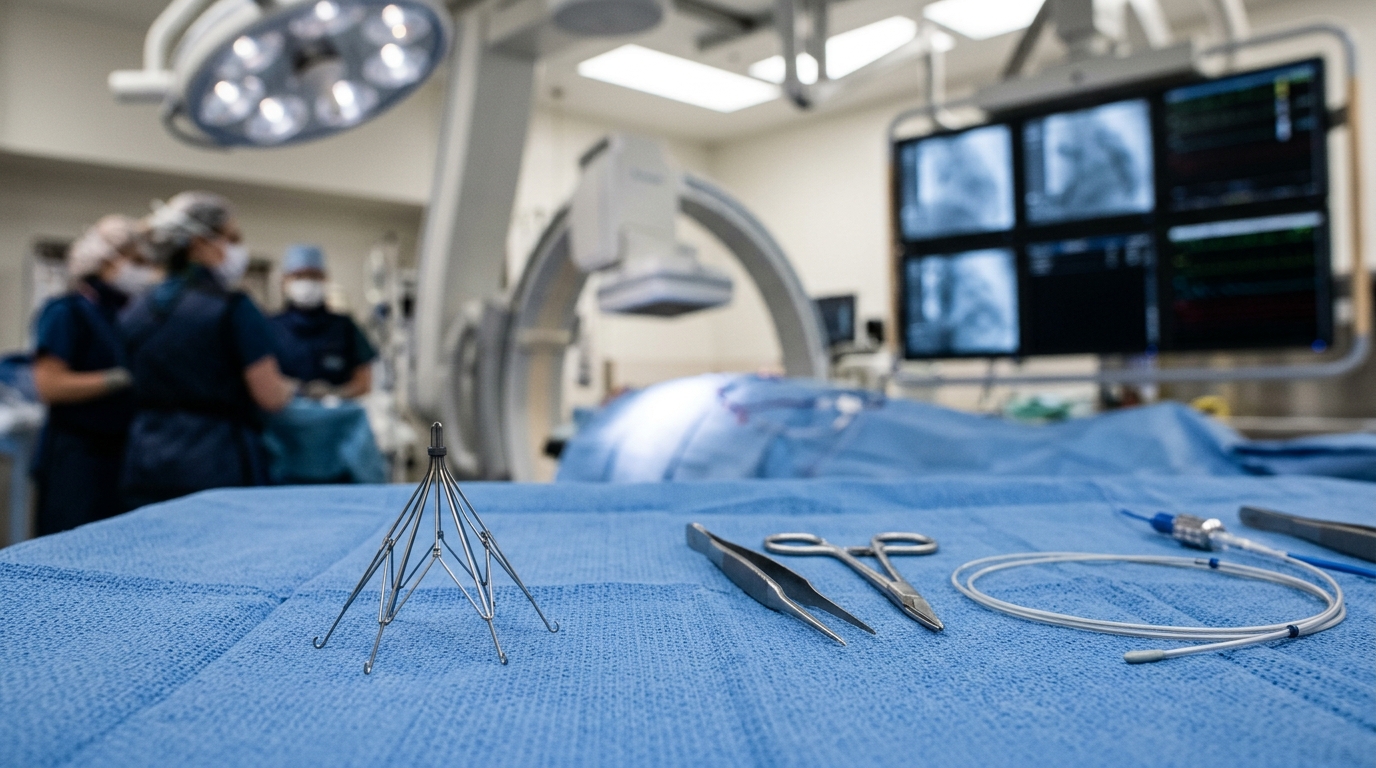
Vascular surgeons have documented a rare clinical case involving an eighty-two-year-old male patient who developed a severe, highly inflammatory saccular infected abdominal aortic aneurysm in immediate anatomical proximity to a permanent inferior vena cava filter deployed six years earlier. The patient presented to the clinical department suffering from high fever and progressive malaise, prompting urgent clinical concern for an impending rupture of an infected aneurysm. His comprehensive medical history was notable for the mechanical implantation of a permanent TrapEase filter into the inferior vena cava six years prior to address deep vein thrombosis. Initial diagnostic laboratory examinations demonstrated a pronounced systemic inflammatory reaction, marked by an elevated white blood cell count of 14,700 per microliter and a markedly abnormal serum C-reactive protein concentration reaching 25.95 milligrams per deciliter. Preoperative contrast-enhanced computed tomography confirmed the existence of a 66-millimeter saccular aneurysm situated immediately distal to the renal arteries, establishing an acute vascular presentation requiring rapid medical and surgical stabilization.
Computed tomography imaging characterized the precise structural relationship between the vascular lesion and the indwelling mechanical device, revealing that the permanent filter was positioned directly adjacent to the right aspect of the aneurysmal sac. Multiple structural struts of the device were located in extremely close anatomical proximity to the compromised aortic wall. Although mechanical filters positioned within the inferior vena cava serve as recognized devices for preventing pulmonary embolism, the long-term retention of permanent metallic hardware introduces recognized risks of delayed complications, including caval occlusion and mechanical interaction with adjacent anatomical structures. Asymptomatic protrusion of filter struts slightly beyond the caval boundary represents a documented finding on routine surveillance imaging; however, localized retroperitoneal vascular pathologies developing directly adjacent to the abdominal aorta remain globally unusual. In this clinical evaluation, the intimate spatial convergence between the metallic struts and the inflammatory arterial wall raised critical diagnostic considerations regarding localized mechanical stress and tissue vulnerability.
To mitigate critical surgical risks and suppress the profound systemic inflammatory response, the clinical team instituted an aggressive preoperative broad-spectrum antibiotic strategy spanning thirty-seven continuous days. The intensive intravenous antimicrobial regimen was administered sequentially, beginning with intravenous ceftriaxone at a dosage of two grams per day for four days, followed by ampicillin and sulbactam at six grams per day across fourteen days. The protocol subsequently transitioned to intravenous cefazolin at four grams per day for fourteen days, concluding with piperacillin and tazobactam at nine grams per day for five days. This targeted preoperative pharmacological intervention successfully suppressed the infectious crisis, yielding a dramatic decline in circulating inflammatory markers, with the patient’s C-reactive protein level decreasing from 25.95 milligrams per deciliter down to 0.77 milligrams per deciliter prior to elective surgical intervention.
Following successful antimicrobial stabilization, the patient underwent elective open surgical reconstruction, which revealed profound localized retroperitoneal tissue alterations resulting from chronic inflammatory processes. Dense fibrotic adhesions were encountered surrounding and binding the infrarenal abdominal aorta, the left renal vein, and the inferior vena cava, directly reflecting extensive periaortic inflammation secondary to the infectious episode. These intense inflammatory adhesions obliterated standard anatomical planes and precluded safe vascular control at the standard infrarenal level, compelling the surgical team to rapidly adjust their operative tactics by establishing a suprarenal aortic cross-clamp. This demanding surgical maneuver ensured complete vascular control while mitigating the severe hazards associated with attempting aggressive dissection through heavily scarred, chronically inflamed retroperitoneal tissue planes adjacent to vital venous structures.
Upon entering the aneurysmal sac, the operative team evacuated organized white intraluminal thrombus, observing no macroscopic purulent discharge and finding no direct visual evidence indicating that a filter strut had physically perforated into the aortic lumen. The presence of dense, fibrous pericaval scarring created an exceedingly high risk of catastrophic venous hemorrhage if open device extraction were attempted. Consequently, the surgical team deliberately avoided open surgical removal of the indwelling hardware, prioritizing patient survival and retaining advanced catheter-based endovascular retrieval as a potential secondary option should clinical indications arise in the future. Aortic continuity was successfully reconstructed utilizing an eighteen-millimeter straight Dacron graft through the standard inclusion technique, achieving secure retroperitoneal restoration without precipitating disruptive mechanical trauma to the adjacent scarred inferior vena cava.
Comprehensive microbiological assessments performed on intraoperative specimens yielded entirely negative bacterial cultures across samples collected from peripheral blood, the resected aortic wall, and evacuated intraluminal thrombus. Histopathological examination of the excised aortic tissue demonstrated advanced atherosclerotic degeneration accompanied by extensive chronic inflammatory infiltration extending from the tunica media outward through the adventitia. Microscopic examination identified that this cellular infiltrate was predominantly composed of mature lymphocytes, exhibiting a pronounced dominance of CD20-positive B-cells. Pathologists and clinicians interpreted these histological findings as representative of the modified, chronic healing phase of an infected aneurysm whose acute microbiological and cellular activity had been profoundly suppressed and altered by the prolonged thirty-seven-day course of intensive preoperative antimicrobial therapy.
The patient experienced an eventful postoperative recovery complicated by hospital-acquired methicillin-resistant Staphylococcus aureus pneumonia, which required targeted systemic antimicrobial intervention comprising intravenous meropenem and vancomycin. Following successful resolution of the pulmonary complication, the patient achieved stable clinical status and was discharged from the inpatient facility on postoperative day twenty-nine. He was subsequently placed on an outpatient regimen of oral clarithromycin at four hundred milligrams daily to provide long-term suppressive antimicrobial coverage. At an outpatient follow-up evaluation conducted eleven months postoperatively, the patient remained entirely asymptomatic without clinical manifestations of recurrent retroperitoneal infection, and laboratory testing demonstrated complete normalization of systemic inflammatory parameters, evidenced by a C-reactive protein level of 0.05 milligrams per deciliter.
The published report situates this clinical experience within the broader medical literature concerning late retroperitoneal complications linked to long-term retained caval hardware. While clinical observations demonstrate that asymptomatic filter abutment against the aortic wall can persist without precipitating acute clinical complications, mechanical analyses indicate that rigid struts can exert sustained physical forces on adjacent structures over extended dwell times. Comprehensive literature reviews indicate that infrarenal aortic pathologies arising in association with indwelling filters remain exceedingly rare across global medical databases. Documented historical cases compiled by researchers include aortic pseudoaneurysms and severe localized infections linked to devices such as the Bird’s Nest, Simon Nitinol, Celect, and Eclipse filters, with dwell times ranging from nine months to twelve years, managed through either open surgical reconstruction or endovascular aneurysm repair.
Because direct microbiological growth and macroscopically visible strut perforation were absent in this specific case, clinicians evaluated dual pathophysiological hypotheses regarding the ultimate origin of the lesion. Given the patient’s advanced age and documented arterial atherosclerosis, the pathology may have originated as a primary infected aneurysm independent of the mechanical device, wherein transient bacteremia seeded an existing atherosclerotic plaque while the anatomical convergence with the hardware was coincidental. Alternatively, chronic proximity to the rigid metallic struts of the TrapEase filter over six years may have induced sustained mechanical stress and microvascular erosion within the aortic adventitia, establishing a localized area of tissue vulnerability susceptible to subsequent hematogenous bacterial colonization, ultimately culminating in localized arteritis and saccular aneurysmal dilation.
The clinical authors emphasized that diagnostic differentiation between primary inflammatory abdominal aortic aneurysms and culture-negative infected aneurysms remains exceptionally challenging when prolonged antimicrobial administration suppresses acute neutrophil-driven suppuration and promotes lymphocytic infiltration. Furthermore, this complex surgical presentation demonstrates the necessity of intraoperative flexibility, including the readiness to implement suprarenal clamping when severe retroperitoneal fibrosis impedes standard vascular access. The authors concluded that preserving the permanent hardware in situ combined with prolonged antimicrobial therapy represents a prudent strategy to avert life-threatening venous hemorrhage during open repair, while highlighting the vital necessity of structured, long-term radiographic surveillance for individuals living with permanent retroperitoneal implants.
Subject of Research: Surgical management and etiology of an infected abdominal aortic aneurysm adjacent to a permanent inferior vena cava filter
Article Title: Infected abdominal aortic aneurysm coexisting with a long-term indwelling permanent inferior vena cava filter: A case report
Article References: Tsuchida, Y., Kamiya, K., & Tsuchida, H. (2026). Infected abdominal aortic aneurysm coexisting with a long-term indwelling permanent inferior vena cava filter: A case report. Annals of Vascular Surgery – Brief Reports and Innovations, 6(3), Article 100478. https://doi.org/10.1016/j.avsurg.2026.100478
Image Credits: AI Generated
DOI: 10.1016/j.avsurg.2026.100478
Keywords: abdominal aortic aneurysm, inferior vena cava filter, infected aneurysm, vascular surgery, aortic repair, Dacron graft, retroperitoneal fibrosis, suprarenal clamping, TrapEase filter, deep vein thrombosis, antibiotic therapy, C-reactive protein, computed tomography, histopathology, atherosclerosis, MRSA pneumonia, clarithromycin, device complications
News Source: Ophelia Keating. (November 24, 2026). Aortic Aneurysm Coexists With Long-Term Inferior Vena Cava Filter. Scienmag.