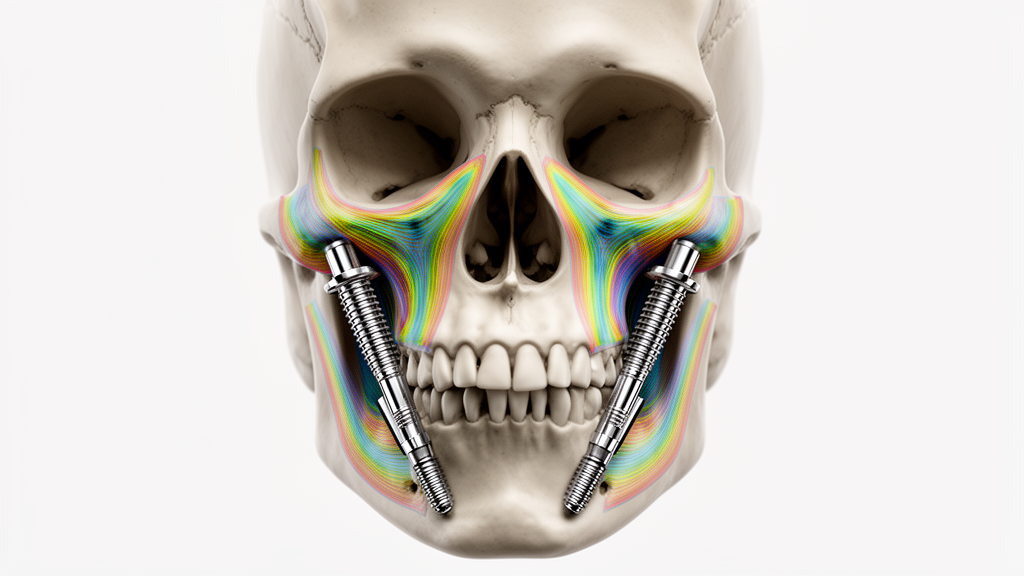
A comprehensive systematic review synthesizing computational and experimental biomechanical investigations has revealed that surgical implant distribution and posterior support configurations substantially alter simulated mechanical stress distribution, cantilever forces, and fixture micromotion in the graftless rehabilitation of the severely atrophic maxilla. Researchers Abhinn Miglani, Dipti Samal, Santosh Kumar Subudhi, and Upasa Sarma Medhi systematically evaluated thirteen peer-reviewed studies published between 2012 and 2026 to clarify how specialized anchorages perform under functional loading. Across the evaluated evidence, isolated computational models demonstrated that zygomatic implants generated lower local peri-implant bone stresses compared to solitary pterygoid fixtures, particularly under compromised bone quality or oblique loading conditions. Conversely, when pterygoid implants were incorporated into comprehensive full-arch rehabilitations alongside anterior or zygomatic fixtures, the models consistently exhibited enhanced posterior load sharing, reduced distal cantilever effects, improved construct stability, and diminished implant micromotion under simulated occlusal forces.
The focused research question of the systematic review centered on how zygomatic implants, pterygoid implants, and combined zygomatic-pterygoid arrangements differ across quantitative biomechanical endpoints, including stress distribution, strain patterns, displacement, micromotion, deformation behavior, load transfer characteristics, and prosthetic framework stress. Severe resorption of the edentulous maxilla presents severe restorative challenges due to limited residual alveolar bone volume, extensive maxillary sinus pneumatization, and a lack of conventional posterior cortical anchorage. While historical systematic reviews have predominantly summarized clinical survival rates, prosthetic maintenance, and surgical complications, the underlying biomechanical behavior governing these graftless techniques had remained fragmented across disparate engineering literature. The investigators conducted their review following the PRISMA 2020 statement guidelines and registered the methodological protocol prospectively in PROSPERO under registration number CRD420251130553, establishing a rigorous PICOS framework to evaluate non-augmented maxillary reconstructions.
To assemble the evidence base, the research team carried out an exhaustive search across six electronic databases, including PubMed/MEDLINE, Scopus, Web of Science Core Collection, Embase, the Cochrane Library, and Google Scholar, capturing literature from database inception through June 2026. The initial electronic screening retrieved 414 total records across the indexing platforms, with 96 from PubMed, 132 from Scopus, 81 from Web of Science, 74 from Embase, 20 from Cochrane Library, and 11 identified through manual screening of reference lists. After removing 126 duplicate records using bibliographic management software, the authors screened 288 titles and abstracts, excluding 242 records that failed to satisfy the eligibility criteria. Full-text retrieval was sought for 46 articles, of which 44 were successfully accessed and assessed in detail. Following full-text appraisal, 31 studies were excluded because they lacked quantitative biomechanical data, presented purely clinical outcomes, comprised case reports or animal trials, or lacked direct relevance to zygomatic or pterygoid biomechanics, yielding a final synthesis of 13 studies.
The thirteen included investigations exhibited considerable diversity in methodological execution, geometric modeling, and regional origin, spanning academic centers in Turkey, Egypt, India, Brazil, Armenia, and China. Twelve of the thirteen included studies, representing 92.3 percent of the reviewed evidence, utilized computational finite element analysis (FEA) as their primary analytical methodology, including one hybrid investigation that paired finite element simulations with physical strain-gauge measurements. Only a single included study, conducted by Koga and colleagues, relied exclusively on physical in vitro testing methods, utilizing extensometric strain gauges and photoelastic fringe analysis to measure mechanical responses without numerical finite element calculations. Due to marked heterogeneity in anatomical reconstruction techniques, mesh properties, material property assignments, interface contact definitions, prosthetic framework geometries, and loading protocols across the thirteen publications, a quantitative meta-analysis could not be performed, necessitating an in-depth narrative and qualitative synthesis.
Anatomical boundary conditions and supporting bone geometries varied widely across the identified investigations. Approximately 84.6 percent of the studies, or 11 of the 13, generated three-dimensional maxillary or craniofacial reconstructions derived directly from patient computerized tomography (CT) or cone-beam computed tomography (CBCT) imaging, or imported standardized DICOM digital skull datasets. In contrast, Daniel and colleagues constructed their computational models from CT scans of a synthetic polyurethane skull, explicitly evaluating the influence of bone densities categorized as D2, D3, and D4 by systematically altering cortical thickness values to 1.5 millimeters, 0.75 millimeters, and 0.5 millimeters, respectively. Koga and colleagues similarly utilized polyurethane and photoelastic resin maxillary physical models for experimental bench testing. Across the computational studies, cortical and cancellous bone substructures were typically separated, yet nearly all computational models applied homogeneous, linearly elastic, and isotropic material properties, assuming uniform stiffness in all directions rather than capturing the orthotropic, anisotropic, and viscoelastic behavior of human bone tissue.
The implant fixtures, dimensions, and architectural distributions examined in the primary literature demonstrated wide variations tailored to local anatomical constraints. Fixture dimensions were explicitly documented in 12 of the 13 studies, showing that zygomatic implants were consistently the longest fixtures, anchored deeply into the body of the malar bone, while pterygoid fixtures were shorter and engaged the posterior pterygomaxillary junction. For instance, Daniel and colleagues modeled 45-millimeter by 4.2-millimeter zygomatic implants, 18-millimeter by 4.2-millimeter pterygoid implants, and 10-millimeter by 4.2-millimeter conventional anterior fixtures. Mostafa and colleagues evaluated zygomatic implants measuring 42.5 and 52.5 millimeters paired with 20-millimeter by 4-millimeter pterygoid implants, whereas Togac and colleagues incorporated 26-millimeter by 4-millimeter transnasal implants alongside 20-millimeter pterygoid and 40- to 42.5-millimeter zygomatic fixtures. The configurations ranged from solitary anchorages to All-on-Four arrangements, All-on-Six constructs with distal pterygoid support, quad-zygoma approaches, and complex transnasal-zygomatic-pterygoid hybrid frameworks, making it impossible to evaluate fixture length or diameter as independent mechanical variables isolated from total construct geometry.
External load applications were evaluated across all 13 included studies, with quantifiable numerical force magnitudes explicitly reported in 12 investigations. Applied loads generally fell within the range of 100 to 300 Newtons, reflecting vertical, lateral, oblique, and simulated masticatory muscular inputs. Multiple investigations applied static vertical forces of 150 Newtons, frequently supplemented by lateral forces of 50 Newtons or masseteric muscle loads up to 300 Newtons. Oblique loading configurations, notably investigated at angles such as 20 degrees by Bakay, Coskun, and Girgin, consistently produced significantly elevated stress concentrations compared to purely vertical axial loading. With the sole exception of a dynamic cyclic fatigue simulation conducted by Alberto and colleagues, the finite element models across the evidence base applied linear static loading vectors. In nearly all computational simulations, the bone-implant interface was modeled as fully bonded, reflecting idealized complete osseointegration and neglecting the transitional micro-mechanics of progressive healing.
The specific biomechanical outcomes documented across the studies predominantly tracked stress distribution in peri-implant bone, implant fixtures, prosthetic screws, and superstructures, with von Mises stress serving as the most widely reported parameter for metal components and principal stresses utilized for cortical and trabecular bone. When evaluating local fixture behavior, studies by Daniel and Bakay identified that isolated zygomatic implants exhibited lower peri-implant stresses than isolated pterygoid implants, especially when cortical thickness was reduced or when forces were directed obliquely. However, when evaluated in the context of complete full-arch prostheses, studies by Coskun, Darwish, Mostafa, Togac, and Girgin demonstrated that introducing posterior pterygoid implants altered the entire load transfer system.
Methodological quality appraisal across the twelve finite element investigations was conducted using the specialized Risk of Bias in Finite Element Analysis in Dentistry (ROBFEAD) tool, which assesses 22 guiding criteria across six domains: model development, material properties, impact load, endpoints tested, mechanical validation, and reporting error. The ROBFEAD assessment revealed substantial variability in scientific rigor. While modern studies frequently adopted image-based anatomical reconstruction and reported explicit mesh convergence testing to ensure numerical stability, recurring methodological shortcomings were identified. These primary concerns included the universal assumption of isotropic and homogeneous material properties for cortical and trabecular bone, the reliance on static unvarying loads rather than dynamic masticatory cycles, the frequent omission of mesh convergence documentation in earlier papers, and a marked absence of independent mechanical or experimental validation. The authors emphasized that favorable ratings in individual domains did not imply that models were free from systematic computational bias.
For the non-computational experimental study by Koga and colleagues, methodological quality was appraised using the Quality Assessment Tool for In Vitro Studies (QUIN), yielding a score of 15 out of 24, or 62.5 percent, corresponding to a moderate risk of bias. While the study demonstrated strengths in clearly stated experimental objectives, defined comparison groups, objective photoelastic and strain-gauge measurements, and appropriate presentation of results, it showed clear limitations regarding the absence of formal sample-size calculations, lack of reported operator calibration, and omission of randomization and blinding protocols. Furthermore, Koga and colleagues observed divergent results depending on the diagnostic instrumentation: physical strain-gauge extensometry showed no statistically significant differences in strain between posterior implant configurations, whereas photoelastic fringe analysis in the same study demonstrated a visibly more favorable stress-dissipation pattern when pterygoid anchorage was present, underscoring that biomechanical conclusions remain highly sensitive to measurement methodology.
The systematic review authors emphasized critical interpretive boundaries, noting that biomechanical stability was operationally defined purely as the mechanical capacity of an implant-prosthesis construct to sustain controlled displacement and minimize stress concentrations under defined simulated loads. This computational definition must not be equated with biological osseointegration, clinical implant survival, marginal bone maintenance, or long-term therapeutic success. Because the included comparative models frequently modified multiple structural parameters simultaneously—such as altering the total number of implants, widening the anteroposterior spread, shortening cantilever lengths, and altering framework materials at the same time as adding pterygoid fixtures—the observed reductions in stress cannot be attributed exclusively to pterygoid anchorage alone. Because living maxillary bone exhibits dynamic biological remodeling, neuromuscular adaptation, and patient-specific anatomical variation, the reported findings represent relative mechanical trends under simplified engineering simulations rather than clinical superiority.
Ultimately, the authors concluded that while combined zygomatic-pterygoid configurations and quad-zygoma arrangements exhibit favorable load distribution and reduced micromotion within computational and bench-top models, standardized methodologies are essential for future research. The evidence indicates that whole-arch implant distribution and the presence of posterior bone anchorage exert far greater influence on mechanical load sharing than individual fixture length or diameter in isolation. To bridge the gap between engineering simulations and patient care, future biomechanical investigations must adopt physiologically realistic, patient-specific anisotropic bone modeling, incorporate dynamic multidirectional loading conditions, disclose comprehensive element and software parameters, and validate computational predictions against physical experiments. The researchers affirmed that prospective clinical trials alongside validated multi-physics modeling remain strictly necessary before any specific graftless implant arrangement can be recommended on the basis of simulated biomechanical performance alone.
Subject of Research: Biomechanical performance of zygomatic and pterygoid implants in severely atrophic maxilla rehabilitation
Article Title: Biomechanical performance of zygomatic and pterygoid implants in the rehabilitation of the severely atrophic maxilla: a systematic review
Article References: Miglani, A., Samal, D., Subudhi, S. K., & Medhi, U. S. (2026). Biomechanical performance of zygomatic and pterygoid implants in the rehabilitation of the severely atrophic maxilla: a systematic review. The Saudi Dental Journal, 38(11), Article 140. https://doi.org/10.1007/s44445-026-00259-4
Image Credits: AI Generated
DOI: 10.1007/s44445-026-00259-4
Keywords: zygomatic implants, pterygoid implants, atrophic maxilla, finite element analysis, biomechanics, stress distribution, von Mises stress, implant micromotion, cantilever reduction, extensometry, photoelastic analysis, ROBFEAD, QUIN tool, prosthetic framework, graftless rehabilitation, posterior anchorage
News Source: Ophelia Keating. (November 24, 2026). Zygomatic and Pterygoid Maxillary Implants Exhibit Distinct Biomechanical Load Distribution Patterns. Scienmag.