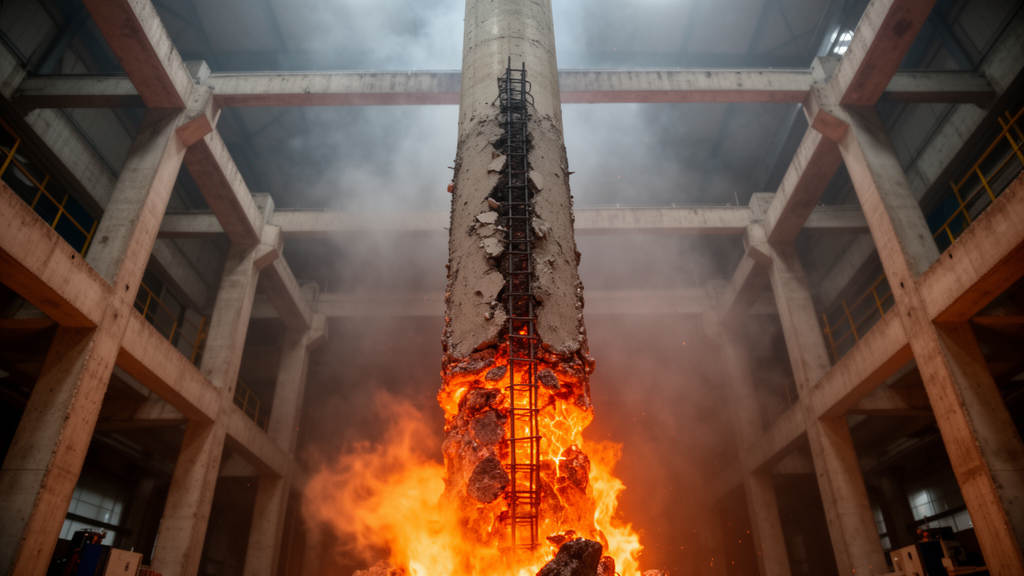
Advanced computational simulations have demonstrated that central interior columns represent the most critical vulnerability when multi-story reinforced concrete frames undergo simultaneous structural loading and elevated thermal exposure. In an extensive numerical investigation evaluating two-dimensional structural frameworks exposed to fire conditions, researchers established that the middle column consistently experiences the most severe structural distress across both bare skeletal frames and masonry-infilled configurations. The computational findings reveal that while the addition of solid brick masonry infills drastically curtails vertical deflection by providing substantial structural rigidity, it simultaneously concentrates internal forces, causing a substantial surge in the Demand Capacity Ratio across key load-bearing members. By capturing the combined effects of mechanical service loads and intense fire curves through transient-state finite element analysis, the research delineates the precise structural trade-offs between frame deformation and internal stress accumulation during severe fire incidents.
Understanding structural failure mechanisms under extreme thermal exposure remains a paramount challenge in civil engineering, where uncontrolled temperature increases can trigger localized damage that rapidly propagates into progressive collapse. To accurately replicate the actual behavior of full-scale reinforced concrete buildings exposed to real fire events, structural models must simultaneously account for four interacting factors: the presence of operational gravity loading, the physical location of the fire compartment, the intensity of the thermal exposure, and the total fire duration.
To investigate these failure sequences under controlled conditions, the research team developed a detailed numerical prototype representing a symmetrical two-dimensional reinforced concrete frame spanning four bays and rising three stories. The structural frame was engineered using M30 grade concrete and Fe 415 grade steel reinforcement, adhering to standard structural specifications for multi-story framed buildings. To evaluate how interior architectural partitions influence fire performance, the investigators modeled both a bare frame devoid of non-structural panels and several infilled frame variations containing unreinforced brick masonry wall panels bonded to the concrete framework with cement mortar interfaces.
The experimental matrix explored three distinct structural configurations to systematically characterize the influence of infill panel location on building stability under thermo-mechanical loading. In the first configuration, designated as Case I, masonry infills were introduced across sequential story levels, comparing completely bare frameworks against fully infilled frames and frames with infill placed solely at specific vertical elevations. The second configuration, Case II, evaluated the asymmetric placement of masonry panels across sequential structural bays, analyzing how horizontal stiffness irregularities influence overall frame mechanics. The third configuration, Case III, examined various distributed bay placements to represent realistic architectural arrangements. Throughout all simulations, pinned boundary supports were enforced at column base joints, and gravity working loads were distributed across all floor levels while high temperatures were applied at the first story directly above ground level to replicate compartmentalized fires.
Finite element simulations were executed using the ABAQUS software suite, employing thermally coupled continuum and structural elements to model complex multi-physics interactions. The concrete beam and column members were modeled using C3D8T eight-node thermally coupled trilinear displacement and temperature solid elements, while the internal reinforcing steel cages were represented using T3D2T two-node thermally coupled three-dimensional truss elements. The brick masonry infill panels and their corresponding cement mortar contact layers were discretized as four-node plane-stress elements featuring two translational degrees of freedom, capturing both horizontal displacement and vertical displacement. Extensive mesh sensitivity studies evaluating infill panel sizes from one-by-one up to twenty-two-by-twenty-two divisions established that an eight-by-eight element discretization provided optimal convergence, complemented by specialized boundary discretization for mortar joints and a refined twenty-five-millimeter mesh for concrete structural elements.
The thermo-mechanical boundary conditions incorporated realistic gravity dead loads and occupational live loads alongside standard fire-induced thermal transients. Structural dead loads were computed in accordance with IS 875 Part-1, applying slab loads of 2.5 kilonewtons per square meter, masonry wall loads of 14.7 kilonewtons per meter, and floor finish allowances of 1.0 kilonewton per square meter, coupled with self-weight calculations for beams, columns, and floor assemblies. An occupational live load intensity of 3.0 kilonewtons per square meter was applied across floor levels in accordance with IS 875 Part-2. Thermal properties, including temperature-dependent thermal conductivity, specific heat capacity, and thermal expansion coefficients for steel and concrete, were abstracted from European standards EN 1992-1-2 and EN 1993-1-2, benchmarking transient temperature escalation against the standardized ISO 834 fire curve over extended heating periods.
Comparative structural assessments revealed dramatic differences in deformation mechanics between bare skeletal frames and masonry-infilled assemblies subjected to identical thermal loading at the ground story. During transient-state simulations where fire attacked the central column, designated as C3, the bare concrete frame exhibited a maximum vertical downward displacement of 32.56 millimeters, whereas the fully infilled frame restricted vertical displacement to merely 3.67 millimeters. This marked difference demonstrated that the bare frame underwent 8.87 times greater vertical deflection than the fully infilled structure under transient conditions, a disparity that expanded to 9.29 times under steady-state thermal exposure. Similarly, when fire attacked the exterior corner column, designated as C1, the bare frame developed a top-story lateral drift of 24.26 millimeters compared to 12.08 millimeters in the fully infilled frame, proving the substantial bracing contribution provided by masonry panels.
Despite providing superior deflection control, the presence of rigid masonry infills induced significantly higher internal force concentrations, yielding elevated Demand Capacity Ratio values throughout critical supporting columns. In the transient-state analysis under combined mechanical loading and fire exposure, the Demand Capacity Ratio at the central column reached a peak value of 6.97 in the fully infilled frame, compared to a modest 1.13 in the corresponding bare frame, representing an overall 6.16-fold increase in structural demand. When thermal loading was shifted to the exterior corner column, the infilled frame recorded a Demand Capacity Ratio of 5.01, whereas the bare frame reached only 0.44.
Detailed evaluations of internal stress distributions and failure durations further highlighted the severe localized stresses developed across heterogeneous frame configurations. Maximum shear stresses in the central column reached 87.45 newtons per square millimeter in the fully infilled frame compared to 76.63 newtons per square millimeter in the bare frame, with asymmetric bay configurations such as IFB1 developing extreme localized shear stresses of 191.28 newtons per square millimeter. Bare frames exhibited longer thermal endurance, surviving up to 171 minutes at 710 degrees Celsius under central column heating and 179 minutes at 746 degrees Celsius under corner column heating, whereas fully infilled frames reached failure at 162 minutes at 641 degrees Celsius. Principal stress measurements within infilled configurations demonstrated tensile and compressive extremes ranging from 101.4 to 7.028 newtons per square millimeter, with partially infilled configurations reaching peak principal stresses of 237.20 newtons per square millimeter.
To accelerate the prediction of structural deformations during complex fire events without requiring computationally intensive finite element simulations, the investigators developed advanced artificial neural network architectures. The predictive models utilized backpropagation neural networks comprising an input layer, an output layer, and hidden layers structured with five and ten neurons operating via non-linear activation functions. Network weights and bias values were optimized using the Levenberg-Marquardt algorithm, which automatically terminated training cycles when validation sample mean squared error ceased to improve, preventing overfitting while ensuring robust generalization. Input training vectors incorporated temporal time intervals, thermal distribution profiles, and specific structural configurations, spanning bare frames, fully infilled frameworks, and intermediate partial infill arrangements across distinct building story elevations.
Validation of the trained neural networks confirmed outstanding accuracy when benchmarking predicted lateral and vertical column displacements against the numerical finite element dataset. For simulations involving thermal exposure at the exterior corner column, the artificial neural network achieved regression correlation coefficients of 0.92565 for training, 0.96553 for validation, and 0.89053 for testing, stabilizing its performance gradient around epoch three with an overall correlation coefficient of 0.91094. Performance was even higher under central column heating, where the model achieved correlation coefficients of 0.92573 for training, 0.98864 for validation, and 0.99201 for testing, stabilizing by epoch one with an overall correlation coefficient of 0.95484. By maintaining correlation values well above 0.9 across all evaluation cases, the neural models proved highly capable of capturing complex non-linear thermo-mechanical interactions, offering an effective computational framework for rapid structural fire safety assessments.
Subject of Research: Structural failure mechanisms and displacement prediction in reinforced concrete frames under thermo-mechanical loading
Article Title: Assessing failure mechanisms in reinforced concrete frame structures under thermo-mechanical loading using finite element analysis
Article References: Parthasarathi, N., Prakash, M., & Kontoni, D.-P. N. (2025). Assessing failure mechanisms in reinforced concrete frame structures under thermo-mechanical loading using finite element analysis. Asian Journal of Civil Engineering, 26(8), 3289-3315. https://doi.org/10.1007/s42107-025-01374-z
Image Credits: AI Generated
DOI: 10.1007/s42107-025-01374-z
Keywords: Reinforced Concrete, Finite Element Analysis, Thermo-Mechanical Loading, Structural Fire Engineering, Demand Capacity Ratio, Progressive Collapse, Masonry Infill, Transient-State Analysis, Steady-State Analysis, Artificial Neural Networks, Displacement Prediction, ABAQUS, Middle Column Vulnerability, Thermal Stress, Levenberg-Marquardt Algorithm, Structural Mechanics, Fire Resistance
News Source: Denise Maddox. (November 24, 2026). Middle Columns Prove Most Vulnerable In Concrete Frames Under Fire. Scienmag.