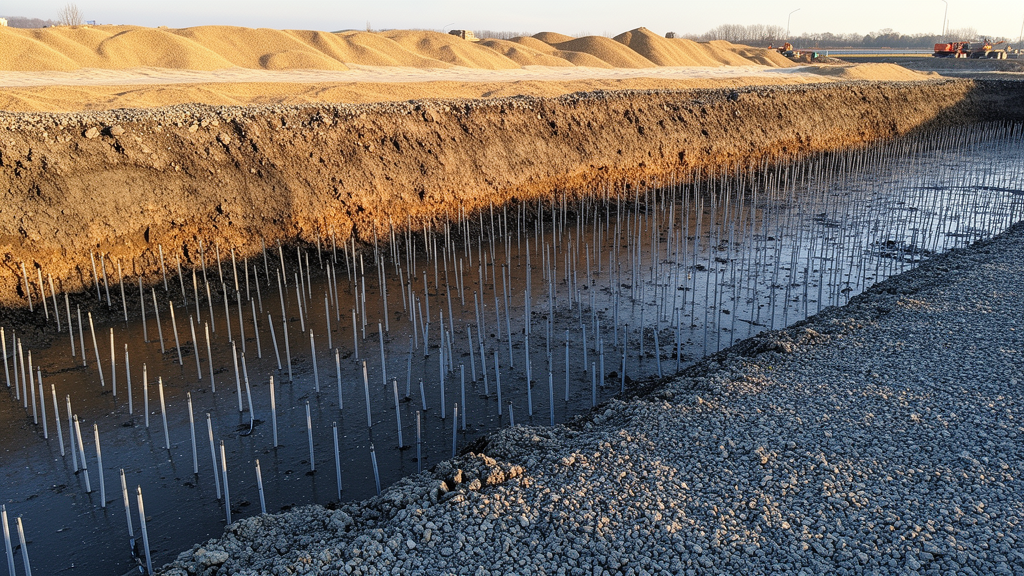
Laboratory testing of cohesive soils under simulated preloading reveals that switching drainage from vertical to radial inward flow consistently magnifies long-term creep settlement across multiple loading, unloading, and reloading stages. Geotechnical engineers have long paired temporary surface preloading with vertical drains to accelerate primary consolidation in weak deposits, yet altering drainage pathways introduces substantial uncertainty into secondary compression forecasts. An experimental investigation published in the Bulletin of Engineering Geology and the Environment demonstrates that axial creep deformation—the gradual restructuring of the clay skeleton under constant effective vertical stress—is noticeably greater when pore water drains radially toward a central collector. Across both undisturbed marine clays and reconstituted reference materials, radial drainage accelerated post-unloading settlement onset and elevated secondary compression indices, challenging conventional settlement control assumptions.
Soft clay foundations pose persistent risks to civil infrastructure because low shear strength and high compressibility cause excessive ground movements during construction and service lifespans. Total settlement comprises two phases: primary consolidation, where excess pore pressure dissipates under changing effective stress, and secondary compression, which progresses under constant effective stress. While geotechnical design prioritizes primary consolidation because it dominates total settlement, secondary compression often governs long-term performance. Because creep accumulates gradually over decades and increases with deposit thickness, unpredicted deformation can trigger serviceability failures.
Preloading mitigates post-construction subsidence by applying temporary surcharge loads exceeding operational stresses, raising preconsolidation pressure and increasing the overconsolidation ratio upon unloading. To accelerate pore pressure dissipation within practical timeframes, contractors install vertical drains to shorten drainage pathways. However, this intervention transforms boundary conditions, forcing pore water to drain radially toward vertical channels rather than vertically toward drainage blankets. Earlier research by Wong and Varatharajan noted that reciprocal creep viscosity decreased under radial drainage in normally consolidated clays, while numerical work by Azari and colleagues examined smear zone disturbances. Nevertheless, the independent influence of radial flow geometry across sequential surcharge loading, unloading to lower overconsolidation ratios, and subsequent structural reloading remained insufficiently characterized.
To isolate the impact of drainage direction, researchers tested undisturbed alluvial soils alongside a reconstituted reference material across comprehensive consolidation sequences. Undisturbed specimens were extracted from deep deltaic deposits in the Nakdong River intertidal zone in South Korea, where land reclamation placed dredged fill over thick alluvial clay. Core samples retrieved at depths of twenty-nine, thirty-eight, and forty-eight meters represented high-plasticity and low-plasticity clay formations. Piezocone penetration soundings and laboratory testing confirmed that natural water contents across all depths exceeded liquid limits, establishing that these natural deposits remained underconsolidated with overconsolidation ratios below unity under ongoing primary settlement.
In parallel with the undisturbed clays, the investigative program prepared homogeneous reconstituted kaolinite specimens to serve as an idealized baseline free from natural fabric variability. The reconstitution sequence followed four stages: mixing kaolinite powder with deaired water at twice its liquid limit with sodium chloride to encourage flocculation and sodium azide to suppress biological growth; allowing self-weight sedimentation in a chamber for three days; incrementally applying pneumatic stresses up to one hundred twenty kilopascals to establish a preconsolidation threshold; and unloading before extracting specimens. Classified as high-plasticity inorganic silt, the reconstituted material exhibited mineralogical purity consisting predominantly of kaolinite and quartz, whereas the natural Nakdong River clays contained quartz, muscovite, anorthite, and albite. This dual-material methodology ensured observed behavioral shifts reflected drainage kinematics rather than mineralogical anomalies.
All consolidation trials utilized modified one-dimensional oedometer cells holding specimens sixty millimeters in diameter and twenty millimeters in height, coated with Teflon and grease to minimize friction. For vertical drainage, pore fluids drained through a permeable porous stone at the top cap. For radial inward drainage, technicians inserted a thin-walled, open-ended trimming tube to core a central opening, installing an alumina porous cylinder measuring five millimeters in diameter. Unlike deformable sand columns that introduce compliance errors, this rigid aluminum oxide cylinder provided an incompressible drainage boundary adhering to Barron’s equal-strain consolidation theory. Testing adhered to standardized incremental loading schedules with a load increment ratio of unity, systematically progressing through initial surcharge compression, unloading across diverse overconsolidation ratios, and subsequent reloading to simulate realistic preloading sequences.
Baseline consolidation evaluations revealed clear contrasts in material compressibility and consolidation kinetics between the upper and lower strata. Compression index values correlated closely with natural water content, with the high-moisture upper clay exhibiting the highest void ratios and compressibility, while the sandier lower clay layers displayed reduced compressibility. Preconsolidation pressures determined through Casagrande, bi-logarithmic, and strain energy constructions confirmed that drainage direction had negligible influence on yield stress values, with differences between vertical and radial setups restricted to between 0.3 and 4.0 kilopascals. However, flow coefficients diverged sharply: the radial coefficient of consolidation exceeded the vertical coefficient of consolidation by factors ranging between 3.2 and 8.1 across all tested samples. This pronounced hydraulic anisotropy directly mirrored natural sedimentary fabric orientation, yet permeability change indices remained comparable, demonstrating that directional flow differences persisted throughout structural volume reduction.
During the initial surcharge loading stage, measurements of the secondary compression index revealed that radial drainage promoted substantially larger creep rates compared to vertical flow. As vertical stresses approached preconsolidation pressure, secondary compression indices increased sharply across all samples, with values under radial drainage exceeding vertical counterparts in the normally consolidated region. Specifically, the peak secondary compression index for upper alluvial clay reached 0.103 under radial drainage, representing a 35.2 percent increase over identical vertically drained specimens. Normalizing secondary compression against the local compressibility index produced linear correlations with determination coefficients exceeding 0.97. Across all test series, the normalized creep parameter under radial drainage was 5.4 to 40.0 percent higher than under vertical drainage, showing that radial drainage intrinsically elevates long-term viscous deformation during virgin loading and near preconsolidation thresholds.
The unloading phase uncovered equally pronounced directional dependencies in time-dependent rebound and secondary swelling behavior. Following surcharge removal, cohesive soil specimens initially underwent primary swelling driven by negative excess pore water pressure dissipation, followed by secondary swelling governed by progressive particle adjustments. Specimens drained radially exhibited consistently larger maximum swelling deformations and higher secondary swelling indices than vertically drained specimens across comparable overconsolidation ratios. This heightened swelling response intensified as the magnitude of removed surcharge increased.
Crucially, when surcharge removal achieved only modest overconsolidation ratios below 1.60—a stress range representative of field preloading practice where economic and schedule constraints limit surcharge heights—swelling halted and creep deformation spontaneously reappeared. Evaluating this phenomenon through Ladd’s tangential method and Mesri’s secant framework revealed that normalized creep onset times were consistently smaller under radial drainage. In reconstituted samples unloaded to an overconsolidation ratio of 1.14, secondary compression resumed substantially earlier, and the reappearance creep index under radial flow was 3.25 times larger than under vertical drainage. Although prolonged surcharge holding times of twenty-four hours delayed creep reappearance relative to classical empirical benchmarks, radial drainage systematically eroded this protective delay, demonstrating that preloading benefits deteriorate more rapidly when vertical drains channel pore water horizontally inward.
Subsequent reloading investigations confirmed that drainage direction continues to exert a governing influence when structural or operational service loads are applied over improved ground. Normalized secondary compression ratios during reloading generally decreased with increasing overconsolidation ratios, corroborating the traditional principle that overconsolidation suppresses creep. Nevertheless, for all specimens reloaded at overconsolidation ratios of two or less, the ratio of radial to vertical reloading creep indices remained strictly greater than unity, spanning from 1.4 to 4.4 in normally consolidated states. Most remarkably, in lower alluvial clay specimens where reloading stresses equaled the prior surcharge stress of 1280 kilopascals, the reloading creep index exceeded the initial virgin loading creep index by a factor of 2.3. This surge indicates that approaching prior preconsolidation thresholds under radial flow triggers profound structural fabric rearrangement.
The underlying physical mechanism driving this augmented creep behavior stems from the complex stress and strain fields induced by radial flow kinematics during consolidation. Unlike uniform one-dimensional vertical flow, radial inward dissipation generates significant spatial non-uniformities in effective stress, developing localized shear strains and deviatoric stress concentrations across the soil skeleton. Because viscous deformation in cohesive soils increases in direct proportion to deviatoric stress, these persistent shear distortions accelerate particle reorientation and double-layer water expulsion under sustained loading. While these element-scale oedometer tests isolated drainage direction using a load increment ratio of unity under rigid lateral confinement, field installations introduce additional complexities such as installation smear and drain spacing. Consequently, the authors conclude that relying exclusively on vertical drainage laboratory tests risks underestimating long-term creep settlement in vertical-drain-improved soft ground.
Subject of Research: Influence of drainage direction on creep behavior in preloaded soft ground
Article Title: Influence of drainage direction on creep behavior of soft ground: an experimental investigation
Article References: Ryu, J.-H., Kim, I., Kim, Y., Choo, J., & Chung, C.-K. (2026). Influence of drainage direction on creep behavior of soft ground: an experimental investigation. Bulletin of Engineering Geology and the Environment, 85(9), Article 554. https://doi.org/10.1007/s10064-026-05168-8
Image Credits: AI Generated
DOI: 10.1007/s10064-026-05168-8
Keywords: radial drainage, vertical drainage, secondary compression, creep behavior, soft ground improvement, preloading, vertical drains, oedometer testing, overconsolidation ratio, secondary swelling index, reappearance creep, preconsolidation pressure, alluvial clay, reconstituted kaolinite, deviatoric stress, Nakdong River delta, consolidation coefficient, Barron equal strain theory
News Source: Denise Maddox. (November 24, 2026). Radial Drainage Magnifies Long-Term Creep Settlement in Soft Ground Preloading. Scienmag.