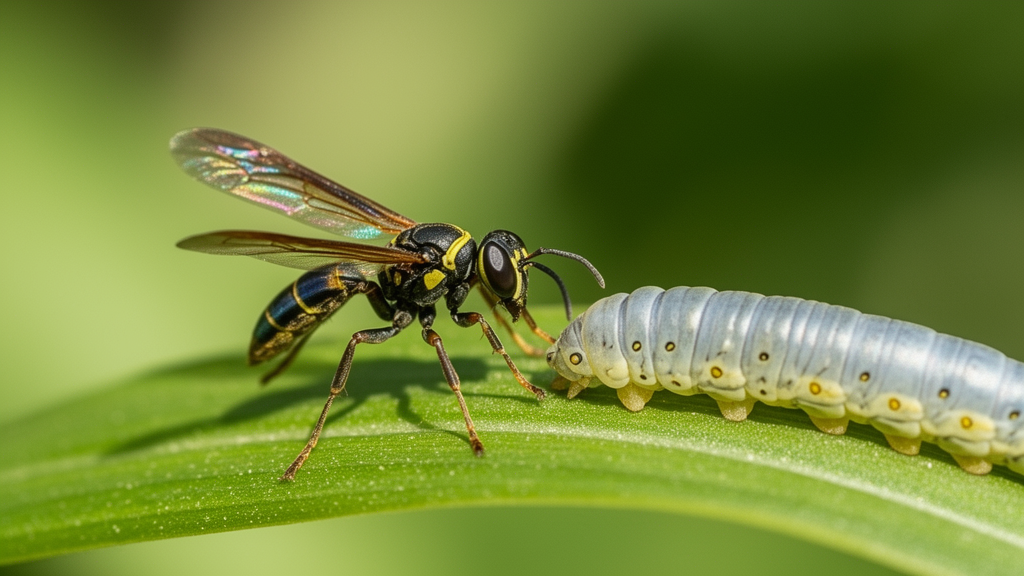
A mathematical modeling study demonstrates that the evolutionary divergence between parasitoid wasps that consume their hosts immediately and those that delay consumption is driven by a polarized trade-off between host growth potential and juvenile mortality. Parasitoid wasps display extraordinary life-history diversity, historically divided into two primary categories: idiobionts, which arrest host development upon initial attack and feed immediately, and koinobionts, which allow their hosts to continue growing and feeding before undergoing terminal consumption. Although biologists have long documented these divergent life cycles across ecological communities, the formal mechanisms governing natural selection on consumption timing have remained unresolved. By developing a stage-structured evolutionary framework based on adaptive dynamics, researchers Ryuichiro Isshiki and Ryosuke Iritani reveal that consumption timing evolves monotonically toward extreme boundary states. Their theoretical analysis demonstrates that the balance between host developmental survival and relative reproductive value dictates whether parasitoids adopt an immediate idiobiont strategy or an extended koinobiont delay.
Parasitoid Hymenoptera comprises at least two hundred thousand species exhibiting remarkable physiological variations shaped by host interactions, including an eighteen-fold variation in body size and more than a hundred-fold variation in potential fecundity. Consequently, idiobiont females must produce large, protein-rich anhydropic eggs containing sufficient resources to sustain embryogenesis, which limits their total egg carriage and overall fecundity. In contrast, koinobionts allow parasitized hosts to continue feeding and growing. This enables koinobiont females to produce numerous small, hydropic eggs with minimal yolk, as specialized embryonic membranes absorb nutrients directly from the living host’s hemolymph. While this adaptation permits rapid oviposition and the exploitation of tiny juvenile hosts, it simultaneously exposes the developing parasitoid larva to considerable mortality risks during the waiting period before consumption.
Earlier attempts to understand the adaptive value of delayed consumption relied on conceptual models that lacked stage-structured ecological dynamics. Classical formulations, such as Peter Price’s verbal framework, defined reproductive fitness as offspring per female multiplied by larval survival, but omitted the underlying physiological and environmental determinants. Subsequent discrete-time mathematical models showed that delayed consumption experiences balancing selection between adult body size gains and waiting-period mortality, yet these models assumed a completely homogeneous host population without developmental structure. In natural ecosystems, however, host populations are sharply structured across ontogenetic stages. Young, early-stage hosts are far more abundant and easier to locate and penetrate, having thinner cuticles and weaker immune defenses. Conversely, late-stage hosts possess substantially greater nutritional value but occur at lower densities, possess stronger physical armor, and mount potent immune responses. Without explicitly incorporating host stage transitions and relative densities, previous theoretical models could not determine which specific demographic factors govern directional selection toward koinobiont or idiobiont life histories.
To resolve this theoretical gap, Isshiki and Iritani constructed a continuous-time system of ordinary differential equations tracking unparasitized and parasitized host stages alongside adult parasitoids. The host population is partitioned into unparasitized early-stage hosts, unparasitized late-stage hosts, and reproductive host adults that produce new early-stage offspring. Early-stage hosts mature into late-stage hosts or die from baseline mortality, while late-stage hosts either develop into reproductive adults or face mortality. Parasitoids attack both non-parasitized stages according to searching efficiency and an evolving preference parameter governing host stage selection. Upon parasitism, early-stage hosts enter a parasitized cohort where they either transition into parasitized late-stage hosts or die through immediate consumption, background mortality, or parasitoid virulence. Parasitized late-stage hosts similarly experience mortality through consumption or pathological virulence. Adult parasitoids emerge upon consuming early- or late-stage hosts, with emergence rates determined by stage-specific conversion efficiencies, providing an explicit demographic representation of host-parasitoid population dynamics.
Using adaptive dynamics theory, the authors investigated how natural selection operates on two evolving parasitoid traits: stage preference and the probability of delayed consumption when attacking early hosts. The ecological model assumes a well-mixed, large population where demographic stochasticity and genetic drift are negligible, mutational steps are small, and inheritance is haploid and asexual. Once the resident system settles at its unique positive endemic equilibrium, a rare mutant parasitoid is introduced to evaluate whether it can invade. Applying the next-generation theorem yields an invasion fitness proxy that partitions mutant reproductive success across three distinct pathways. Pathway A represents attacking and immediately consuming early-stage hosts. Pathway B represents attacking early hosts but delaying consumption until the host grows to the late stage. Pathway C represents attacking late-stage hosts and consuming them immediately. By evaluating the selection gradient across these pathways, the model determines whether mutants with altered timing or preference can successfully invade the resident population.
The analysis reveals that the selection gradient on delayed consumption is strictly polarized, driving populations toward either zero delay or complete delay. The sign of the selection gradient is proportional to the difference between the expected reproductive return from delayed development and that from immediate feeding. In this formulation, the developmental survival probability of parasitized early-stage hosts multiplied by the expected parasitoid fecundity on late-stage hosts is compared directly against the expected fecundity from early-stage consumption. Because this mathematical sign depends entirely on non-evolving physiological parameters rather than the mutant’s current phenotypic value, natural selection acts monotonically. Consequently, the delayed consumption trait does not settle at an intermediate equilibrium. Instead, selection forces the strategy to one of two stable boundaries: immediate consumption or completely delayed consumption. Mathematical evaluation confirms that both boundary outcomes are evolutionarily stable against invasion and convergence stable, establishing that natural selection polarization is an inherent property of stage-dependent host exploitation.
This monotonic polarization can be intuitively understood through Fisher’s concept of reproductive value, which balances the immediate gains of consumption against future developmental returns. If host growth does not enhance the parasitoid’s expected conversion efficiency, selection unconditionally favors immediate consumption before host development progresses. However, when maturing hosts yield superior nutritional resources, selection evaluates whether the reproductive value of an early host consumed immediately is higher or lower than the discounted value of waiting for host growth. Waiting exposes the developing parasitoid to juvenile background mortality and virulent pathology, creating a survival hurdle. Delayed consumption evolves only when the product of the host’s developmental survival probability and the conversion efficiency of late-stage consumption exceeds the conversion efficiency of immediate early consumption. In this way, Fisher’s reproductive value framework explains how natural selection integrates growth probability, mortality hazards, and nutritional quality, creating an evolutionary threshold that splits parasitoid wasps into idiobiont and koinobiont strategies.
When evaluating the joint evolution of stage preference, the mathematical model delineates five distinct life-cycle patterns governed by the equilibrium density ratio of late-stage to early-stage hosts. Two mathematical solutions involve the immediate consumption of early-stage hosts, but the authors emphasize that these outcomes are biologically implausible because early instars lack sufficient biomass for larval development. Among biologically viable outcomes, the model captures obligate koinobionts, which exclusively attack early hosts and delay consumption, and idiobionts, which attack only late hosts for immediate consumption. Furthermore, the model explains facultative koinobionts that attack both early- and late-stage hosts. In facultative systems, parasitoids consume late hosts immediately but delay consumption when parasitizing early hosts. This flexible strategy occurs when parasitoids encounter variable host abundances: when late-stage hosts are sufficiently abundant, direct exploitation avoids waiting costs; when early-stage hosts predominate, delayed consumption capitalizes on high encounter rates while allowing hosts to reach necessary nutritional size.
These mathematical dynamics elucidate why specific host exploitation strategies correlate strongly with host ecology and microhabitat characteristics. In sheltered microenvironments, background mortality caused by generalist predators and scavengers is low, enabling many hosts to survive into late instars. An incapacitated host on a leaf surface would rapidly fall victim to predators, destroying both host and parasitoid. Because high developmental mortality makes mature exposed hosts rare, koinobionts exploit abundant early instars through delayed consumption, demonstrating how stage-specific mortality structures life-history divergence.
The authors confirmed the robustness of their findings through numerical simulations incorporating logistic density-dependent regulation on host reproduction, demonstrating that resource-bounded growth preserves the evolutionary polarization of consumption timing. Although derived under a haploid asexual framework, the mathematical predictions also hold under haplodiploid genetics, because female behavioral choices affect male and female offspring fitness equally without altering sex allocation. Nevertheless, the study notes key simplifying assumptions that outline essential avenues for future ecological modeling. By establishing a rigorous quantitative framework rooted in Fisherian reproductive values, Isshiki and Iritani provide a measurable baseline for empirical parasitoid biology, showing how demographic stage structure and environmental mortality interact to shape the evolutionary divergence of host exploitation.
Subject of Research: Mathematical modeling of the evolutionary dynamics governing host exploitation timing and consumption strategies in parasitoid wasps
Article Title: The evolution of host exploitation by parasitoids: the timing of attack and consumption
Article References: Isshiki, R., & Iritani, R. (2026). The evolution of host exploitation by parasitoids: the timing of attack and consumption. Behavioral Ecology and Sociobiology, 80(10), Article 128. https://doi.org/10.1007/s00265-026-03804-7
Image Credits: AI Generated
DOI: 10.1007/s00265-026-03804-7
Keywords: parasitoid wasps, host exploitation, delayed consumption, idiobiont, koinobiont, stage-structured model, adaptive dynamics, reproductive value, larval mortality, conversion efficiency, selection gradient, host developmental stages, hymenoptera life histories, behavioral ecology, fecundity trade-offs, host ontogeny, invasion fitness
News Source: Reid Dalton. (November 24, 2026). Mathematical Model Reveals Why Parasitoid Wasps Evolve Delayed Host Consumption Strategies. Scienmag.