A design science research investigation conducted with a global manufacturer in the high-tech pump sector has demonstrated that deploying specialized multi-agent artificial intelligence systems can restructure industrial service delivery while keeping human experts in executive control. The research project, carried out by Nick Tugarin and Christian van Husen, addresses an emerging operational transition in manufacturing from conventional product–service systems to smart product–service systems. In earlier industrial paradigms, equipment manufacturers paired physical machinery with lifecycle services such as routine maintenance, configuration, and manual repairs, treating digital technologies primarily as passive background tools for data collection. The new study formalizes a distinct socio-technical category termed Human–AI Interaction Service Systems, in which artificial intelligence functions as an active collaborator engaged in dynamic task allocation, mutual adaptation, and structured decision-making across engineering and customer support operations.
The empirical foundation of the investigation was situated in an embedded single-case study involving an international industrial pump manufacturer employing approximately 180 personnel across operations in Germany, the United States, Mexico, Canada, and China. At the project’s inception, the partner company’s service organization was evaluated using the acatech Industrie 4.0 Maturity Index, which categorized its digital capabilities between the connectivity and visibility stages. Although operational logs and machine data were recorded across interconnected digital platforms, the firm lacked real-time process transparency, automated predictive reasoning, and systematic tools to handle unstructured customer queries. Frontline service workflows were heavily constrained across three embedded units of analysis: technical customer support, specific system customization engineering, and field commissioning and maintenance. Across these domains, service delivery suffered from extended case resolution times, repeated documentation bottlenecks, uneven first-time-fix rates across regional teams, and an excessive reliance on scarce tacit engineering expertise.
To overcome these operational vulnerabilities, the researchers formulated a design science research strategy following the six-stage methodology established by Peffers and colleagues, structured through the concurrent cycles of relevance, design, and rigor. In the initial problem identification phase, the team engaged service managers, field technicians, technical support representatives, and enterprise information technology staff through formal stakeholder mapping and a 180-minute semi-structured focus group workshop. Qualitative content analysis of the workshop transcripts revealed five pervasive challenge areas: process delays during intake and calculation, high tacit knowledge barriers, variability in diagnostic consistency and documentation quality, coordination overhead under product customization, and siloed technical repositories. These empirical challenges were mapped directly into verifiable company-level objectives and cross-referenced with a five-dimension human–AI interaction framework spanning adoption, interaction dynamics, technologies, organizational implementation, and ethics.
The first core artifact constructed to fulfill these objectives was the HAI-SS Agent, a modular, orchestrated multi-agent software application built on the CrewAI framework and engineered across seven functional layers: user, agent, language model, tool, knowledge, memory, and monitoring. In this software architecture, user interactions are mediated by role-based authentication and context controls that maintain a strict human-in-the-loop operational boundary. When a service query is submitted, an orchestration agent analyzes the input and delegates tasks to specialized sub-agents dedicated to intake classification, document summarization, domain knowledge retrieval, dataset analysis, mathematical computation, and automated hallucination detection. The language model layer combines lightweight open-source models with enterprise-hosted vector databases, applying retrieval-augmented generation to ground probabilistic outputs in verified company schematics, test protocols, and maintenance archives, while avoiding external cloud dependencies to preserve data sovereignty.
To evaluate the technical viability of the multi-agent system, the authors conducted a controlled field-study demonstration spanning 39 distinct test runs executed by six practitioner participants over a two-week period. The experimental protocol evaluated three testable design propositions: seamless integration into corporate infrastructure without modifying established workflows, successful execution of problem-driven objectives in realistic scenarios, and continuous system refinement through human feedback logging. Across all 39 test runs, the overall median end-to-end response time was 25.3 seconds, ranging from 12.1 seconds to 46.4 seconds. System latency varied substantially across service categories, recording a median of 19.5 seconds for technical support requests, 25.4 seconds for commissioning procedures, and 34.9 seconds for complex engineering customization tasks that required multi-step document reasoning and external computational scripts.
A critical operational assessment evaluated 20 replayed historical customer service cases where original resolution times had been formally recorded in the manufacturer’s enterprise ticketing systems. When replayed using the collaborative multi-agent prototype, assisted working times to reach an accepted output were shorter across all 20 historical cases. Specifically, working times decreased by 2.3 to 3.7 minutes in technical customer support from a baseline median of 13.4 minutes, reflecting an efficiency gain of approximately 17 to 28 percent. In system customization workflows, working times were reduced by 7.2 to 11.9 minutes from a historical median of 75.2 minutes, representing an improvement of 10 to 16 percent. In commissioning and maintenance, task execution times fell by 7.4 to 9.5 minutes from a median baseline of 49.5 minutes, an improvement between 15 and 19 percent. Across all 39 experimental runs, four executions terminated in an unsuccessful state due to tool invocation errors or retrieval discrepancies, yielding an overall run completion success rate above 89 percent.
Because generative language models pose critical risks of hallucination in high-stakes manufacturing and safety environments, the researchers executed a dedicated validation trial targeting the automated hallucination-detection agent. The experimental protocol utilized 60 test queries derived from archived service records—20 per service category—that were deliberately rephrased to prevent simple verbatim text matching. Domain experts reviewed every agent response to evaluate whether ungrounded assertions were present and whether the system’s self-correction mechanism functioned reliably. Under a comprehensive evaluation standard that treated minor factual inconsistencies and designation mismatches as ungrounded, the hallucination agent flagged 12 of the 60 responses. Expert review corroborated nine of these flags as genuine hallucinations, while three were categorized as unconfirmed false alarms arising from acceptable terminological variations in component naming.
When an ungrounded flag was triggered, the multi-agent system executed an autonomous self-correction loop by reformulating its internal search query and restricting retrieval to verified documentation within the organizational knowledge repository. Through this autonomous query restructuring, the agent successfully resolved six of the nine confirmed hallucination instances. For the remaining three ungrounded outputs where autonomous correction was incomplete, the system did not silently alter the text; instead, it appended explicit uncertainty warnings to the interface, deferring final resolution and technical verification to human engineering personnel. Telemetry recorded by the integrated monitoring layer via AgentOps confirmed that user feedback, prompt modifications, and retrieval adjustments were persistently captured with full provenance, fulfilling the design proposition for continuous architectural refinement without disrupting core enterprise IT policies.
Complementing the software prototype, the researchers developed the HAI-SS Assessment Model to provide an adaptable, structured framework for evaluating human–AI collaborative systems across their entire socio-technical lifecycle. Developed using the Goal–Question–Metric paradigm across derivation, consolidation, and expert refinement phases, the model condensed an initial pool of 120 metrics and 103 evaluation methods into a standardized catalog of 51 operational metrics and 40 evaluation methods. The metrics are structured into eight thematic clusters: basic metrics, traceability and explainability, compliance and privacy, data quality and knowledge integration, changes for employees and skills, customer experience, business and stakeholder alignment, and interaction efficiency. Rather than imposing a uniform checklist, each cluster is governed by a conditional statement, allowing organizations to activate only the evaluation modules relevant to their technical, organizational, or regulatory context.
The evaluation model establishes 129 explicit relational links between its 51 metrics and 40 methods, resulting in an average of 2.53 methods per metric and demonstrating substantial instrument reuse. Methodological analyses show that broad-based techniques such as qualitative stakeholder interviews and quantitative surveys each support 18 and 15 metrics across six clusters, with the five most common evaluation instruments accounting for 47 percent of all operational linkages. The model incorporates validated psychometric tools such as the System Usability Scale, NASA-TLX workload indices, and the Technology Acceptance Model, alongside automated log evaluations, explainable artificial intelligence techniques such as SHAP and LIME, algorithmic bias audits, and longitudinal tracking of business key performance indicators.
The qualitative case simulation revealed significant operational nuances that purely technical indicators fail to detect. While the multi-agent system demonstrated technical reliability, user trust varied markedly across individual employees rather than correlating directly with algorithmic precision. Staff members exhibited cognitive friction when confronted with dense functional options, and willingness to adopt the tool fluctuated in response to server load and inference latency. Furthermore, perceived utility was shaped by an employee’s prior familiarity with artificial intelligence, underscoring that value co-creation remains contingent on human readiness and organizational role allocation. Some participants initially exhibited automation over-reliance, expecting the system to resolve complex queries autonomously and demonstrating the necessity of visible uncertainty markers and strict human oversight boundaries.
The authors emphasize several methodological boundaries that contextualize the findings. Because the study was conducted within a single specialized manufacturing company under simulated laboratory conditions, the reported time reductions and diagnostic metrics represent controlled proof-of-concept indicators rather than generalized production statistics. Furthermore, the 60-question hallucination trial relied on domain experts who both initiated queries and evaluated system outputs, introducing potential rater interdependence. The investigators conclude that establishing definitive effect sizes will require multi-center longitudinal deployments spanning 12 to 24 months, controlled quasi-experimental trials comparing augmented and unassisted service teams, and broad psychometric validation of the assessment clusters across diverse industries such as energy, logistics, and healthcare.
Subject of Research: Design and evaluation of human–AI interaction service systems in industrial manufacturing
Article Title: Designing and Evaluating Human–AI Interaction Service Systems: An Industrial Case Study
Article References: Tugarin, N., & van Husen, C. (2026). Designing and Evaluating Human–AI Interaction Service Systems: An Industrial Case Study. International Journal of Information Management Data Insights, 6(2), Article 100438. https://doi.org/10.1016/j.jjimei.2026.100438
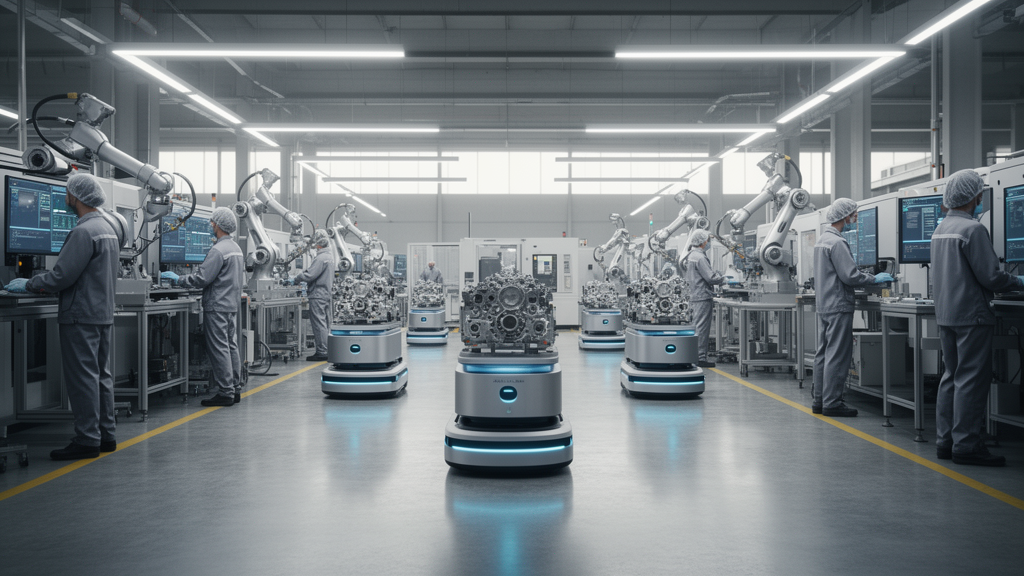
Image Credits: AI Generated
DOI: 10.1016/j.jjimei.2026.100438
Keywords: Human–AI Interaction, Smart Product–Service Systems, Multi-Agent Systems, Design Science Research, Industrial Services, Generative AI, Retrieval-Augmented Generation, Hallucination Detection, Human-in-the-Loop, Goal-Question-Metric, Sociotechnical Systems, Field Simulation, Task Allocation, Digital Servitization, AgentOps Telemetry, Industrial Automation, Knowledge Engineering, Process Optimization
News Source: Denise Maddox. (November 23, 2026). Industrial Study Demonstrates Multi-Agent Architecture for Smart Product Service Delivery. Scienmag.