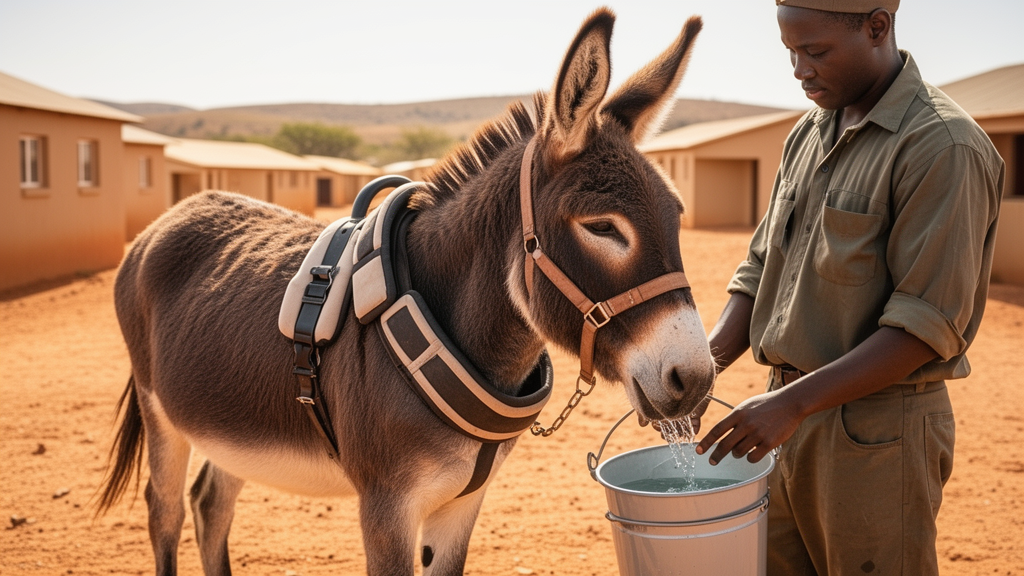
A detailed investigation into the management practices and physical welfare of working equids in South Africa has revealed substantial deficits in basic animal husbandry, healthcare provision, and infrastructural support across rural and peri-urban communities. Conducted within the Mogalakwena Local Municipality of Limpopo Province, the cross-sectional study surveyed 111 households responsible for working draught animals. The research documented critical vulnerabilities across multiple welfare dimensions, establishing that approximately half of the surveyed owners followed no consistent grazing routine, nearly ninety-three percent provided no supplementary feed during seasonal forage shortages, and every surveyed owner reported an absence of preventative vaccinations. Furthermore, widespread dependence on unsupervised home remedies and the use of improvised harnessing materials were found to place substantial physical strain on the animals, highlighting an urgent need for targeted educational initiatives, accessible veterinary services, and systemic policy attention to safeguard these essential working animals.
Working equids remain vital contributors to household livelihoods and local socioeconomic stability in areas where commercial mechanisation has not displaced animal traction. In the Mogalakwena Local Municipality, located within the Waterberg District of Limpopo Province, poverty and unemployment rates range between forty-five and seventy percent, making low-cost transport options indispensable for daily survival. The region experiences hot summers and mild winters, set within an undulating landscape of lowlands and hills where donkey carts serve as one of the primary mechanisms for moving domestic goods, agricultural produce, water, and firewood. Despite the vital economic role these animals fulfill by reducing human physical labor and supporting communal income generation, formal welfare oversight has historically remained minimal, leaving rural working equids exposed to severe environmental and management-related hardships.
To rigorously examine these living conditions, researchers employed both qualitative and quantitative methodologies, selecting households across fourteen peri-urban settlements through a structured snowball sampling strategy. Because no centralized registry of working equid owners existed, initial contacts facilitated connections to subsequent owners until all identifiable households within the target areas were documented. The study received formal ethical clearance from the Research Ethics Committee of the University of South Africa, and data were gathered through comprehensive face-to-face interviews lasting thirty to forty-five minutes. These interviews were administered manually by the lead researcher and trained animal health assistants holding qualifications in animal welfare. In total, the survey captured data on 407 working equids, comprising 404 donkeys representing 99.3 percent of the observed population and three mules accounting for 0.7 percent, with no working horses identified across the surveyed households.
Demographic preferences among respondents heavily favored donkeys over other equine species due to their relative affordability, low maintenance requirements, and perceived resilience to hardship and disease. Mules, while recognized by some owners for their strength, intelligence, and endurance, were broadly regarded as difficult to train, prone to aggressive behavior, and prohibitively expensive to acquire given reduced market availability. The resulting working donkey population was subjected to varied nutritional management, dominated by unrestricted grazing without standardized schedules. Approximately 50.45 percent of respondents operated without any formal grazing timetable, allowing equids to forage only after work, overnight, or during sporadic breaks. Only 36.94 percent took their animals out to graze once daily, while 8.11 percent provided grazing twice daily, and 4.50 percent offered three grazing intervals.
Nutritional vulnerability was further compounded by a pronounced absence of dietary supplementation, with 92.79 percent of owners reporting that they never supplied supplementary feed, leaving animals entirely dependent on natural pastures even during cold winter months when forage quality significantly declines. Only 7.21 percent provided supplementary nutrition, while 17.12 percent supplied crop residues, 2.70 percent provided concentrates, and 1.80 percent offered kitchen scraps. Regarding hydration, 87.39 percent of owners provided drinking water in buckets placed inside homestead enclosures, usually before or after daily work. Conversely, 16.22 percent of owners allowed equids turned out into bushes or communal lands to fend for themselves by finding water in local streams and rivers, exposing them to dehydration risks during hot periods when physiological water demands escalate.
Housing conditions across the surveyed communities exhibited similar deficiencies in environmental protection. Just under half of the participating owners, representing 45.05 percent, housed their equids at night inside traditional kraals constructed from wood, thorn bushes, or scrap materials. While these enclosures are specifically intended to safeguard animals against local theft and predatory wildlife, they provide virtually no barrier against rain, wind, or direct temperature extremes. An even larger proportion of owners, comprising 55.86 percent of the sample, allowed their working animals to roam freely in the bush overnight without any structural protection, while 6.31 percent confined their animals within residential yards. These housing practices conflict with statutory welfare expectations, which mandate that domestic working animals be afforded adequate shelter to protect them from inclement weather, insect exposure, and vehicular collisions.
Veterinary health management among the surveyed households was characterized by a heavy reliance on self-treatment and an almost complete absence of professional veterinary oversight. A significant majority of respondents, representing 79.28 percent, treated sick or injured equids themselves rather than seeking veterinary assistance, while 6.31 percent took no action when an animal became ill, and 1.80 percent consulted neighboring owners. Strikingly, 5.41 percent of participants explicitly stated that equids, particularly donkeys, do not experience illness, reflecting an enduring cultural perception of donkeys as impervious beasts of burden. Only 7.21 percent reported contacting a local animal welfare organization or veterinary professional during episodes of equine illness, creating acute risks of disease mismanagement, improper drug dosages, and prolonged animal suffering.
Preventative medical procedures were virtually nonexistent across the study area, with exactly one hundred percent of respondents reporting that they never vaccinated their working equids against infectious diseases. Parasite management was similarly neglected: 88.29 percent of owners provided no treatment for internal parasites, and 53.15 percent failed to treat external parasitic infestations. Among the minority who administered parasitic remedies, treatments were almost universally conducted without professional supervision, raising concerns regarding improper dosing and the acceleration of antiparasitic drug resistance. While 67.57 percent of owners acquired medicines through agricultural co-operatives, 28.83 percent purchased no commercial medications, frequently resorting to hazardous home remedies such as the direct application of used motor vehicle engine oil, battery ash, petroleum jelly, or agricultural disinfectants to open cutaneous wounds.
Institutional assistance was reported to be virtually absent by the surveyed community members, with one hundred percent of participants stating that no governmental veterinary programs or supportive equine services operated within their municipal vicinity. Furthermore, 83.8 percent reported that no private or non-governmental equid welfare organizations existed in their communities, leaving working animals cut off from essential infrastructure.Routine physical maintenance was likewise abandoned; none of the surveyed owners provided hoof trimming or dental care to their equids, citing a total absence of technical knowledge and service providers. Castration was reported by only a single respondent, who carried out the procedure without veterinary anesthesia to prevent fighting among stallions, while the remaining 99.1 percent kept intact working males for breeding purposes.
Daily operational schedules for working equids varied widely according to commercial demand and seasonal cycles, with peak workloads concentrating during the winter months. Increased winter carting was driven primarily by heightened household demand for firewood and ongoing national electrical power shedding. Work intensity was predominantly dictated by client availability, cited by 61.26 percent of owners, while 29.73 percent worked their animals daily. Over three-quarters of respondents, representing 77.48 percent, worked their equids for three to six hours per day, 18.92 percent operated for under two hours, and 2.70 percent subjected their animals to heavy shifts lasting seven to eleven hours. Daily travel distances ranged between zero and four kilometers for 57.66 percent of equids, five to ten kilometers for 39.64 percent, and exceeded ten kilometers for 2.70 percent.
Working welfare was further compromised during daily operations by prolonged physical strain and suboptimal harnessing equipment. Although 99.10 percent of respondents reported providing daytime rest breaks for their working equids, all of these owners left draught carts and full cargo loads attached to the animals during their rest periods. Furthermore, resting animals were rarely provided with water, feed, or shade. While 94.59 percent of drivers directed their animals using verbal commands, 10.81 percent reported using whipping, and 10.81 percent pulled on reins. Harnessing posed additional hazards: although 99.10 percent utilized working harnesses, 47.75 percent admitted their equipment was unsuitable for the required tasks. Harnesses were predominantly constructed from discarded vehicle seatbelts, old garments, coarse ropes, and industrial conveyor belts, materials known to cause severe chafing, bruising, and chronic soft-tissue wounds.
Attitudes toward the terminal phase of an equid’s working life showed notable compassion alongside persistent vulnerabilities, with 79.28 percent of owners affirming that they continue feeding and caring for their animals until natural death occurs. Surrender to animal welfare centers was cited by 6.31 percent, while 4.50 percent acknowledged neglecting unproductive animals, 3.60 percent opted to sell them, and 0.90 percent utilized humane euthanasia. Interpreting these collective findings requires acknowledging key study limitations, including the reliance on owner self-reporting, the potential for recall and social desirability biases, and the absence of direct physiological or clinical welfare scoring. Nonetheless, the findings clearly demonstrate that working equids in Limpopo Province face chronic welfare risks stemming from socioeconomic barriers and limited veterinary access, underscoring the necessity of collaborative community education, supportive legislation, and accessible rural healthcare to safeguard both animal well-being and rural livelihoods.
Subject of Research: Working equid welfare and management practices in Limpopo Province, South Africa
Article Title: Management practices and welfare of working equids in Mogalakwena local municipality, Limpopo Province, South Africa
Article References: Molapo, D. B., McCrindle, C. M. E., Mbombo-Dweba, T. P., & Oguttu, J. W. (2026). Management practices and welfare of working equids in Mogalakwena local municipality, Limpopo Province, South Africa. Animal Welfare, 35, Article e44. https://doi.org/10.1017/awf.2026.10097
Image Credits: AI Generated
Keywords: working equids, donkeys, animal welfare, Mogalakwena Local Municipality, Limpopo Province, veterinary care, supplementary feeding, kraal housing, parasite control, vaccination coverage, draught animals, harnessing equipment, Animal Protection Act, snowball sampling, rural livelihoods, carting, Waterberg District
News Source: William Thompson. (November 23, 2026). South African Working Equids Face Significant Gaps in Basic Husbandry Care. Scienmag.