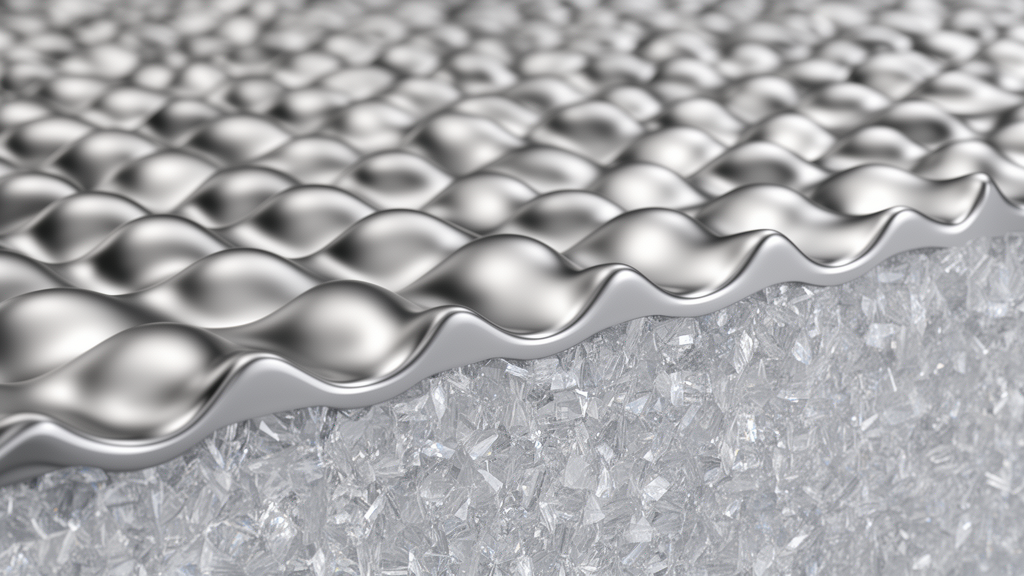
Introducing a microstructured egg-box topography at the interface between metallic lithium and a Li6PS5Cl solid electrolyte increases the discharge current density at which interfacial voiding commences by a factor of ten.
When the operating temperature is elevated to 60 degrees Celsius, the same contoured interfacial configuration successfully accommodates pulsed currents reaching 8 milliamperes per square centimeter while maintaining continuous ionic transport.
To evaluate performance under dynamic conditions representative of practical automotive applications, researchers subjected the contoured cells to discharge current profiles derived directly from the Worldwide Harmonized Light Vehicles Test Procedure. Current and voltage time series from battery testing of a Hyundai Ioniq, sourced from Argonne National Laboratory electric vehicle evaluation datasets, were converted into equivalent cell-level areal current densities based on a 77.4-kilowatt-hour total pack energy capacity and an assumed cell areal capacity of 5 milliampere-hours per square centimeter, with regenerative charging currents excluded. Tested at 2 megapascals of stack pressure and 60 degrees Celsius, the egg-box contoured interface successfully sustained the full demanding WLTP discharge profile, which involves peak discharge currents reaching 9 milliamperes per square centimeter.
The geometric profile of the microstructured interface was designed as a continuous three-dimensional egg-box pattern generated by sweeping a mathematical cosine function along the trajectory of an identical, perpendicular cosine function. The interfacial surface topography is formally defined by the mathematical expression where the surface elevation f(x,y) equals H multiplied by the cosine of 2 pi x divided by S plus H multiplied by the cosine of 2 pi y divided by S. In this formulation, H represents the peak height or amplitude, fixed at 5 micrometers, while S defines the peak separation or spatial wavelength, set to 30 micrometers.
Print trajectories were compiled with NanoWrite software on a commercial Nanoscribe Photonic Professional GT system operating in a dip-in laser lithography configuration, utilizing a 25-times magnification lens with a numerical aperture of 0.8 and liquid IP-S resin. The circular templates, measuring 5 millimeters in diameter with a contoured face opposite a flat baseline face, were built in a layer-by-layer sequence using a slicing distance of 1 micrometer, a hatching spacing of 0.5 micrometers, and a lateral writing block size of 300 micrometers by 300 micrometers. Following optical polymerization, the templates were washed in propylene glycol monomethyl ether acetate of at least 99.5 percent purity to dissolve unpolymerized precursor resin, rinsed with isopropanol of at least 99.5 percent purity, dried under vacuum overnight, and transferred directly into an argon-filled glovebox environment maintained below 1 part per million of oxygen and moisture.
Solid electrolyte pellets were fabricated by loading 30 milligrams of Li6PS5Cl argyrodite powder, possessing an average particle diameter of 1 micrometer, together with the microstructured polymer template into a 5-millimeter die set. Applying a uniaxial compaction pressure of 400 megapascals imprinted the egg-box surface topography directly onto the ceramic powder while consolidating the electrolyte disc to an overall thickness of approximately 1 millimeter. After mechanical pressing, the polymeric template was detached from the shaped electrolyte pellet. Both contoured and flat comparative Li6PS5Cl discs subsequently underwent thermal sintering in a muffle furnace at 300 degrees Celsius for 30 minutes to optimize bulk ionic conductivity.
Electrochemical validation of interfacial stripping behavior was performed within specialized three-electrode pouch cells assembled inside the inert argon glovebox. Metallic lithium discs measuring 1 millimeter, 0.5 millimeters, and 5 millimeters in diameter served as the working, reference, and counter electrodes, respectively, with an insulating polymer layer isolating the working and reference elements on one face of the electrolyte pellet while the counter electrode resided on the reverse side.
The critical current density for stripping was quantitatively tracked using a Gamry 1010E potentiostat via a stepped chronopotentiometry protocol. Cells were initially cycled by electrochemically plating lithium at 0.2 milliamperes per square centimeter and stripping at 0.2 milliamperes per square centimeter to a fixed areal capacity of 0.2 milliampere-hours per square centimeter. In subsequent cycles, the plating current was maintained at a constant 0.2 milliamperes per square centimeter while the stripping current density was increased incrementally by 0.2 milliamperes per square centimeter per cycle.
To evaluate the architectural concept under complete electrochemical device conditions, solid-state full cells were assembled by coupling the contoured lithium anode with a composite transition-metal oxide cathode. The cathode composite was formulated by mortar-and-pestle blending of LiNi0.83Mn0.06Co0.11O2 powder, Li6PS5Cl solid electrolyte, and conductive carbon nanofibres in a weight ratio of 75 to 22 to 3. For standard full cells, 5.2 milligrams of this composite powder were co-pressed with 30 milligrams of Li6PS5Cl and the polymer template at 400 megapascals, after which a 5-millimeter lithium disc was affixed to the anode side. A thin-electrolyte cell variant was prepared by consolidating 2.4 milligrams of Li6PS5Cl with 5.2 milligrams of cathode composite under 50 megapascals, followed by warm isostatic pressing at 450 megapascals and 80 degrees Celsius for 30 minutes before lithium disc attachment. Sealed in stainless-steel pouch casings and operated between cut-off voltages of 4.25 volts and 2.5 volts with a 10-minute terminal hold at 2.5 volts, the thin contoured full cell replicated the superior discharge tolerance of the microstructured interface over its flat equivalent.
Synthesized by heating 99.99 percent purity silver foil and lithium metal in a boron nitride crucible to 500 degrees Celsius for 2 hours with gentle agitation under argon, the resulting Li-Ag alloy delivered even higher operational discharge currents due to enhanced internal lithium flux. The authors noted that while contouring dramatically suppresses voiding during discharge, earlier investigations demonstrated that interface contouring improves charging current limits against dendrite penetration by at most 50 percent, indicating that contouring during discharge must be integrated with complementary charge-focused dendrite suppression techniques.
Subject of Research: Mitigation of void formation at the lithium and solid electrolyte interface during discharge using contoured surface topography
Article Title: Contouring mitigates voiding at the lithium/ceramic electrolyte interface on discharging solid-state batteries
Article References: Zhang, S., Hu, B., Melvin, D. L. R., Spencer-Jolly, D., Gao, X., Wang, L., Yang, L., Monroe, C. W., & Bruce, P. G. (2026). Contouring mitigates voiding at the lithium/ceramic electrolyte interface on discharging solid-state batteries. Nature Energy. https://doi.org/10.1038/s41560-026-02172-w
Image Credits: AI Generated
DOI: 10.1038/s41560-026-02172-w
Keywords: solid-state batteries, lithium metal anode, Li6PS5Cl, argyrodite electrolyte, interfacial voiding, egg-box topography, critical current density of stripping, voltage polarization, WLTP drive cycle, lithium-silver alloy, two-photon lithography, warm isostatic pressing, three-electrode cell, X-ray computed tomography, composite cathode, LiNi0.83Mn0.06Co0.11O2, stack pressure, pulse cycling
News Source: Faith Mcneil. (November 23, 2026). Egg-Box Interface Contouring Suppresses Voiding During Solid-State Battery Discharge. Scienmag.