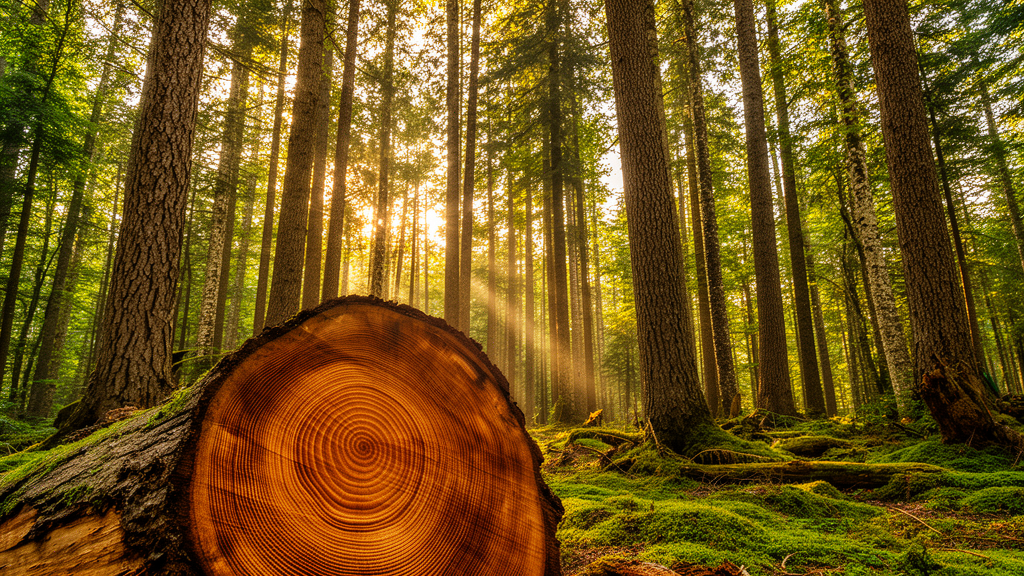
Integrating temperature-sensitive wood density into a demographic vegetation model alters simulated forest structure and biomass accumulation, revealing that warmer conditions can yield shorter, denser trees that store less carbon during early stand development. Dynamic global vegetation models have historically treated wood density as an unvarying, species-specific constant, overlooking the physiological plasticity that trees exhibit across environmental gradients. In a proof-of-concept modeling experiment using the LPJ-GUESS ecosystem framework, researchers demonstrated that replacing static wood properties with an environmentally responsive formulation fundamentally reshapes tree growth trajectories and forest dynamics. When simulated across a European climate gradient, stands developing under higher temperatures produced denser wood tissues but experienced restricted vertical elongation, altering competitive interactions and carbon allocation before canopy closure. These findings indicate that accounting for dynamic wood formation is critical for accurately projecting forest carbon sequestration, particularly across young and regenerating woodlands where early allometric shifts exert lasting influences on ecosystem structure.
Dynamic global vegetation models serve as foundational tools for projecting terrestrial carbon sinks and climate feedbacks, yet their core representations frequently simplify anatomical variability into fixed plant functional types. In the standard architecture of the Lund-Potsdam-Jena General Ecosystem Simulator, designated LPJ-GUESS-STD, wood density is held constant for each functional category, assigning Norway spruce (Picea abies) a fixed baseline value of 186 kilograms of carbon per cubic meter. Under this formulation, simulated spruce cohorts in cold Siberia share identical wood density parameters with cohorts in temperate Germany, irrespective of prevailing thermal regimes. Carbon allocation in standard models optimizes stem, foliage, and root pools through fixed allometric scaling rules, meaning that simulated warming primarily increases carbon assimilation and ring width without adjusting structural carbon density per unit volume. By neglecting environmental regulation of wood tissue construction, conventional demographic models risk introducing systematic biases into long-term predictions of tree height, biomass accumulation, and stand-level competitive thinning.
Wood density represents a central functional trait governing tree mechanical stability, hydraulic transport capacity, and demographic life-history strategies across diverse forest ecosystems. The anatomical property originates during annual xylogenesis, in which temperate and boreal trees generate distinct intra-annual growth rings characterized by earlywood and latewood cellular zones. Early in the vegetative growing season, trees construct earlywood composed of wide-lumen, thin-walled tracheids designed for efficient water transport, whereas later in the season they transition to forming latewood characterized by narrow lumens and thickened secondary walls that confer structural support and elevated density. Numerous dendrochronological investigations demonstrate that latewood density positively correlates with late-summer temperatures, providing a reliable paleoclimatic proxy for reconstructed thermal fluctuations across centuries. At the tree level, wood density governs a trade-off between growth and survival: individuals producing low-density wood expand quickly but suffer higher mortality, whereas trees investing in dense tissues grow slower vertically while gaining mechanical resistance and longer lifespans.
To implement dynamic wood anatomy within LPJ-GUESS, the researchers constructed a semi-empirical module calibrated on latewood density measurements obtained from 52 International Tree-Ring Data Bank sites across Europe and Russia spanning 1901 to 1999. July, August, and September exhibited the strongest correlation between latewood density and temperature, with an explanatory coefficient of determination of 0.34. The authors binned climatic observations into half-degree temperature intervals and fitted a Richard logistic curve using nonlinear least squares regression to characterize physiological bounds. Wood density values were converted to carbon units using an air-dry to oven-dry factor of 0.828 and a carbon fraction multiplier of 0.5. To assess parameter sensitivity, the team formulated two distinct functions: a best-fit formulation termed fLWD-Best and an expanded full-range formulation designated fLWD-Range. Both functions were coupled to a baseline earlywood density of 139 kilograms of carbon per cubic meter and an established 70 to 30 earlywood-to-latewood volumetric ratio.
The simulation experiments evaluated stand recovery following catastrophic stand-clearing disturbances across five European study locations representing distinct temperature regimes: Switzerland, Germany-Hessen, Russia, Germany, and France. Climate inputs were derived from historical CRU JRA meteorological data covering 1901 to 1930, repeated in 30-year cyclic intervals and corrected for topography using an environmental lapse rate of 0.649 degrees Celsius per 100 meters of elevation. Following an extensive 700-year spin-up phase that established stable soil pools, simulations introduced stand-destroying events and initiated 300 years of subsequent recovery replanted at a standardized density of 200 boreal needle-leaved evergreen individuals per hectare. To evaluate establishment variability, the researchers generated 30 climate ensemble members per site, averaging outputs across 25 replicate patches. The experimental design specifically tested three sequential hypotheses: whether temperature-driven wood density alters individual tree stature and carbon content, whether individual structural shifts modify self-thinning mortality and tree density, and whether climate warming impacts diverge across developmental life stages.
Stem wood density diverged substantially from the static 186 kilograms of carbon per cubic meter baseline across study sites, supporting the hypothesis that dynamic wood properties markedly modify individual tree stature. At the warmest geographic sites in Germany and France, mean stem wood density exceeded default parameter values by 5 to 7 kilograms of carbon per cubic meter under fLWD-Best and by 8 to 12 kilograms under fLWD-Range. Conversely, cooler environments in Switzerland and Germany-Hessen exhibited wood density reductions ranging from 2 to 15 kilograms under the best-fit curve and 3 to 27 kilograms under full-range conditions. These anatomical differences generated pronounced allometric consequences: trees developing lighter wood in cool climates grew taller, exceeding standard model height predictions by more than 14 percent in Switzerland, whereas trees constructing denser xylem in warmer locations exhibited up to 7 percent lower mean height. Individual wood carbon storage diverged by over 41 percent in Swiss simulations and fell by up to 17 percent in French stands.
Stand-level demographic trajectories confirmed that dynamic wood density modifies forest structure, though the magnitude of self-thinning responses varied across the geographic gradient. Because all simulations began with identical replanting densities, stem numbers remained equivalent until canopy closure. Following canopy closure, stands comprised of taller, low-density trees in Switzerland and Germany-Hessen experienced accelerated light competition and intensified self-thinning, losing between 13 and 40 additional trees per hectare compared to standard model projections. In contrast, plots in Germany and France featuring shorter, denser trees delayed self-thinning mortality, retaining up to 10 to 23 more stems per hectare. These competing structural effects caused stand-level wood carbon per square meter to fluctuate before canopy closure, showing deviations ranging from minus 32 percent to plus 30 percent across ensemble members. Over 300 years of stand maturation, however, carbon stocks per unit ground area stabilized, yielding modest long-term differences of approximately 0.1 kilograms of carbon per square meter across sites.
Simulating a 2-degree Celsius warming perturbation revealed that forest carbon responses to environmental shifts depend strongly on stand developmental age and canopy architecture. When warming was applied before canopy closure, young stands exhibited an immediate increase in wood density, establishing allometric trajectories that constrained vertical elongation. In contrast, mature stands subjected to identical thermal increases responded far more gradually, as newly formed dense outer wood rings progressively integrated with historical low-density inner heartwood reserves. Across most simulated sites, warming reduced individual tree wood carbon because the allometric cost of diminished height outweighed direct wood densification gains. A notable exception emerged in closed-canopy Russian forests, where carbon content increased despite decreased stature, demonstrating that specific combinations of stand age and ambient temperature allow density increases to override height constraints. Furthermore, cold-limited Swiss stands exposed to warming achieved peak relative carbon gains significantly earlier, illustrating temporary productivity surges prior to canopy stabilization.
The authors emphasize that their exploratory framework incorporates necessary simplifications that outline crucial directions for future demographic model refinement. By employing a static 70 to 30 earlywood-to-latewood ratio and fixing earlywood density at 139 kilograms of carbon per cubic meter, the current formulation transfers latewood climatic sensitivity directly to total ring density, which likely overestimates total ring responses compared to direct field measurements. Empirical observations demonstrate that earlywood properties fluctuate with moisture availability, while atmospheric nitrogen deposition and extended growing seasons alter ring proportions over decades. Additionally, the experimental implementation focused exclusively on a single conifer taxon, Picea abies, across five European locations, leaving open questions regarding how diverse broadleaved functional types and multi-species competitive mixtures would respond under equivalent environmental drivers. Mechanistic representations capturing hormonal regulation, cell division rates, and secondary wall thickening will be necessary to resolve the full physiological complexity of xylogenesis under fluctuating environmental conditions.
Despite these structural simplifications, incorporating dynamic wood density into demographic models represents a significant methodological advance for global carbon cycle modeling and forest vulnerability assessments. By uncoupling wood construction from total carbon assimilation, the LPJ-GUESS-WD framework provides an empirical platform to explore source-sink hypotheses, evaluating whether wood formation is limited by photosynthetic substrate availability or environmental constraints on tissue synthesis. Dynamic wood traits also improve simulated resilience against disturbances like drought-induced cavitation and wind damage, which correlate with wood density and tree stature. Because secondary, regenerating woodlands account for approximately 60 percent of global forest cover, capturing how young stands allocate carbon prior to canopy closure is essential for managing secondary carbon sinks. Ultimately, integrating flexible anatomical traits into dynamic global vegetation models reduces persistent uncertainties surrounding carbon residence times and provides a physiologically grounded foundation for predicting forest ecosystem feedbacks under accelerating climate change.
Subject of Research: Modeling the impact of environmentally responsive wood density on forest carbon storage and stand dynamics
Article Title: Environmentally dependent wood density influences forest structure and dynamics in a demographic vegetation model
Article References: Voss, A.-K., Olin, S., Zhou, H., Fonti, P., & Eckes-Shephard, A. H. (2026). Environmentally dependent wood density influences forest structure and dynamics in a demographic vegetation model. Quantitative Plant Biology, 7, Article e5. https://doi.org/10.1017/qpb.2026.10038
Image Credits: AI Generated
Keywords: LPJ-GUESS, wood density, dynamic global vegetation models, carbon storage, forest dynamics, Picea abies, Norway spruce, latewood density, earlywood, canopy closure, tree allometry, stem wood density, self-thinning, tree rings, International Tree Ring Databank, temperature response, biomass allocation, secondary forests
News Source: Drew Townsend. (November 23, 2026). Dynamic Wood Density Reshapes Tree Height and Carbon in Forest Simulations. Scienmag.