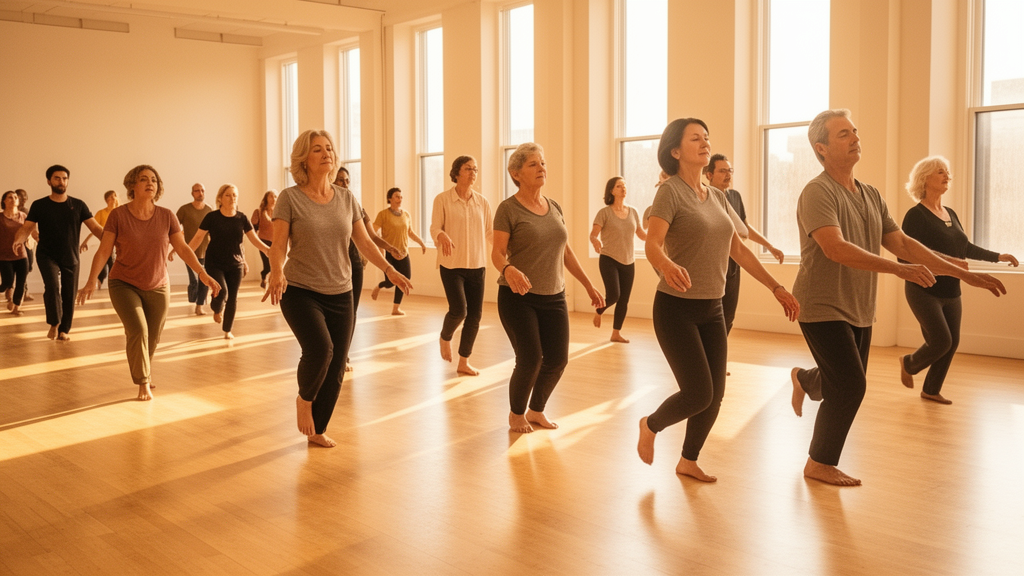
A six-year longitudinal qualitative investigation published in the American Journal of Dance Therapy documents how intentional dance prayer, a specialized therapeutic modality derived from authentic movement, fosters profound emotional integration, bodily grounding, and spiritual awareness among practitioners. Developed by researcher and dance movement therapist Anette Torgersen beginning in 2018, intentional dance prayer bridges somatic movement traditions, phenomenological philosophy, and contemplative ritual. Rather than relying on intellectual discourse or conventional talk therapy, the practice engages the body as an original source of valid knowledge. The empirical inquiry tracked participant experiences through long-term practical and theoretical reflections, qualitative interviews, and pedagogical workshops conducted between 2018 and 2025. Across systematic evaluations, participants reported notable shifts in self-acceptance, emotional release, and personal insight, illustrating how structured movement interventions can access unconscious psychological material and facilitate psychological wholeness within a benevolent communal container.
The theoretical framework of intentional dance prayer is fundamentally anchored in Maurice Merleau-Ponty’s body phenomenology alongside established principles of authentic movement. Within phenomenological philosophy, human bodily experience provides an immediate, first-person perspective that underpins emotional and spiritual meaning-making. According to embodiment theory, internal psychological processes and spiritual experiences occur directly through physical form, wherein sensory information from the flesh actively shapes consciousness and vice versa. Authentic movement, originally conceived in California during the 1950s by Mary Stark Whitehouse as movement-in-depth and expanded by Janet Adler and Joan Chodorow, centers on a disciplined relationship between a mover and an outer witness. In traditional authentic movement setups, a mover closes their eyes, attends to internal kinesthetic impulses, and moves spontaneously without premeditation, while a non-judgmental witness holds an empathetic holding space. Intentional dance prayer incorporates this dual dynamic while introducing explicit, conscious intentionality formulated as prayer.
Structurally, intentional dance prayer departs from classical authentic movement by establishing a clear division of roles centered on a stated intention. Sessions gather participants into a circular ritual container that functions as a collective field of shared wisdom. Within this group setting, an individual known as the prayer-person identifies an existential question, emotional burden, or personal longing, articulating it into a concise prayerful intention such as praying for heart opening or self-confidence. Rather than dancing their own statement, the prayer-person assumes the role of witness, remaining still with an open posture to observe the unfolding movement. Simultaneously, another participant, designated as the prayer-dancer or mover, undertakes the physical embodiment of that prayer. Serving the group without personal stake in the outcome, the prayer-dancer surrenders conscious ego control, attending closely to bodily sensations and spontaneous somatic impulses to translate the originator’s intention into physical motion.
The research methodology applied hermeneutic phenomenological approaches to analyze the lived dimensions of this movement practice. Following the phenomenological methodologies of Max van Manen, the study prioritized personal descriptions, close qualitative observation, and conversational interviews to capture accounts that must be felt somatically rather than merely grasped through cognitive analysis. Formal qualitative data collection took place in 2024 through in-depth conversational interviews with eight women selected from a cohort of twenty long-term practitioners who had engaged with the practice over several years. In addition to these primary interviews, the author drew upon observational findings from educational workshops and clinical classes conducted between 2018 and 2025 at the University of South-Eastern Norway, which encompassed approximately 100 to 120 dance movement therapy students. Ethical protocols ensured that all participant identities were pseudonymized, and the wider research project was officially registered with SIKT, Norway’s national knowledge sector service provider.
Data analysis proceeded through axial deductive coding structured around the overarching concept of experience, ultimately establishing four defined thematic subcategories aligned with the primary interview questions. These categories examined the lived experience of having another person dance one’s personal prayer, the somatic experience of dancing someone else’s prayer, observed processes of insight and therapeutic transformation, and the specific mechanics of working with an explicit intention. Within these classifications, recurring keywords emerged consistently across the interview transcripts, highlighting spiritual awakenings, realization processes, bodily grounding, states of being moved, emotional integration, and perceptual clarity. Participants repeatedly characterized the practice room as a secure, non-judgmental environment that fostered vulnerability, deep presence, unadorned authenticity, and profound mutual recognition, enabling individuals to confront internal difficulties that had previously remained inaccessible to conscious awareness.
When examining the first thematic area—experiencing another person dancing one’s prayer—participants described the phenomenon as an existential awakening and deep validation. A participant named Nisima recounted that witnessing her prayer embodied by another mover felt like a direct realization process that bridged her physical body and soul. Nisima emphasized that the prayer-dancer remarkably captured the subtle essence of her internal struggle, clarifying personal potentials and unresolved challenges that she had not clearly formulated at the beginning of the workshop session. The empirical data highlighted that because the original intention arose from deep bodily contact rather than abstract mental rationalization, seeing it manifested visually in space exerted a reinforcing psychological effect. In phenomenological terms, witnessing one’s inner psychic material mirrored in physical movement allowed participants to navigate between subjective first-person bodily sensations and objective third-person observational perspectives, thereby dissolving inner fragmentation.
Regarding the second thematic subcategory, participants who assumed the role of the prayer-dancer reported entering profound states of somatic resonance and ego surrender. Asked to summarize the experience of dancing another person’s longing in a single word, respondents cited terms such as honor, reverence, sacred ritual, transformation, and authentic expression. A participant named Carla compared this embodied attunement to her historical background in silent Quaker meetings, where individuals speak only when inwardly moved by the spirit. In intentional dance prayer, movers described an analogous process of emptying their personal ego and listening inwardly to kinesthetic impulses until physical action emerged organically from collective unconscious dynamics. Drawing on Janet Adler’s mystical writings, the study notes that when the mover and witness engage in deep intersubjective attunement, an empathic bridging occurs wherein personal boundaries soften, allowing both participants to encounter a shared sense of transpersonal interconnectedness and mutual compassion.
The third investigative dimension addressed the practical realization of psychological insight, emotional processing, and therapeutic healing. Several long-term practitioners detailed how the movement container provided an essential physical outlet for complex grief and life transitions that resisted conventional cognitive therapies. Carla recounted utilizing intentional dance prayer to navigate the painful emotional aftermath of a divorce following thirty years of marriage. Having previously experienced frustration with the analytical worksheets of cognitive behavioral therapy, she found that intentional dance prayer permitted unfiltered weeping, physical expression of despair, and eventual emotional reconciliation. Grounding these findings in Carl Jung’s analytical psychology, the author notes that unexpressed affect often congeals into emotionally charged complexes that become split off from the conscious ego; by granting those emotions direct physical manifestation, intentional dance prayer facilitates the symbolic and energetic release necessary for transitioning from inertia to psychological resolution.
A critical operational element examined in the fourth subcategory involves the precise psychological role of formulating an explicit intention. Drawing on Franz Ruppert’s identity-oriented psychotrauma therapy intention method, Torgersen observed that verbalizing a focused intention serves as an organizing catalyst that directs unconscious forces toward conscious manifestation. A participant named Karin explained that defining a singular focus provided clarity of purpose and prevented cognitive overwhelm during somatic exploration, giving the ensuing dance structured direction. In accordance with Mary Stark Whitehouse’s foundational observations on active imagination in movement, the stated prayer forces the mover to tolerate inner tension until an authentic kinesthetic image arises organically. Katy similarly reported that engaging with clear intentionality produced an undeniable sensation of truth and vulnerability, stripping away defensive pretenses and allowing participants to encounter core aspects of their human identity without evasion.
Beyond formal participant interviews, the investigation documents insights gathered from Torgersen’s personal professional evolution as a facilitator over decades of movement exploration. Her methodology incorporated elements of Elaine Summers’ Kinetic Awareness somatic technique, specifically utilizing slow, localized body movements and specialized rubber ball exercises to release physical tension and heighten sensory self-witnessing prior to authentic movement sessions. The author also experimented with innovative group adaptations, such as group healing prayers where an entire collective dances a single participant’s articulated intention, and transition prayers where the prayer-dancer physically transmits the unfolding dance back to the originator to foster complete somatic integration. Through these clinical variations, Torgersen observed that facilitators develop heightened somatic presence, enabling them to safely navigate unpredictable, emotionally intense therapeutic spaces while maintaining clear boundaries.
To assist practitioners seeking to implement this approach, the author outlines foundational clinical guidelines and structural precautions for therapeutic practice. Facilitators must establish a consistent ritual container that prioritizes three basic physiological principles: cultivating continuous bodily presence, maintaining deliberate breath awareness, and ensuring physical grounding against the floor. Before any dancing commences, every participant must independently articulate and record their own intention without external manipulation or interpretive interference from the facilitator. Torgersen advises clinicians to pilot the basic intentional dance prayer format in controlled, one-on-one settings with colleagues or individual clients before attempting group implementations. Crucially, the author emphasizes clear clinical exclusion criteria, noting that group intentional dance prayer formats are contraindicated for individuals experiencing untreated trauma, active substance use disorders, or severe acute psychiatric instability due to the intense emotional and archetypal material evoked.
In its synthesis, the study demonstrates that intentional dance prayer provides an embodied, non-verbal methodology for integrating mind, body, and spiritual dimensions within clinical and somatic frameworks. By combining the rigorous witnessing dynamics of authentic movement with explicit intentionality, the practice enables participants to transform split-off unconscious material into conscious awareness and embodied self-acceptance. While the qualitative findings offer deep empirical insights into the subjective lived experiences of its eight primary interviewees and broader university student cohorts, the author notes that future research should continue documenting and evaluating structured variations across diverse therapeutic settings. Ultimately, the paper situates intentional dance prayer as a grounded somatic discipline that demonstrates how expressive physical movement can bridge personal psychology and transpersonal experience, providing a valuable qualitative contribution to contemporary dance movement therapy scholarship.
Subject of Research: Qualitative investigation of participant experiences and therapeutic processes within intentional dance prayer
Article Title: My Dance Is My Prayer
Article References: Torgersen, A. (2026). My Dance Is My Prayer. American Journal of Dance Therapy, 48(1), 6-23. https://doi.org/10.1007/s10465-025-09426-2
Image Credits: AI Generated
DOI: 10.1007/s10465-025-09426-2
Keywords: intentional dance prayer, authentic movement, dance movement therapy, body phenomenology, Merleau-Ponty, qualitative longitudinal study, hermeneutic phenomenology, somatics, somatic resonance, kinetic awareness, active imagination, inner witness, transpersonal psychology, embodied awareness, psychic wholeness, University of South-Eastern Norway, SIKT Norway
News Source: Ophelia Keating. (November 23, 2026). Longitudinal Qualitative Study Analyzes Therapeutic Experiences in Intentional Dance Prayer. Scienmag.