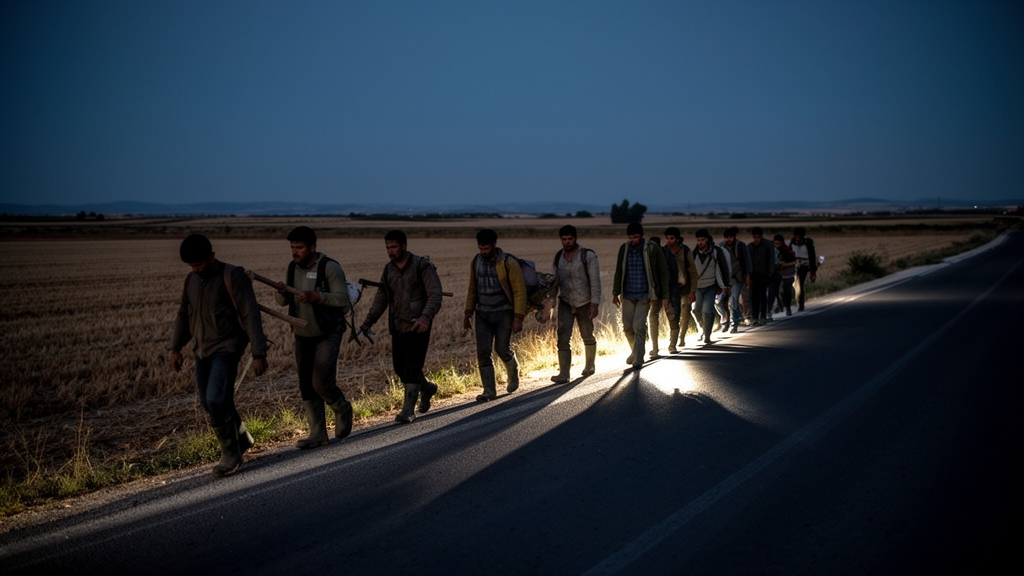
A twelve-month ethnographic study published in Agriculture and Human Values reveals that irregular migrant farmworkers in Spain face acute risks of injury and fatal vehicular collisions during transit to agricultural fields. Conducted by researcher Diana Tung across Murcia, Valencia, and Catalunya, the investigation demonstrates how modern industrial agrifood production, combined with immigration enforcement and informal contracting systems, shifts severe occupational hazards beyond farm boundaries. While occupational health frameworks traditionally evaluate work-related injury strictly within physical farm borders, the study argues that transportation constitutes an integral, dangerously unregulated component of agricultural infrastructure. By tracking the daily mobility of undocumented agricultural labourers, Tung establishes that traffic collisions involving passenger vans, known locally as furgonetas, represent predictable outcomes of structural vulnerability rather than isolated commuting mishaps or mere individual driver errors.
The operational scale of the Spanish agricultural sector provides essential context for the pervasive movement of seasonal labour across rural territories. Spain generates approximately one-quarter of all fruits and vegetables produced within the European Union, an output heavily reliant on an estimated 229,000 migrant labourers who constitute roughly 70 percent of the national agricultural workforce. Published figures indicate that at least 8.9 percent of these workers possess irregular migratory status, though researchers acknowledge this underestimates the population due to underreporting. Within this national network, the southeastern region of Murcia, known as the orchard of Europe, generates more than 2.8 billion euros annually across just 2.2 percent of Spain’s territory. Murcia supplies 20 percent of Spanish fruit and vegetable exports, including lettuce, apricots, melons, and citrus fruits. Crucially, migrant workers account for three out of every five agricultural labourers working across Murcian farms.
National legal frameworks and workplace inspections shape the clandestine mechanisms through which undocumented migrants enter rural employment. Under Spanish immigration statutes, agricultural enterprises caught hiring irregular workers face administrative penalties reaching up to 100,000 euros per unauthorised worker. Agribusinesses frequently rely on sprawling, isolated geographical sites to keep undocumented labourers outside the view of state regulators. For recent arrivals from Latin America, North Africa, and sub-Saharan Africa lacking legal work permits, agricultural harvesting represents the sole accessible entry point into the domestic labour market. Fieldwork highlights pronounced gendered divisions, as newly arrived male migrants are predominantly channeled into arduous field harvesting, whereas women more frequently secure domestic service or elder care positions. Although male workers often regard agricultural harvesting as a temporary survival strategy while seeking contacts to enter formal employment, legal barriers frequently prolong their dependence on farmwork circuits.
To insulate commercial producers from direct liability and streamline labour management, the sector relies extensively on an informal subcontracting structure known as the cuadrilla system. Under this arrangement, growers avoid negotiating contracts with individual workers, relying instead on an intermediary known as a cabo. The cabo oversees a flexible crew of five to fifteen farmworkers, directing daily tasks and retaining a percentage of each worker’s wages in exchange for securing employment, transportation, and basic accommodation. Field observations show that cabos frequently share irregular legal status or national backgrounds with their crew members, functioning simultaneously as community fixers and extractive intermediaries. Workers depend heavily on crew heads to navigate essential administrative hurdles, such as securing housing and registering an official address through the municipal empadronamiento process, which serves as a necessary prerequisite for any future legal regularisation under Spanish administrative procedures.
The logistical requirements of flexible agricultural harvesting compel cuadrillas to traverse expansive geographical distances on unpredictable schedules. Crew members assemble before dawn at regional transit hubs, such as the El Rollo roundabout near the primary railway station in Murcia city, often unaware of where that day’s shift will occur. Depending on daily ripening patterns and contractor demands, crews assembled in Murcia are routinely transported on two-hour journeys to Lorca or neighboring provinces, while Lorca-based crews may be dispatched simultaneously toward Murcia. Trade union estimates from Comisiones Obreras indicate that between 10,000 and 15,000 migrant farmworkers are dispatched each morning from Lorca alone into surrounding districts. Because municipal restrictions prohibit large commercial buses from entering urban centres due to size and pollution concerns, labour intermediaries rely on commercial cargo vans with heavily tinted rear windows, facilitating discreet boarding operations that minimize visibility and evade local traffic police scrutiny.
Fieldwork data demonstrates the severe financial deductions that transportation dependencies impose on irregular workers receiving discounted piece rates. For example, an undocumented Colombian labourer named Esteban reported receiving 1.30 euros per 30-kilogram crate of harvested mandarins, 1.00 euro per 30-kilogram crate of pomegranates, and approximately 50 euros per day for broccoli picking. By comparison, documented workers performing identical harvesting tasks earned 2.00 euros per crate and approximately 80 euros daily for broccoli. From daily earnings averaging 81.25 euros for harvesting 500 crates of mandarins or 50 euros for pomegranates across eight-person crews, cabos universally deducted a mandatory daily transit fee of 5 euros. Workers were required to pay this transit fee in cash every Saturday, facing strict exclusion from the van on Monday if they defaulted, while biweekly pay schedules forced workers into recurring debt cycles with intermediaries.
The combination of long working hours, physical exhaustion, and vehicle maintenance deficits creates hazardous commuting conditions among intermediaries transporting crews along regional roadways. Because crew leaders must drive transport vans before sunrise and immediately following grueling field shifts, driver fatigue represents an acute hazard across rural highways. The study documents cases where intermediaries engaged in dangerous driving behaviors, including excessive speed and erratic routing, to evade detection by police officers patrolling regional thoroughfares. When intermediaries struggle with personal strain, alcohol misuse, or suspended driving licences following vehicular crashes, labourers face an agonizing choice between boarding an unsafe vehicle or losing critical daily wages. Tung argues that public narratives often reduce these dangerous transit conditions to isolated individual choices or behavioral deficiencies of drivers, ignoring the overarching economic pressures and legal precarity that force exhausted intermediaries and vulnerable workers onto highways.
Vehicular collisions along rural highways function as devastating tragedies for migrant families, yet industrial agricultural networks frequently treat them as minor operational interruptions. Reviewing contemporary media accounts, the study highlights a collision on 18 July 2024, when a commercial freight truck struck a stationary van carrying farmworkers along a highway shoulder, killing an unnamed Nigerian national and trapping eight surviving passengers who sustained grave trauma, including two requiring emergency neurosurgery. Earlier that year, on 15 January 2024, another road collision in La Escarihuela claimed the life of an unnamed 21-year-old Colombian woman and injured 13 other agricultural passengers returning from harvesting iceberg lettuce. News media typically report these devastating collisions in brief, clipped dispatches that omit the names, burial arrangements, post-mortem repatriation logistics, and long-term rehabilitation struggles of victims, allowing commercial harvesting and packaging networks to replace injured labourers rapidly without disrupting supply schedules.
The investigation connects these contemporary transit hazards with the historical precedent of the 2001 Lorca collision, in which a passenger train struck an overcrowded van carrying fourteen undocumented Ecuadorian farmworkers. The disaster claimed twelve lives, leaving only two survivors, and highlighted the precarious transportation conditions endured by irregular agricultural labourers. Following the tragedy, Spanish authorities arrested and fined businessman Victor Lirón, enacting statutory penalties ranging between 1 million and 10 million pesetas for hiring irregular labourers. This enforcement prompted widespread agricultural grower strikes that left thousands of migrants without livelihood, precipitating the historic March for Life where two thousand Ecuadorian workers marched from Lorca to Murcia.
The political mobilization that followed the Lorca disaster forced the Spanish government to enact extraordinary amnesty provisions, granting legal residency and work authorization to approximately 20,800 undocumented Ecuadorian migrants while repatriating another 4,000 individuals. Beneficiaries of this regularisation, including former farmworker Mario Águilar, went on to establish enduring civic organizations, such as the Association of New Lorquinians in 2009, which organizes annual commemorative events at the Plaza de la República de Ecuador. Today, Ecuadorian residents form an established community of roughly 4,000 individuals in Lorca, giving rise to the municipality’s colloquial name of LorQuito. Nevertheless, the study demonstrates that while policy interventions transformed the trajectory of that specific migrant cohort, they left underlying structural vulnerabilities intact for subsequent waves of undocumented farmworkers, who continue to undertake high-risk highway transit in overcrowded vehicles to reach dispersed field sites across the Spanish countryside.
Methodologically, the investigation synthesises twelve months of ethnographic fieldwork conducted between July 2025 and July 2026, incorporating twenty-five Spanish-language semi-structured interviews, direct site visits across citrus supply chains, textual analyses of twenty media reports, and reviews of digital classified advertisements on platforms such as Milanuncios. The findings challenge conventional institutional frameworks, noting that European Commission guidelines for workplace accidents explicitly exclude commuting journeys between home and work, even though Spanish statutes acknowledge in itinere collisions as occupational traffic accidents. Tung concludes that expanding occupational health frameworks beyond physical field boundaries is essential, especially as agricultural labourers face mounting environmental hazards, including record heat waves, destructive wildfire seasons, and extreme storms, alongside heightened social hostility exemplified by anti-migrant unrest in Torre Pacheco during July 2025. The paper points to the national regularisation initiative announced in January 2026 for 500,000 irregular migrants as a crucial step toward mitigating structural vulnerabilities off the farm.
Subject of Research: Structural vulnerabilities and vehicular transit hazards among irregular migrant farmworkers in Spain
Article Title: Death and disposability: irregular migrant-farmworkers’ extraordinary exposure to traffic ‘accidents’ in Spain
Article References: Tung, D. (2026). Death and disposability: irregular migrant-farmworkers’ extraordinary exposure to traffic ‘accidents’ in Spain. Agriculture and Human Values, 43(4), Article 184. https://doi.org/10.1007/s10460-026-10966-7
Image Credits: AI Generated
DOI: 10.1007/s10460-026-10966-7
Keywords: agricultural labour, irregular migration, cuadrilla system, occupational health and safety, Murcia agriculture, transit hazards, furgoneta transport, Lorca tragedy, in itinere accidents, citrus supply chains, empadronamiento, farmworker exploitation, automobility, regularisation policies, Torre Pacheco unrest, piece rate wages, Association of New Lorquinians, ethnographic fieldwork
News Source: Alan Morgan. (November 23, 2026). Undocumented Farmworkers in Spain Face Severe Transit Hazards Beyond Field Borders. Scienmag.