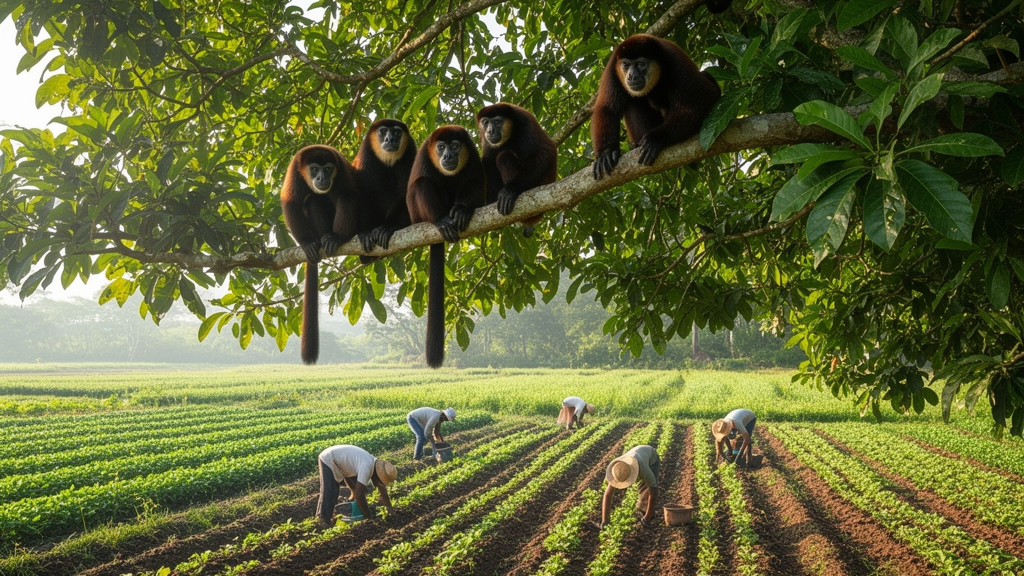
In human-modified landscapes across the globe, wild animals must balance avoiding anthropogenic disturbance against the physiological costs of avoidance, which are paid primarily in the currency of physical locomotion. A field study published in Behavioral Ecology and Sociobiology by Ariadna Rangel-Negrín, Andrea Forero-Orduña, and Pedro A. D. Dias demonstrates that mantled howler monkeys (Alouatta palliata) living in a working shade-agroforestry plantation do not exhibit reactive flight to approaching farm laborers. Instead of fleeing when people approach, these arboreal primates maintain their typical energy-conserving routines. The empirical findings reveal that approximately 63 percent of the moment-to-moment changes in distance between monkeys and workers are generated by the movement of humans rather than the animals. Furthermore, while monkey groups maintained greater average distances from laborers on high-worker days, counterfactual spatial analyses demonstrate that this separation was produced primarily by where farm tasks occurred rather than active relocation by the primates.
The theoretical framework governing animal responses to human encounters is anchored in the risk-disturbance hypothesis and escape theory, which posit that wildlife perceive anthropogenic stimuli as predation-like threats and execute antipredator maneuvers accordingly. In conventional disturbance studies, researchers frequently rely on proximity-based metrics, such as flight-initiation distances or immediate displacements, under the implicit assumption that changes in separation are authored exclusively by the animal. However, because Euclidean separation between two mobile entities is a joint product of both trajectories, spatial shifts cannot be attributed to animal decisions without tracking human movement vectors. This conceptual ambiguity is acute for time-minimizing species. Unlike energy maximizers that dedicate substantial portions of their daily budgets to foraging and can absorb the metabolic costs of repeated flight, time minimizers fulfill fixed caloric requirements and spend up to 80 percent of daylight resting. For these animals, locomotion imposes severe energetic penalties, which predict elevated fecal glucocorticoid concentrations in wild howlers.
To decompose howler monkey spatial behavior into reactive and cumulative components, the research team conducted their investigation at La Flor de Catemaco, a 165-hectare property within the Los Tuxtlas Biosphere Reserve in Veracruz, Mexico. Approximately 100 hectares consist of tropical evergreen rainforest dedicated to shade cultivation of ornamental palms and ferns beneath large canopy trees. The property features pedestrian paths and service roads traversed by tractors, trucks, and agricultural laborers whose daily assignments vary according to management schedules. The researchers tracked two habituated groups of mantled howler monkeys, consisting of 15 to 17 and 11 to 13 individuals, that have been monitored since 2012. Several resident individuals were translocated to the site in 2002 to 2004 or were born within the forest, experiencing daily exposure to agricultural labor without hunting. This habituation allowed the researchers to evaluate primate responses to routine human presence independent of acute predatory threats or direct persecution.
Between March 2021 and March 2022, observers conducted field follows spanning 112 observation days across 37 visits, accumulating 3,116 synchronous, instantaneous records collected at 15-minute intervals. Follows were carried out on weekdays during seven-hour windows, primarily between 07:30 and 16:00, using handheld GPS units with horizontal accuracy under five meters. At each scan, one observer recorded the coordinates of the primate group geometric center and predominant group activity, while a second observer synchronously mapped the position and activity of the nearest agricultural laborer. Worker numbers ranged from 1 to 55 individuals per scan, with a median of 5, categorized by operational duties including greenhouse work, warehouse tasks, road maintenance, resting periods, or shift conclusions. Concurrent acoustic measurements were logged using a calibrated Class 2 integrating sound-level meter, capturing equivalent continuous sound pressure levels over 60-second intervals spanning 40 to 80 decibels. Group displacements exceeding five meters between successive 15-minute intervals were classified as true locomotive steps.
The empirical results firmly refuted the primary prediction that human proximity or density would trigger reactive flight responses in howler groups. Primate groups remained stationary in 85.6 percent of the 2,990 usable single-interval observation steps, engaging in locomotion exceeding five meters during only 14.4 percent of recorded intervals. Binomial generalized linear mixed models incorporating random intercepts for observation days and visits demonstrated that the probability of group movement was statistically unrelated to the number of agricultural workers present, ambient sound levels, Euclidean distance to the nearest laborer, or time of day. Incorporating the movement state of the preceding interval yielded no significant effect, indicating that movement occurrence was close to serially independent within observation days. Rather than exhibiting heightened vigilance-induced flight or disturbance-driven agitation, the monkeys displayed an unwavering baseline of near-immobility. Crucially, statistical analyses showed that remaining stationary was not an active freezing response to humans, but reflected the resting biology of an energy-conservative time minimizer.
When howler monkey groups did initiate movement, their directional trajectories showed no spatial orientation away from nearby farm personnel, contradicting the second reactive-flight prediction. Circular statistical assessments of 428 recorded movement steps revealed a mean resultant vector length of 0.08, denoting a near-uniform angular distribution indistinguishable from random orientation relative to the nearest worker. A V-test for concentration away from workers confirmed the absence of directed escape, while orthogonal vector decomposition showed that lateral movement dominated, with a median lateral displacement of 28.4 meters compared to a median radial displacement of negative 6.0 meters. This negative value indicates a slight net bias toward rather than away from the nearest laborer, with only 46 percent of movements increasing monkey-worker distance. Permutation analyses rotating daily bearings across 5,000 iterations and day-level cluster bootstraps corroborated that this lack of avoidance was robust, while centripetal controls verified that it was not an artifact of range-center attraction.
Investigating the third prediction concerning the mechanical authorship of distance adjustments, the researchers partitioned consecutive changes in monkey-worker separation using a counterfactual accounting identity. Across intervals where Euclidean separation changed by more than one meter, approximately 63 percent of the absolute change magnitude was attributable to worker locomotion rather than primate travel, with nearest-worker identity reassignments accounting for only 2.5 percent of intervals. This dominant human contribution remained consistent across four alternative mathematical definitions, ranging from 42 percent under variance decomposition up to 79 percent when averaging per-interval shares. Although nearest workers were physically stationary in 57 percent of intervals, the aggregate magnitude of worker displacements drove overall proximity fluctuations. Furthermore, the probability that monkey-worker distance changed within any 15-minute interval increased significantly with worker headcount, reflecting the heightened mobility of larger labor crews rather than primate evasion. When workers remained stationary, the monkeys still exhibited a median radial movement of negative 6.9 meters.
At the cumulative timescale of entire observation days, researchers evaluated whether groups achieved spatial separation from human disturbance regimes without increasing daily travel budgets. Linear mixed models revealed that groups maintained greater mean distances from farm workers on days characterized by elevated worker numbers, with a one-standard-deviation increase of approximately 11 workers yielding roughly 21 percent greater spatial separation. However, this day-scale distancing occurred without any accompanying expansion or contraction of monkey locomotive activity. Daily path lengths, mean step lengths, step lengths given movement, and the daily proportion of moving intervals exhibited no significant relationships with daily worker dosage. Daily noise levels similarly showed no association with cumulative separation, registering only a weak negative correlation with day-to-day activity center displacement. Variance decomposition established that the worker-dose effect operated exclusively across days rather than within them, tracking the overarching daily operational tempo of the plantation rather than real-time human movements, and leaving primate home-range spread entirely unchanged.
Rigorous counterfactual modeling proved that the observed day-scale separation could not be interpreted as evidence of active cumulative avoidance by the howler monkeys. When the researchers calculated counterfactual distances holding primate group locations fixed at their historical range centers, the positive relationship between worker numbers and group-worker separation persisted at roughly half its original magnitude. Conversely, when worker coordinates were held fixed while monkey movements varied freely, the statistical association disappeared entirely. Empirical tracking demonstrated that nearest-worker locations were situated significantly further from the monkeys core range on high-worker days, while monkey distances from their own range center showed no correlation with worker counts. Day-swap null distributions confirmed that the observed association was not statistically distinguishable from random temporal pairings. This pattern arose directly from agricultural logistics: labor-intensive greenhouse tasks, which concentrated an average of 16.1 workers, occurred at a mean distance of 353 meters from core monkey habitat, whereas warehouse duties averaged 4.5 workers at 224 meters.
These findings illuminate critical methodological considerations for wildlife monitoring and conservation management within commercial agroforestry ecosystems and working landscapes. Proximity-based metrics that implicitly attribute changing animal-human distances solely to wildlife flight can substantially misinterpret anthropogenic disturbance dynamics when human actors are mobile and spatially structured. While mantled howler monkeys exhibit notable behavioral tolerance and spatial resilience to agricultural labor, the authors caution that spatial immobility must not be conflated with an absence of physiological stress or subclinical fitness costs. In managed working habitats where valuable canopy resources overlap with commercial understory crops, primates may prioritize vital foraging access over costly energetic evasion. Consequently, conservation strategies must avoid relying strictly on wildlife presence or gross spatial separation to infer habitat compatibility, recognizing that observed separation often reflects human enterprise schedules rather than active animal choices. Accurate ecological stewardship requires evaluating both participants trajectories, integrating physiological indicators, and accounting for the complex operational geometry of human land use.
Subject of Research: Spatial movement responses and avoidance mechanisms of mantled howler monkeys exposed to agricultural workers
Article Title: Avoidance without flight: actor and timescale in the spatial responses of an arboreal primate to human presence
Article References: Rangel-Negrín, A., Forero-Orduña, A., & Dias, P. A. D. (2026). Avoidance without flight: actor and timescale in the spatial responses of an arboreal primate to human presence. Behavioral Ecology and Sociobiology, 80(11), Article 136. https://doi.org/10.1007/s00265-026-03811-8
Image Credits: AI Generated
DOI: 10.1007/s00265-026-03811-8
Keywords: Alouatta palliata, mantled howler monkeys, arboreal primates, agroforestry landscapes, human-wildlife coexistence, spatial ecology, flight-initiation distance, risk-disturbance hypothesis, animal movement, Los Tuxtlas Biosphere Reserve, time-minimizing strategy, circular statistics, displacement analysis, anthropogenic noise, behavioral ecology, wildlife disturbance, spatial separation, counterfactual modeling
News Source: Alan Morgan. (November 23, 2026). Howler Monkeys Maintain Distance From Farm Workers Without Exhibiting Reactive Flight. Scienmag.