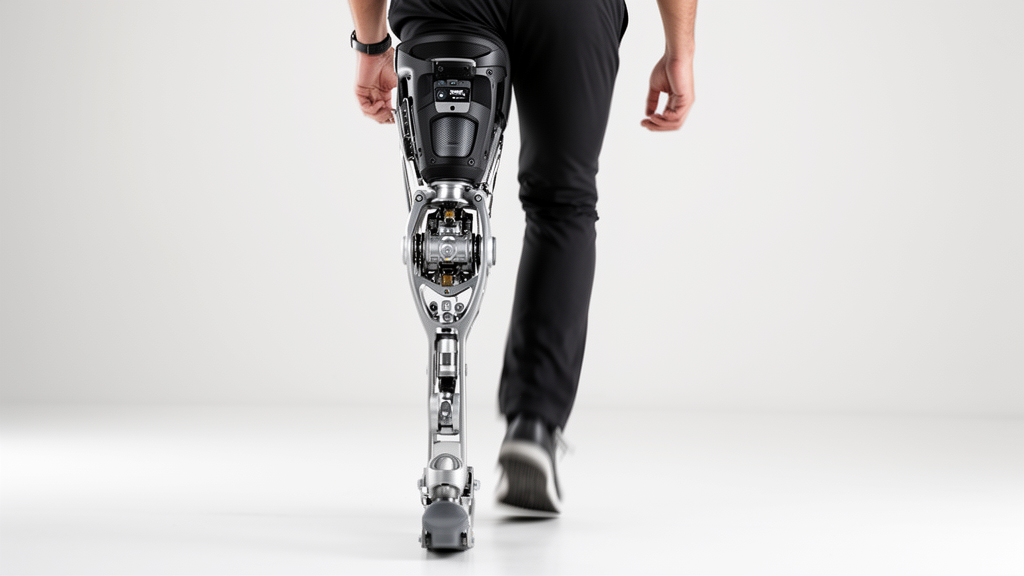
A specialized backward-walking controller implemented on a prototype swing-assist knee prosthesis significantly increases swing-phase knee flexion and heel clearance while reducing compensatory hip elevation among individuals with transfemoral amputation, according to an overground biomechanical study published in Wearable Technologies. In everyday environments, stepping backward is an indispensable component of common domestic and occupational tasks, from maneuvering within kitchens and workshops to opening doors and adjusting positions near counters. When able-bodied individuals walk or step backward, they actively flex their knees, shortening the effective length of the leg during the swing phase. This knee flexion increases ground clearance beneath the foot and creates an essential margin of safety against tripping and falling over unseen floor obstacles. However, individuals with above-knee limb loss who rely on conventional daily-use prostheses face severe biomechanical barriers during backward maneuvers, as standard commercial replacement knees remain energetically passive devices that cannot self-generate active flexion torque when moving in reverse.
The underlying challenge stems directly from the physics of reverse locomotion and ballistic limb dynamics. During forward walking, forward acceleration of the thigh naturally produces passive knee flexion through inertial coupling between the thigh and shank, allowing energy-dissipating hydraulic cylinders to modulate the movement without requiring motorized assist. In backward walking, this physical coupling reverses completely: rearward acceleration of the thigh imposes passive knee extension forces across the joint. Consequently, achieving backward knee flexion requires an active torque source that can overcome the inertial forces pushing the joint into extension, accelerate the shank in flexion, and elevate the foot against the pull of gravity. Because conventional microprocessor-controlled knees are energetically passive and cannot supply active mechanical work during swing, individuals with transfemoral amputation must step backward with an extended, stiff-legged limb. Users typically drag the prosthetic foot across the ground using residual-limb hip extension, exposing them to stumble hazards unless they adopt unnatural compensatory maneuvers such as hip hiking or vaulting to gain clearance.
To overcome this mechanical limitation, researchers evaluated a semi-powered swing-assist microprocessor-controlled knee prototype, designated the SAMPK. This experimental prototype occupies an intermediate design space between entirely passive devices and fully motorized limbs. It integrates a microprocessor-regulated passive hydraulic cylinder to deliver substantial stance support and modulate swing damping alongside a compact, highly backdrivable brushless motor and drive system capable of delivering approximately 6 Newton-meters of active peak torque. To track orientation, limb motion, and ground interaction, the prototype houses an embedded six-axis inertial measurement unit, a knee angle encoder, and an axial shank load cell. While the small electric actuator cannot generate the massive torques necessary for powered stance push-off, its output is ideally suited for shaping swing-phase trajectories by injecting targeted bursts of positive mechanical power to bend and extend the joint.
Operation of the active backward-walking mode is governed by a dedicated three-state finite-state-machine controller engineered to coordinate hydraulic resistance and motorized assistance across the stride cycle. In State 1, representing stance phase, the hydraulic flexion valve closes completely to maintain high resistance against knee bending, while the electric motor remains de-energized, matching the stance security of commercial passive microprocessor knees. Once the user unweights the prosthetic limb at the conclusion of stance, measured by the axial load cell dropping below a threshold set at 15 percent of body weight, the controller immediately triggers Transition T12 into State 2 for swing flexion. In this second state, the hydraulic valve opens to low resistance, and the brushless motor energizes to deliver an approximately constant flexion assistance torque of 5 Newton-meters, drawing roughly 15 amperes of current. Motor torque drives knee flexion until reaching a user-customized angular threshold, whereupon the system initiates Transition T23 into State 3 for swing extension.
During State 3, the motor delivers approximately 4 Newton-meters of extension torque at approximately 12 amperes to extend the knee in advance of loading, while the flexion valve closes to prepare for stance support. Normal return to stance occurs through Transition T31 when the load cell detects ground contact or the knee reaches complete extension. To maximize user safety, the state machine incorporates an automatic 0.5-second state timeout as a guard condition if the flexion threshold is not attained, as well as an immediate override path, T21, that switches the knee straight into high-resistance stance if the user loads the prosthesis during swing flexion. Actuator commands utilize smoothed torque pulses with ramped onsets, which are mechanically filtered by device inertia and hydraulic damping. This architecture eliminates harsh torque reversals, suppresses unwanted oscillations characteristic of high-gain position controllers, and provides distinct, predictable tactile feedback that alerts users to leg state when visual monitoring is impossible.
The prospective value of the backward-walking controller was evaluated in an overground walking protocol approved by the Vanderbilt University Institutional Review Board. Four individuals with unilateral transfemoral amputation—comprising three males and one female ranging from 31 to 67 years in age, 61 to 104 kilograms in body mass, and 6 to 53 years post-amputation—participated in the proof-of-concept investigation. All four participants used the C-Leg 4 as their prescribed daily-use prosthesis. Participants walked backward along a straight five-meter walkway positioned between parallel bars, completing six consecutive passes totaling approximately 30 meters per condition, with turns excluded from the kinematic data. Three conditions were tested: the participant’s daily-use C-Leg 4, the SAMPK prototype operating under a conventional passive microprocessor control algorithm, and the SAMPK prototype executing the active backward-walking controller. Acclimation and self-selection of the peak knee flexion target required under 15 minutes per participant, resulting in chosen flexion targets of 17 degrees for P1, 30 degrees for P2, 30 degrees for P3, and 20 degrees for P4.
Lower-body three-dimensional kinematics were recorded using an XSENS Awinda wireless inertial motion capture system, configured with segment tracking units across the feet, shanks, thighs, and pelvis, supplemented by dedicated markers placed on both heels and hips. Statistical comparisons evaluated per-stride kinematic variables within each individual participant using non-parametric Mann-Whitney U tests paired with Holm-Bonferroni corrections to maintain family-wise error control across pairwise comparisons. The resulting data revealed dramatic alterations in knee kinematic trajectories during backward stepping. Under daily-use and passive SAMPK conditions, participants P2 and P3 exhibited classic stiff-legged gait profiles, maintaining an extended knee throughout the stride cycle with median swing knee angles of only 3.9 degrees and 4.3 degrees on their daily devices. Conversely, participants P1 and P4 displayed a stance-yielding pattern on their daily C-Leg 4, bending the knee under load during stance up to 14.5 degrees and 8.8 degrees, but extending throughout swing.
Activating the backward-walking controller fundamentally reshaped these joint trajectories, shifting peak knee flexion definitively into the swing phase across all participants and restoring a biomimetic swing profile resembling able-bodied motion. Median peak swing knee angles increased significantly to 17.7 degrees for P1, 30.0 degrees for P2, 28.7 degrees for P3, and 23.4 degrees for P4, with every participant demonstrating statistically significant increases over both daily-use and passive prototype baselines at the p < .001 level. This active joint bending directly translated into improved ground clearance beneath the heel, which constitutes the leading edge of the foot during backward stepping and represents the primary locus of stumble risk. Normalized across the middle 80 percent of stride displacement, median heel clearance rose from 2.40 centimeters to 3.78 centimeters in P1, from 2.24 centimeters to 4.14 centimeters in P2, from 2.99 centimeters to 4.85 centimeters in P3, and from 3.31 centimeters to 5.78 centimeters in P4. In aggregate, the mean heel clearance climbed from 2.76 centimeters with daily prostheses to 4.72 centimeters under active swing assist, an increase of 1.96 centimeters that surpasses the 1.3-centimeter threshold recognized as clinically meaningful for stumble mitigation.
Crucially, motion capture confirmed that this elevated heel clearance was achieved through anatomical knee flexion rather than increased bodily compensation. Across all participants, mean vertical hip excursion fell from 4.37 centimeters to 3.46 centimeters. In particular, P1 and P3 noted transitions from high or neutral hip exertion down to low perceived effort, while P4 shifted from low to very low effort, demonstrating that users experienced the functional benefits directly without encountering disorienting actuator disturbances.
While these findings demonstrate a successful proof of concept for specialized backward-walking assistance, the authors emphasized several methodological and structural limitations. The investigation was confined to a small cohort of four individuals who all utilized the same model of daily-use microprocessor knee, meaning outcomes may not generalize across broader patient demographics, varied amputation etiologies, or alternative commercial prosthetic components. Furthermore, experimental testing was conducted over a single laboratory session lasting under three hours, within the protective confines of parallel bars where participants maintained light handrail contact due to inherent safety concerns. The testing protocol was non-randomized, walking speed was not explicitly controlled or reported, and the controller’s fixed torque profiles and state thresholds do not actively adapt to varied walking cadences or irregular outdoor terrain. Nonetheless, the trial provides the first experimental demonstration that low-torque swing assistance can restore biomimetic knee flexion and enhance clearance during backward steps, establishing backward walking as an addressable activity mode for future semi-powered assistive devices.
Subject of Research: Biomechanical evaluation of a swing-assist backward-walking controller for transfemoral knee prostheses
Article Title: Prospective value of a backward-walking controller for a swing-assist knee prosthesis
Article References: Hagstrom, M., Marsh, D., & Goldfarb, M. (2026). Prospective value of a backward-walking controller for a swing-assist knee prosthesis. Wearable Technologies, 7, Article e13. https://doi.org/10.1017/wtc.2026.10048
Image Credits: AI Generated
Keywords: backward walking, prosthetic knee, swing-assist prosthesis, transfemoral amputation, finite-state machine, heel clearance, hip compensation, biomechatronics, rehabilitation robotics, C-Leg 4, gait kinematics, microprocessor-controlled knee, knee flexion, motion capture, stance resistance, stumble prevention
News Source: Denise Maddox. (November 23, 2026). Swing-Assist Knee Controller Improves Backward Walking Clearance and Reduces Hip Compensation. Scienmag.