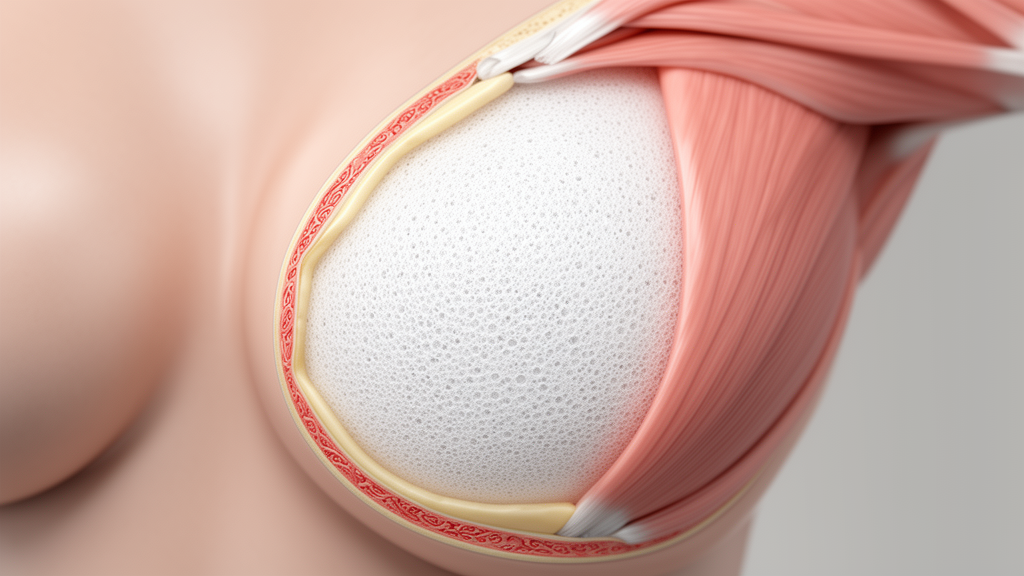
Surgeons evaluating reconstructive and cosmetic outcomes in patients presenting with compromised pectoral anatomy have documented acceptable short-term safety and stability using polyurethane foam-coated silicone implants placed in a dual-plane retromuscular pocket. According to a retrospective single-center study published in Aesthetic Plastic Surgery, this surgical strategy addressed challenging structural conditions, including attenuated or disrupted musculature, prior operative interventions, and reduced soft tissue coverage. Across a consecutive clinical series, the approach yielded a cumulative reoperation rate of 7.4 percent over an average follow-up period of nine months, with no documented instances of clinically significant capsular contracture, implant rupture, or major malposition. The authors underscored that careful patient selection and precise pocket plane execution remain central to achieving favorable results when standard anatomical layers are compromised.
Breast implant design and surface topography have undergone continuous evolution since modern silicone prostheses were introduced in the early 1960s by Cronin and Gerow. Early smooth-walled devices placed in the subglandular space frequently suffered from high rates of capsular contracture, prompting the development of textured shells and subsequent polyurethane foam coatings first described by Ashley in 1970. The polyurethane foam surface fundamentally modifies the foreign-body reaction at the interface between the prosthetic shell and surrounding host tissues. This cellular configuration has historically reduced capsular contracture and enhanced positional stability in subglandular and traditional submuscular pockets, though clinical data regarding dual-plane retromuscular placement in anatomically compromised patients had previously remained limited.
The dual-plane operative approach, originally detailed by Tebbetts, combines partial retropectoral and retromammary pocket positioning to optimize coverage and refine the anatomical relationship between the implant and overlying parenchyma. While dual-plane dissection is widely utilized for routine primary breast augmentations, its application becomes significantly more challenging in complex primary or secondary operations. In secondary procedures such as revision augmentations, augmentation-mastopexies, and reductions with implants, surgeons frequently encounter thin parenchymal coverage, scarred tissue beds, and pectoralis major muscles that have been attenuated, torn, or chronically detached by prior submuscular devices. In such clinical settings, standard smooth or microtextured implants face an increased risk of dynamic animation deformities, lateral displacement, or inferior displacement known as bottoming-out deformities, creating a need for prosthetic surfaces that provide immediate adherence and mechanical anchorage.
The retrospective investigation evaluated a consecutive cohort treated by a single senior surgeon between 2017 and 2025, operating within an established institutional data-collection framework that documented procedures dating back to 2009. Out of 1293 total implant-based breast operations performed across the practice, 68 patients met the specific criteria for dual-plane retromuscular placement using polyurethane-coated silicone implants, accounting for 5.3 percent of the total surgical volume. The procedural breakdown within this selective study cohort comprised 17 augmentation-only operations, 49 augmentation-mastopexies, and 2 reductions combined with implant placement. By contrast, the broader institutional practice utilized retroglandular pockets for the vast majority of straightforward augmentations and reductions, reserving dual-plane retromuscular placement of polyurethane devices strictly for high-risk anatomical scenarios presenting pocket degradation or soft tissue deficiency.
Patient selection relied upon defined intraoperative clinical assessments rather than preoperative quantitative metrics. As part of the operative protocol, eligible candidates were those exhibiting atrophic, scarred, or mechanically compromised pectoralis major musculature, history of prior breast interventions, or inadequate tissue thickness. The definitive choice between microtextured implants and polyurethane foam-coated devices was made intraoperatively during pocket dissection based on direct visual assessment of tissue quality and muscular thickness. Patients undergoing primary aesthetic augmentations who demonstrated normal muscle thickness and adequate coverage were treated with microtextured implants and excluded from this cohort.
Preoperative surgical preparation and marking followed an exacting dimensional protocol, particularly for patients undergoing mastopexy. Markings were initiated with patients seated fully upright, utilizing a ruler and compass to measure the sternal notch, midline, and notch-to-acromion distances to generate a symmetrical geometric frame. The baseline nipple-areola complex position was evaluated to plan precise medialization, establishing point A while seated to designate medial and lateral borders. Subsequent supine positioning permitted pinch testing to establish points B and C before bilateral transposition. In the operating room, procedures were performed under general anesthesia with patients supine. Dissection utilized an inframammary incision across all 68 cases, dividing the inferior origin of the pectoralis major laterally from the inframammary fold while strictly preserving medial sternal attachments to prevent symmastia.
Surgical dissection incorporated dual-plane variations I, II, or III depending on breast parenchymal ptosis and glandular morphology, systematically releasing attachments between the pectoralis major and glandular parenchyma up to the lower or upper border of the areola. Device dimensions were determined by measuring breast base width, areola-to-inframammary fold distances, tissue thickness, and aesthetic volume goals. The series utilized silicone gel implants manufactured with polyurethane foam coatings from Polytech and Silimed, with 15 patients receiving Polytech devices and 53 receiving Silimed prostheses. The cohort demonstrated a mean implant volume of 350 mL, ranging from 190 to 675 mL, with moderate projection selected in 30 cases and high projection in 21 cases. When mastopexy was required, superior or superomedial pedicle techniques were performed following implant placement to tailor cutaneous resections without creating excessive tension along the inframammary closure line.
To prevent microbial colonization and associated capsular contracture, the surgical team enforced a multi-step aseptic protocol across all procedures. Intravenous cefazolin was administered at anesthesia induction at a dose of 1 gram and continued every 8 hours throughout hospitalization, transitioning to oral cefadroxil at 500 mg every 12 hours for 8 days following discharge. The surgical team executed mandatory glove exchanges immediately before device introduction, and an introducer funnel was employed in 100 percent of the operations to prevent contact between the implant shell and cutaneous margins. Implant pockets and devices were thoroughly irrigated with 500 mL of normal saline mixed with one ampoule each of gentamicin and cefazolin. Closed-suction surgical drains were placed in every patient and maintained for 5 to 7 days postoperatively to accommodate the known propensity of polyurethane surfaces to generate transient serous drainage.
The study cohort comprised 68 female patients with a mean age of 38.1 years, ranging from 18 to 59 years, and an average body mass index of 22.9 kg/m2. Self-reported racial demographics showed that 74 percent of participants identified as white, 25 percent as mixed race, and 1 percent as black. Postoperative evaluations took place at 48 hours, 1 week, 15 days, 1 month, 3 months, 6 months, and annually thereafter, yielding a mean follow-up duration of 9 months with a range spanning 1 to 60 months. During follow-up examinations, clinicians systematically evaluated breast shape, symmetry, incision healing, seroma formation, infectious signs, and capsular contracture graded according to the Baker scale, tracking reoperations classified into cosmetic revisions and complication-related surgical interventions.
Overall, 5 out of 68 patients underwent reoperation during the follow-up period, corresponding to an overall reoperation rate of 7.4 percent. Three of these reoperations, representing 4.4 percent of the cohort, were requested for cosmetic reasons when patients sought volume enhancement. In two of these volume-adjustment cases, surgeons observed a mild high-riding implant presentation characterized by superior migration and disproportionate fullness in the upper pole contour. Complication-related surgical revisions occurred in 2 patients, or 2.9 percent of the study group. One patient presented with a waterfall deformity at 1.5 percent, and one patient developed an infectious complication at 1.5 percent. Notably, no patients developed implant rupture, major malposition, or clinically significant capsular contracture during the available observation windows.
Analysis of the complication cases provided specific insights into tissue dynamics and surgical management. The patient who presented with a waterfall deformity experienced descent of the native glandular tissue over an adherent, stably positioned retromuscular implant. Correction was successfully achieved through skin excision and parenchymal reshaping without requiring implant removal or pocket repositioning. The authors noted that this phenomenon represents progressive tissue descent over time rather than primary implant malposition, particularly in patients with baseline ptosis or compromised parenchymal support. The infectious event involved a unilateral late seroma developing roughly 40 days postoperatively in an active smoker who failed to observe cessation guidelines, resulting in Candida species contamination that required implant removal without immediate exchange.
The study authors highlighted several methodological limitations that warrant consideration when reviewing these outcomes. The investigation was retrospective and single-center in design, capturing the surgical practice of a single senior clinician, which necessarily restricts external generalizability. Pocket plane and implant surface allocations were determined by intraoperative qualitative judgments rather than standardized, prospectively validated quantitative tools. Furthermore, the mean clinical follow-up of 9 months represents a relatively brief timeframe, meaning that long-term complications such as late capsular contracture, late seroma, or shell rupture cannot be completely excluded. The authors concluded that while larger prospective studies with extended follow-up remain necessary, polyurethane-coated implants in dual-plane retromuscular pockets represent a safe and effective option for complex breast surgery in appropriately selected patients.
Subject of Research: Clinical outcomes of dual-plane retromuscular placement of polyurethane-coated breast implants in complex breast surgery
Article Title: Dual-Plane Retromuscular Placement of Polyurethane-Coated Breast Implants in Patients with Compromised Pectoral Musculature: Clinical Outcomes
Article References: Batista, A. P., & Peduti, J. T. (2026). Dual-Plane Retromuscular Placement of Polyurethane-Coated Breast Implants in Patients with Compromised Pectoral Musculature: Clinical Outcomes. Aesthetic Plastic Surgery. https://doi.org/10.1007/s00266-026-06343-8
Image Credits: AI Generated
DOI: 10.1007/s00266-026-06343-8
Keywords: polyurethane-coated implants, dual-plane pocket, retromuscular placement, breast surgery, reoperation rate, capsular contracture, pectoralis major, revisional augmentation, augmentation-mastopexy, breast reduction, Silimed, Polytech, inframammary approach, seroma, surgical outcomes, postoperative complications, Baker grade, breast parenchyma, plastic surgery, single-surgeon series
News Source: Ophelia Keating. (November 23, 2026). Polyurethane Implants in Dual-Plane Pockets Show Low Complication Rates in Complex Surgeries. Scienmag.