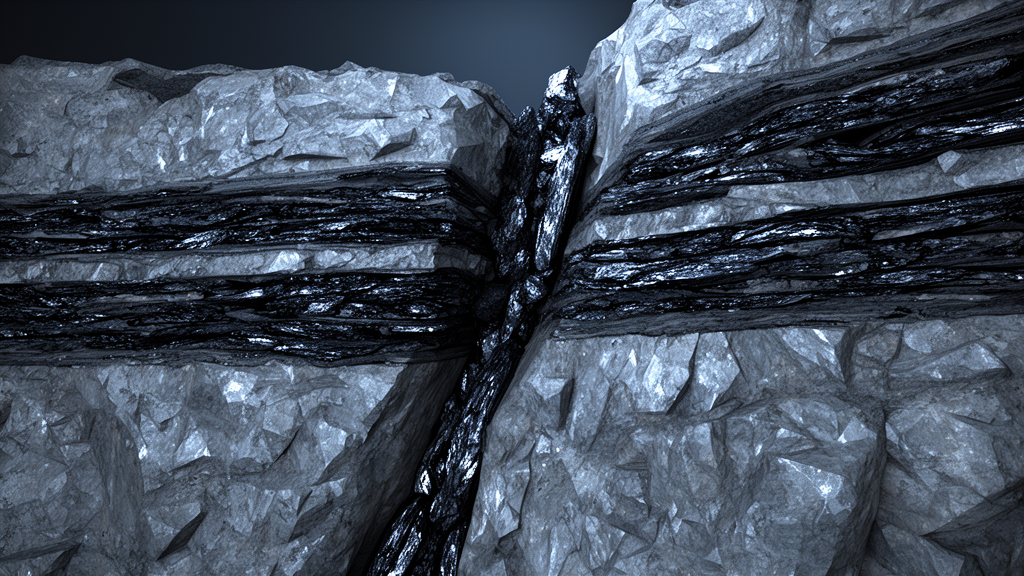
A multi-method investigation combining field monitoring, physical analog simulation, numerical simulation, and laboratory dynamic loading tests has demonstrated that mining activities advance toward underground thrust faults in a manner that induces segmented fault slip, creating a mechanical clamping effect that concentrates severe static stress in adjacent coal bodies and releases dynamic stress waves capable of triggering catastrophic coalbursts. Coalburst disasters provoked by thrust fault movements represent persistent hazards in subterranean extraction environments, frequently causing extensive structural roadway deformation, wall collapse, and severe personnel casualties while the underlying triggering mechanics historically remained unresolved. By tracking the sequential deformation of geological structures during working face advance, the research team identified that faults do not slip uniformly across their entire plane as previously assumed, but instead experience distinct rotational dislocation across separated upper and lower sections. This discontinuous motion governs the redistribution of in situ tectonic stress, transforming ordinary strata subsidence into an active loading mechanism that primes the surrounding coal mass for sudden dynamic failure.
To capture the mechanical interactions occurring between underground panel extraction and fault structures, the researchers evaluated the geological behavior of Fault F16 as an analytical and physical prototype. Excavation within the footwall of the thrust fault removes subterranean support, inducing three distinct mechanical failure zones across the overlying and underlying strata: an immediate caving zone, an interconnected crack zone, and an extensive sagging zone. Because the spatial extent of the failure zone developed within roof strata is substantially greater than that within floor strata, an asymmetrical void is formed toward which surrounding rock masses migrate under prevailing geostresses. As longwall extraction panels advance progressively closer to Fault F16, the crack zone expands both vertically and forward until horizontal tensile fractures intersect the primary fault plane. This direct physical connection between the mining-induced roof crack network and the fault interface accelerates localized instability, enabling distinct sections of the fault to undergo differential slip along both dip and strike directions under tectonic loading.
The structural subsidence and deformation profile of the strata revealed that Fault F16 exhibits a marked segmented slip pattern as mining panels approach the fault boundary. Specifically, the upper section of the thrust fault slips in an anticlockwise rotational direction, whereas the lower section slips in a clockwise rotational direction. This opposing movement arises because tectonic stresses and mining-induced voids drive surrounding rock mass displacements differentially across the hanging wall and footwall strata. Simultaneously, geostress pushes the floor strata toward the mined-out gob area, further reinforcing the clockwise rotation of the lower fault segment. Because the upper and lower sections displace in opposite rotational senses, the relative dislocation generates an intense mechanical clamping effect directly upon the intervening coal seam situated between the working face and the fault zone. The failure of the surrounding roof and floor strata serves as the direct physical driver governing this segmented slip, which acts as the core theoretical cause of severe static stress concentration ahead of the advancing panel.
Mathematical and mechanical stress analyses established that the total concentrated vertical stress acting on a localized coal cell ahead of the panel results from the superposition of three independent physical mechanisms. The first component is the direct mining-induced vertical stress, calculated as the product of the mining-induced stress concentration coefficient, the average bulk rock density, and the total burial depth of the coal seam, where the concentration coefficient is derived directly from real-time borehole stress monitoring conducted ahead of the working face. The second component is the additional vertical stress generated by the segmented fault clamping effect, wherein horizontal tectonic stress transmits through overlying hard roof strata until it is blocked by the thrust fault interface, deflecting downward along the fault dip angle to exert load on the coal seam. This transferred stress is determined by the rock mass integrity coefficient, quantified through microseismic wave velocity field inversion, scaled by the inclined fault angle.
The third stress component driving static concentration arises from gravitational bending, rotation, and subsidence of the hanging wall along its breaking boundary within the upper triangle zone. The overlying hard roof strata positioned over the mined-out gob behave analogously to a cantilever beam structure, transferring extensive structural weight forward onto the unmined coal seam. By formulating moment equilibrium along the rock failure boundary, the normal force acting across the fault surface is resolved as a function of the hanging wall bending mass gravity and normal stresses acting along the boundary, modulated by their respective mechanical force arms. Projecting this normal force through the angular deviation relative to the vertical direction yields the secondary additional vertical stress. The ultimate vertical stress sustained by the coal body represents the algebraic summation of the mining-induced baseline stress, the fault-clamping redirected horizontal stress, and the hanging-wall bending load, driving localized static stress fields to exceptionally high levels.
Beyond high static stress fields, segmented slip events along Fault F16 act as major sources of dynamic stress disturbances by abruptly releasing stored strain energy as seismic waves. When the upper and lower segments of the fault slip under mining perturbation, large quantities of seismic energy radiate outward as primary compressional waves and secondary shear waves originating from distinct hypocentral locations. Dynamic stress waves emanating from hypocenters situated along the lower section of the fault propagate upward to load the pre-stressed coal body primarily along its major principal stress axis. Conversely, stress waves originating from slip hypocenters located within the upper section of the fault traverse strata to load the coal body predominantly along its intermediate principal stress axis, subjecting the underground coal mass to complex, multi-directional dynamic perturbations that superimpose onto existing static stress concentrations.
To determine the failure response of coal subjected to combined static and dynamic loading, researchers conducted coupled laboratory tests on hollow cylindrical coal specimens engineered to simulate underground roadway entries. In agreement with baseline dynamic compressive strength principles, the dynamic load-bearing capacity of coal increases initially with elevating pre-applied axial static pressure under one-dimensional and three-dimensional conditions, but begins to deteriorate rapidly once pre-applied static stress surpasses a critical threshold. Field conditions examined in the Yima mining area indicated that static stress concentrations ahead of panels advancing toward Fault F16 routinely exceeded this critical threshold, generating dense networks of microcracks throughout the coal mass prior to dynamic disturbance. Furthermore, empirical findings demonstrated that the ultimate energy released during the catastrophic failure of coal under high static stress conditions is significantly greater than energy liberated under low static stress states, explaining the elevated severity of fault-slip bursts.
The physical transformation of incoming seismic energy into destructive roadway failure is governed by stress wave reflection mechanics occurring at entry boundaries. Underground roadways excavated along the top of the coal seam leave a portion of coal intact within the floor, exposing free rock and coal surfaces along the roof, sidewalls, and floor. When incident compressional stress waves generated by fault slip reach these excavated boundaries, the impedance boundary condition forces the compressive waves to reflect back into the surrounding coal mass as tensile stress waves, with reflected tensile amplitude directly balancing the incident compressive stress. Simplifying three-dimensional wave propagation into a one-dimensional elastic wave formulation allows the maximum reflected tensile stress to be estimated from the product of the coal mass bulk density, the primary wave propagation velocity in coal, and the peak particle velocity recorded at the site.
Whenever the maximum reflected tensile stress traveling inward from an entry perimeter equals or exceeds the inherent dynamic tensile strength of the coal mass, localized tensile fracturing occurs, culminating in dynamic spalling. Because compressive stress waves cannot sustain tensile loads across a free surface, the reflected tensile wave drives sudden extension and rapid coalescence of pre-existing cracks, causing fractured rock and coal fragments to be violently ejected into the roadway opening at elevated velocities. In accordance with spalling theory, incident stress waves arriving from the upper fault section reflect across roof and wall boundaries to induce significant roof falls and sidewall spalling, whereas stress waves propagating from the lower fault section primarily generate violent floor heave combined with sidewall spalling. The geometric and structural failure patterns observed during theoretical wave modeling closely matched both indoor hollow specimen experiments and field observations recorded during underground monitoring.
The authors formulated a unified theoretical framework identifying segmented reverse fault slip and its attendant clamping effect as the fundamental physical triggers of thrust fault-slip coalbursts. Mining activity in the footwall creates asymmetrical void spaces that prompt differential strata movement, compelling upper and lower fault segments to rotate in opposite directions, clamping the intervening coal seam and elevating static stresses beyond critical stability limits. Subsequent fault slip abruptly releases compressional and shear stress waves that impinge on pre-stressed roadway perimeters, where wave reflection generates intense tensile stresses that drive rapid crack coalescence and explosive spalling. Effective prevention requires mitigating static stress concentrations induced by fault clamping and eliminating dynamic disturbance sources, while utilizing peak particle velocity metrics for early warning, though future investigations must incorporate groundwater pore pressure, gouge mechanical softening, and slip-weakening constitutive models.
Subject of Research: Triggering mechanism of mining-induced coalburst disasters driven by segmented thrust fault slip
Article Title: Mechanism of coalburst triggered by thrust fault slipping based on field monitoring, indoor experiments and numerical simulation
Article References: Zhang, N., Zhang, Z.-X., Ouyang, Z., Liu, Y., Li, Y., Xu, Q., Liu, J., & Shi, Q. (2026). Mechanism of coalburst triggered by thrust fault slipping based on field monitoring, indoor experiments and numerical simulation. Bulletin of Engineering Geology and the Environment, 85(10), Article 638. https://doi.org/10.1007/s10064-026-05302-6
Image Credits: AI Generated
DOI: 10.1007/s10064-026-05302-6
Keywords: coalburst, thrust fault slip, segmented fault slip, clamping effect, underground mining, stress concentration, dynamic stress waves, tensile stress waves, coupled static-dynamic loading, roadway spalling, floor heave, Fault F16, Yima mining area, peak particle velocity, numerical simulation, physical analog simulation, borehole stress monitoring
News Source: Denise Maddox. (November 23, 2026). Segmented Thrust Fault Slip and Strata Clamping Trigger Underground Coalburst Disasters. Scienmag.