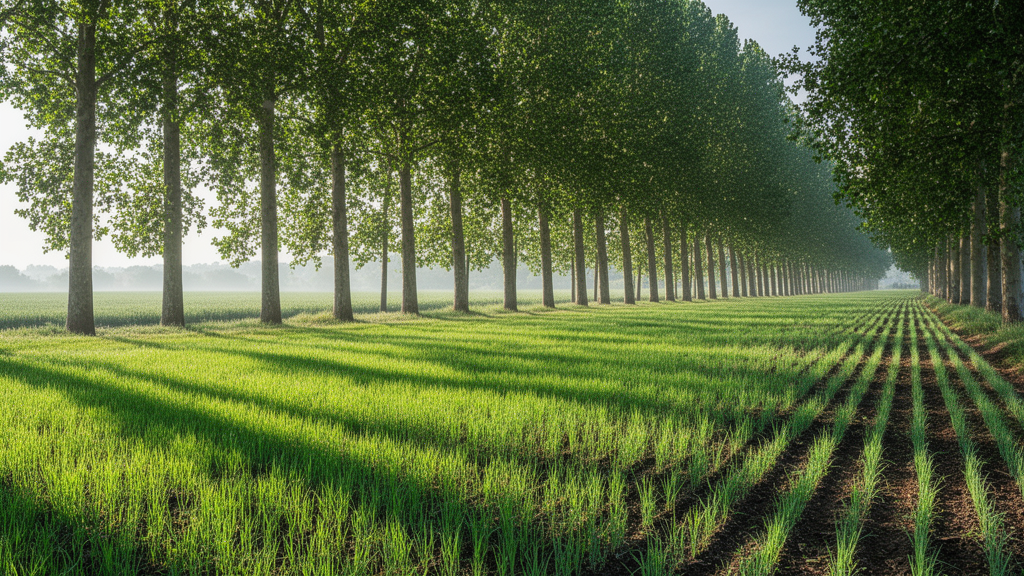
A comprehensive six-year field investigation across multiple agricultural regions in Germany has revealed that the productivity of alley-cropping agroforestry depends fundamentally on tree age and whether cultivated species are sown in spring or autumn. Publishing their empirical findings in Agronomy for Sustainable Development, an international research team led by Sarah Choe, Edzo Veldkamp, and Marife D. Corre demonstrated that temperate agroforestry systems combining annual arable crops with fast-growing hybrid poplar strips produce contrasting yield outcomes over time. When poplars reached five years of age or older within a coppice rotation cycle, spring-sown crops suffered area-weighted yield losses ranging between 10 and 35 percent compared to adjacent treeless open cropland. In sharp contrast, winter-sown crops maintained yields that matched conventional open cropland across tree ages spanning one to nine years, proving that carefully timed crop rotations can overcome shading competition in tree-based agricultural landscapes.
The study addresses persistent agronomic uncertainties that have historically limited the adoption of temperate alley cropping among commercial farmers. Modern conventional farming practices often degrade soil structure, elevate greenhouse gas emissions, and contribute to agricultural nutrient runoff into surrounding watersheds. Integrating perennial woody species alongside conventional crop fields offers recognized ecological benefits across provisioning, regulating, and supporting ecosystem services, including enhanced carbon sequestration, reduced wind erosion, enriched biological habitats, and improved soil nutrient cycling. However, agricultural producers have remained hesitant to implement alley-cropping agroforestry due to unresolved concerns regarding yield losses caused by competition between trees and crops, compounded by uncertain economic returns from woody biomass production. To date, rigorous empirical evaluations comparing both crop yields and timber production across consecutive coppice rotations have remained scarce, leaving farmers without precise management guidelines to optimize long-term agricultural revenues and ecosystem functions. Consequently, determining whether shading or resource competition drives yield losses is vital for future agroforestry management.
To resolve these productivity questions, the investigators conducted continuous monitoring from 2018 through 2023 at four experimental field sites in Germany representing divergent soil textures and climatic conditions. The sites included Dornburg in Thuringia situated on Calcaric Phaeozem soil, Forst in Brandenburg located on Gleyic Cambisol, Vechta in Lower Saxony on Arenosol, and Wendhausen in Lower Saxony on Vertic Cambisol. At every experimental location, the researchers paired an established alley-cropping system with an immediately adjacent treeless open cropland parcel that served as an unshaded reference system. The agroforestry configuration featured a twelve-meter-wide tree strip planted with fast-growing hybrid poplar clone Max 1, a cross of Populus nigra and Populus maximowiczii, aligned along a north-south axis. This timber strip alternated with a forty-eight-meter-wide arable crop alley, dividing the cropland into twenty-four-meter-wide growing zones on either side of the trees. Across these sites, poplar heights expanded from 5.6 meters in three-year stands to 11.7 meters in nine-year stands.
Experimental controls were rigorously maintained across all field sites to ensure that observed yield differences reflected tree interactions rather than divergent farming methods. Both the agroforestry crop alleys and the open cropland references received identical agronomic inputs, including identical tillage, sowing dates, harvesting dates, and conventional chemical fertilization rates. The hybrid poplar strips received no synthetic fertilizer inputs, and their canopy branches and root networks were left completely unpruned, allowing the research team to evaluate the natural, unmodified influence of tree maturation. Plot combine harvesters collected yield data across distinct transect distances placed at one, four, seven, and twenty-four meters from the tree rows, with an additional eighteen-meter sampling distance added during the final three study years. All harvested biomass was oven-dried to determine constant dry matter and standardized to commercial moisture specifications before computing relative yield ratios. Area-weighted calculations based on spatial coverage allowed the authors to establish representative whole-field comparisons.
The spatial data demonstrated that tree shading, rather than belowground competition for moisture or nutrients, was the dominant mechanism depressing spring crop performance. As hybrid poplars matured, expanding live crowns cast extensive shade across adjacent crop rows. In agroforestry alleys bordered by trees aged five years or older, spring-sown crops exhibited severe localized yield depressions within the first seven meters of the tree row, with reductions reaching 36 to 82 percent within one to four meters. Silage corn, a C4 photosynthetic species characterized by low shade tolerance, experienced localized yield drops between 33 and 48 percent within four meters of mature trees. Similarly, spring barley yields within one meter of five- and six-year-old trees dropped to between 48 and 80 percent of open cropland yields, while potatoes cultivated beside three-year-old trees suffered localized yield declines of 23 to 30 percent.
Crucially, auxiliary meteorological and edaphic measurements showed that belowground resource limitation did not account for the observed spring crop yield penalties. Instruments across the plots, alongside buried-bag incubations, revealed no significant differences in soil net nitrogen mineralization rates or gravimetric soil moisture within the top five centimeters between agroforestry crop rows and open cropland. In fact, during an exceptionally dry growing season in 2019, soil moisture within seven meters of the tree rows was significantly higher than in treeless open fields across multiple soil types. Poplar tree rows acted as functional windbreaks that diminished near-surface wind speed, suppressed evaporative moisture losses, and prevented physical crop lodging. This microclimatic protection enabled two-year-old agroforestry spring barley on Gleyic Cambisol to achieve higher overall yields than open cropland, highlighting the tangible buffering capacity of young agroforestry strips during severe moisture deficits.
Unlike spring-sown varieties, autumn-sown winter crops demonstrated remarkable resilience to tree presence across all tree ages from one to nine years. While winter crops displayed minor localized yield declines within one meter of trees aged four years or younger, and within four meters of older trees, these localized deficits were fully offset by elevated yields recorded at seven and twenty-four meters from the tree strips. Winter wheat, winter barley, winter oilseed rape, and winter rye maintained an overall area-weighted relative yield that matched adjacent open croplands across the entire six-year study. This resilience stems from temporal and phenological resource complementarity: winter crops establish in autumn and complete essential vegetative and reproductive milestones, such as flag leaf emergence and spike development in barley, before hybrid poplars reach full canopy closure during late spring. An isolated yield drop in 2018 winter wheat on Vertic Cambisol was attributed to seedling smothering by leaf litter rather than resource competition.
Management trials conducted within the study further revealed that nitrogen fertilization in agroforestry systems can be substantially modified without compromising agricultural output. In an add-on experiment conducted on Calcaric Phaeozem soil, the researchers halved conventional nitrogen fertilizer application rates across winter wheat, winter barley, and winter oilseed rape over three consecutive growing seasons. Despite receiving only fifty percent of standard mineral fertilizer inputs, these winter crops sustained yields that did not differ significantly from conventionally fertilized plots in either agroforestry or open cropland. Soil analyses indicated that winter crops successfully utilized plant-available mineralized nitrogen released naturally from soil reserves and decomposing tree foliage. This strategy preserves farm profits amid high fertilizer prices while mitigating nitrate leaching. However, complete omission of nitrogen applications on spring barley caused significant yield declines between 9 and 22 percent, demonstrating that moderate baseline fertilization remains essential.
Simultaneously, the researchers documented rapid increases in aboveground woody biomass production and carbon sequestration as the hybrid poplar strips advanced through multiple short-rotation coppice cycles. Annual wood production correlated strongly with tree age, escalating from an annual increase of 2.5 megagrams of dry biomass per hectare each year during the first and second rotation cycles to 7.2 megagrams per hectare each year during the third and fourth rotations. Woody carbon storage mirrored this trajectory, expanding from 1.2 megagrams of carbon per hectare annually in early rotations to 3.5 megagrams in later cycles, with wood carbon concentrations averaging 47.2 percent. Annual leaf litter production and soil net nitrogen mineralization rates within the tree rows also increased with tree age, fostering greater microbial nitrogen cycling without depleting the nutrient pools of adjacent crop alleys, thereby confirming that coppice strips sustainably generate substantial renewable bioenergy feedstocks.
Synthesizing crop yields and timber production using the Land Equivalent Ratio metric confirmed that temperate alley-cropping agroforestry achieves superior total land-use efficiency compared to separate monocultures. Winter crops attained Land Equivalent Ratio values of 1.02 for tree ages up to four years and 1.09 for older trees, while spring crops reached 1.16 alongside trees under three years old before dropping to 0.94 beside mature poplars. Based on these findings, the authors recommend cultivating flexible combinations of spring and winter crops during the first three years of coppice growth, followed by an exclusive transition to winter crops or shade-tolerant cultivars once trees exceed four years. Furthermore, maintaining short coppice harvest intervals between three and four years captures peak wood biomass yields while mitigating chronic light competition, providing an evidence-based roadmap for sustainable agricultural intensification.
Subject of Research: Impact of tree age and seasonality on crop yields and wood biomass in temperate alley-cropping agroforestry
Article Title: Optimizing crop types in temperate alley-cropping agroforestry depends on tree age
Article References: Choe, S., Niu, D., Hahn, P., de Waard, R., Langhof, M., Majaura, M., Manu, R., Veldkamp, E., & Corre, M. D. (2026). Optimizing crop types in temperate alley-cropping agroforestry depends on tree age. Agronomy for Sustainable Development, 46(6), Article 78. https://doi.org/10.1007/s13593-026-01149-z
Image Credits: AI Generated
DOI: 10.1007/s13593-026-01149-z
Keywords: alley-cropping agroforestry, hybrid poplar, short-rotation coppice, crop yield, spring crops, winter crops, tree age, tree shade, light competition, silage corn, spring barley, winter wheat, wood biomass production, carbon sequestration, nitrogen mineralization, soil moisture, Land Equivalent Ratio, temperate agriculture
News Source: Alan Morgan. (November 23, 2026). Older Poplar Trees Reduce Spring Crop Yields in Temperate Agroforestry. Scienmag.