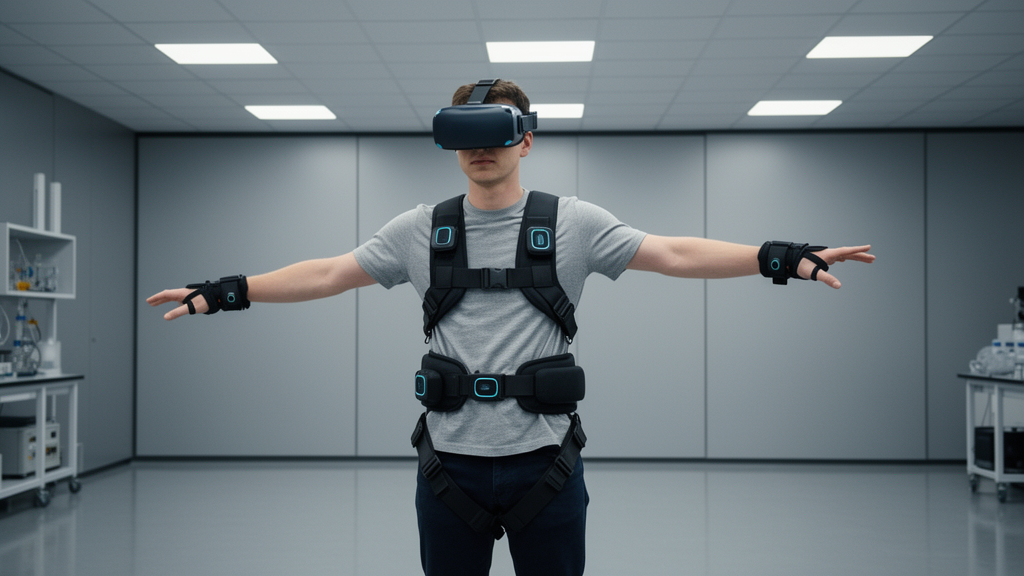
Integrating artificial appendages into the human sensory apparatus requires coordination between voluntary motor intent, visual feedback, and bodily sensation. In a research article published in Frontiers in Virtual Reality, investigators Kenta Tanizawa, Yugo Nakamura, and Shogo Fukushima demonstrated that delivering event-specific multimodal haptic feedback significantly enhances the subjective embodiment of virtual wings. By combining electromyographic sensing from the abdominal muscles with localized cutaneous skin stretch and vibrotactile sensations on the torso, the engineering team constructed an interactive augmented reality platform that bypasses the limitations of ordinary limb movement. Across two laboratory user studies involving eighteen healthy adult participants, the researchers measured how sensory localization and haptic encoding influenced the perceived reality of possessing non-human appendages. Their findings revealed that visual wings positioned near the physical site of haptic stimulation at the waist were judged far more plausible than traditional shoulder-mounted designs. Furthermore, functionally differentiating wing motions and external collisions through distinct tactile modalities produced stronger self-reported ownership and plausibility than uniform or vibration-only feedback schemes.
The theoretical framework guiding the study centers on the cognitive architecture of bodily self-consciousness, specifically separating the sense of body ownership from the sense of agency. Body ownership represents the perceptual feeling that an observed body part belongs to oneself, fundamentally arising from the passive integration of afferent visual, tactile, and proprioceptive sensory signals. In contrast, agency represents the conscious experience of initiating and executing motor actions, structured by predictive internal forward models comparing voluntary motor commands with anticipated sensory consequences. Previous investigations into supernumerary body augmentation have explored robotic limbs, artificial tails, and wearable appendages to extend human task performance or foster mindfulness. However, incorporating an artificial organ that possesses no natural biological analog in human anatomy requires extending the body’s total degrees of freedom without commandeering existing limb joints needed for standard interactions. To achieve this separation, the authors utilized isometric contractions of trunk musculature, specifically the rectus abdominis, generating an effort-related motor cue that remains mechanically independent of upper-body articulation while establishing an intuitive muscular correspondence across the spine.
To support a coherent sensorimotor experience, the authors formulated an event-specific multimodal mapping that assigned distinct physical sensations to functional wing occurrences rather than delivering arbitrary tactile pulses. Cutaneous skin stretch was deployed to convey wing movement and structural deformation because lateral skin traction provides strong directional cues regarding spatial displacement. In bird anatomy, flight muscles are arranged symmetrically across the spinal column, motivating the researchers to position the dorsal skin-stretch actuator directly opposite the contracting rectus abdominis to simulate an anatomical hinge. When the virtual wing tips swept forward during a flap or collapsed under external force, the dorsal skin was pulled inward toward the vertebral column, engaging mechanoreceptors that signal directional movement. Conversely, spatial vibrotactile feedback was assigned to external contact events, utilizing an array of discrete vibration motors aligned horizontally from the flanks toward the back. Because spatial tactile discrimination on the human back exhibits higher acuity along the horizontal axis than the vertical axis, this transverse actuator layout enabled users to infer contact events.
Physical delivery of these multimodal cues relied on a custom adhesive wearable device originally characterized by Tanizawa and colleagues, weighing approximately 150 grams and spanning an overall length of 405 millimeters. The device comprises six distinct modular units: two central traction units straddling the spine to administer lateral skin stretch, flanked by four outer units housing vibration motors. Each module was adhered directly to the user’s skin using biocompatible adhesive gel patches positioned approximately 40 millimeters superior to the navel level. Mechanical skin traction was driven by a miniature TowerPro SG90 servo motor coupled to a linear guiding mechanism that converts rotational torque into horizontal displacement. Although capable of a maximum bilateral displacement of 35 millimeters, the controller was programmed for a commanded mechanical displacement of 30 millimeters, operating at an extension speed of 60 millimeters per second and a retraction speed of 30 millimeters per second with elastic spring assistance. Vibrotactile cues were produced by miniature eccentric rotating mass motors powered at 5 volts to achieve an estimated operating frequency of 250 hertz.
Voluntary user control was captured through a surface electromyography module affixed over the participant’s rectus abdominis, situated 40 millimeters above the navel where muscular bulging occurs during contraction. To isolate voluntary isometric tension from respiration, cardiac rhythms, and movement artifacts, the acquired raw signals underwent a standardized multi-stage filtering algorithm. The system first established an individual baseline by recording three voluntary contractions, setting the lowest observed peak amplitude as the unit normalization reference. The input stream was subsequently segmented into 50-millisecond windows, and a sliding moving-average filter spanning six consecutive frames (300 milliseconds with an 83.3 percent overlap) smoothed high-frequency transients and suppressed approximately 1-hertz heartbeat fluctuations. An active contraction was registered whenever the moving signal exceeded a threshold of 0.4 times the reference value relative to the signal three frames prior. Muscle relaxation was detected when the differential dropped by 0.2 times the reference. In an implementation verification with ten standing participants performing one hundred metronome-timed contractions, the pipeline recorded six false negatives and zero false positives.
The software environment unified electromyographic processing, graphics rendering, and haptic actuation into an integrated real-time mirror-image simulation. The user stood facing an 86-inch 120-hertz display showing a frontal mirror view captured by an Apple MacBook Air camera running Unity 2022.3.3f1 via WebCamTexture. Total end-to-end visual latency between physical movement and on-screen rendering was approximately 150 milliseconds, while inter-module communication was routed across a local Wi-Fi network via an open-source Mosquitto MQTT message broker. During idle states, the rendered virtual wings rested in an expanded posture, oscillating with an organic 1-hertz idle animation while actuators remained dormant. Abdominal contraction immediately initiated a 0.5-second wing-closing animation with corresponding skin traction and vibration onset, transitioning into a 12-hertz oscillatory shimmer signifying sustained muscular tension. Subsequent abdominal relaxation triggered a 1.0-second opening animation accompanied by tension release. In addition to voluntary flapping, predefined touch events lasting 0.5 seconds and push events lasting 1.5 seconds were administered to the left wing using a handheld M5Stick microcontroller operated by an experimenter.
The first formal experiment examined the spatial conflict between anatomical intuition and tactile localization, evaluating where virtual wings should be rendered when haptic sensations are delivered at the waist. Eighteen participants aged 21 to 25 experienced three visual attachment elevations: the anatomically standard scapular region (Condition A), the mid-back (Condition B), and the waist directly aligned with the wearable device (Condition C). After performing three guided flapping cycles in each counterbalanced condition, participants ranked the configurations by perceived plausibility. Seventeen of the eighteen participants concluded that waist-mounted wings were the most plausible, ranking Condition C first, Condition B second, and Condition A third, with only one participant reporting the inverted order. Post hoc pairwise Wilcoxon signed-rank tests with Holm corrections confirmed significant differences between all condition pairs, establishing that sensory colocation strongly overrides anatomical preconceptions in mirror-view augmented reality.
The second experiment investigated how different tactile configurations influenced embodiment across voluntary flapping, external touch without deformation, and external push with deformation. Using a within-subject design, the same eighteen participants tested three distinct mappings: a non-event-specific multimodal baseline presenting identical skin stretch and vibration for all events; an event-specific vibrotactile condition using varied vibration sequences without skin traction; and the proposed event-specific multimodal system combining directional skin traction for movement and spatial vibration for touch. Participants experienced four repetitions of each event type per condition, observing the experimenter perform contactless gestures behind them that matched automated tactile delivery. The survey evaluated five core dimensions: ownership, agency, body addition, plausibility, and experience quality.
Quantitative evaluations demonstrated that the event-specific multimodal configuration produced superior ratings across nearly every measured embodiment metric. Nonparametric Friedman tests with Holm corrections revealed significant differences among the three feedback mappings for ownership (chi-square = 23.12, p < 0.001, Kendall’s W = 0.64), body addition (chi-square = 16.62, p < 0.001, Kendall’s W = 0.46), plausibility (chi-square = 22.06, p < 0.001, Kendall’s W = 0.61), agency (chi-square = 11.23, p = 0.007, Kendall’s W = 0.31), and experience quality (chi-square = 9.38, p = 0.009, Kendall’s W = 0.26). Post hoc Wilcoxon tests showed that the proposed multimodal mapping scored significantly higher than both comparison mappings for ownership, body addition, and plausibility. Interestingly, agency exhibited a unique response pattern: while both the vibrotactile-only and multimodal event-specific mappings significantly outperformed the uniform baseline (p = 0.006), they did not differ significantly from one another (p = 0.204). This statistical dissociation suggests that the conscious feeling of motor agency depends primarily on whether haptic signals successfully differentiate distinct behavioral states, whereas deep feelings of physical ownership and plausibility demand rich, multi-channel sensory congruence matching physical deformation.
Despite these findings, the authors emphasized critical methodological limitations that warrant careful interpretation and future empirical investigation. Because the experimental conditions evaluated integrated feedback paradigms, the study design did not independently cross event specificity with tactile modality in a full factorial matrix. Consequently, the observed benefits of the complete multimodal system cannot be isolated to skin stretch alone, the presence of multiple sensory channels, or the semantic correspondence of the mappings. Additionally, the experimental apparatus fixed tactile stimulation exclusively at the waist, leaving open the question of how participants would evaluate wings if skin-stretch actuators were physically mounted across the scapulae. The evaluation relied on explicit Likert self-reports, which remain vulnerable to subjective demand characteristics; future efforts will incorporate implicit behavioral indices, such as intentional binding paradigms that measure perceived temporal compression between motor execution and sensory onset. Nevertheless, by demonstrating that synchronized abdominal electromyography and waistline cutaneous stretch can induce robust body ownership, the research establishes foundational engineering principles for augmenting human morphology in extended reality environments.
Subject of Research: Multimodal haptic feedback and electromyographic interfaces for virtual body augmentation
Article Title: Virtual-wing embodiment through event-specific multimodal haptic feedback
Article References: Tanizawa, K., Nakamura, Y., & Fukushima, S. (2026). Virtual-wing embodiment through event-specific multimodal haptic feedback. Frontiers in Virtual Reality, 7, Article 1898599. https://doi.org/10.3389/frvir.2026.1898599
Image Credits: AI Generated
DOI: 10.3389/frvir.2026.1898599
Keywords: virtual embodiment, haptic feedback, skin stretch, vibrotactile stimulation, supernumerary appendages, electromyography, rectus abdominis, body ownership, sense of agency, extended reality, multisensory integration, body augmentation, spatial congruency, wearable robotics, motor control, cutaneous stretch, tactile perception
News Source: Denise Maddox. (November 23, 2026). Multimodal Haptic Cues and Waist Alignment Enhance Virtual Wing Embodiment. Scienmag.