A recombinant strain of the probiotic bacterium Escherichia coli M17 successfully expressed and secreted the cholera toxin beta-subunit in the digestive tract of mice, triggering a pronounced humoral immune response across both mucosal and systemic compartments. Published in Applied Biochemistry and Microbiology, the experimental investigation demonstrated that engineering this well-characterized probiotic microorganism to carry an expression cassette under the control of a bacteriophage T5 promoter enabled the functional production of the pentameric CtxB protein without requiring specialized viral RNA polymerases. Following oral administration to laboratory mice and subsequent induction with lactose dissolved in their drinking water, the live bacterial culture provoked the formation of specific antibodies that exceeded background levels in control animals by more than an order of magnitude. These observations confirm that live probiotic delivery vectors can synthesize complex immunomodulatory polypeptides directly within the mammalian gastrointestinal tract.
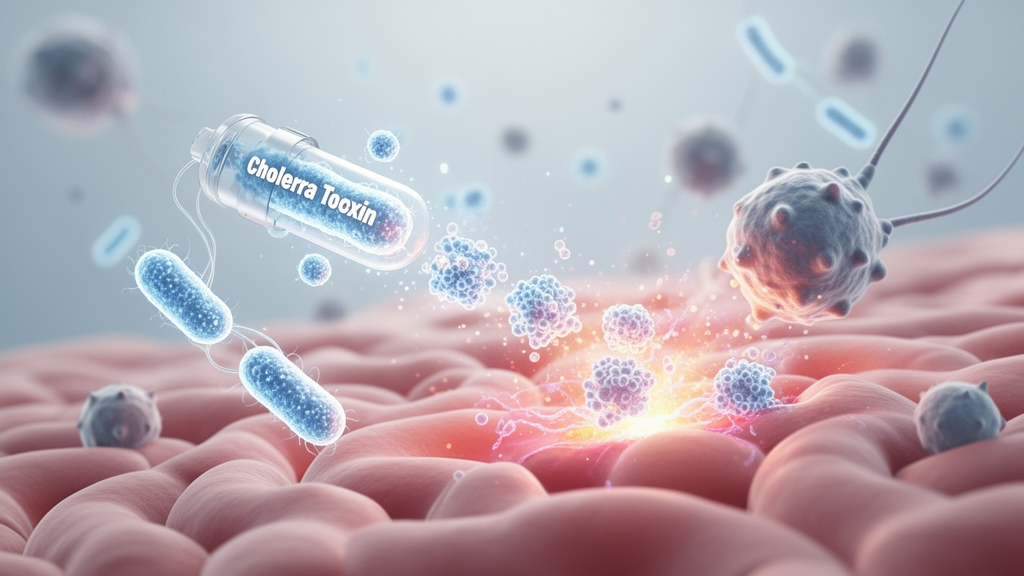
The target molecule investigated in the study, designated CtxB, is the non-toxic beta-subunit of the multi-component cholera enterotoxin. In its natural biological context, cholera toxin comprises an enzymatically active catalytic alpha-subunit coupled to a pentameric ring of beta-subunits. This beta-assembly governs the initial binding of the holotoxin to monosialoganglioside GM1 receptors distributed across the eukaryotic plasma membrane. Receptor mapping studies have documented that GM1 gangliosides are not merely restricted to the apical brush border of intestinal enterocytes; they are also abundantly displayed on the surface membranes of professional antigen-presenting cells, including tissue macrophages, dendritic cells, and mature B lymphocytes.
When presented across intact mucous membranes, the structural subunit can promote the induction of systemic oral tolerance, positioning it as an investigational candidate for the therapeutic mitigation of specific autoimmune pathologies and severe allergic disorders. Nevertheless, realizing the clinical and pharmaceutical utility of CtxB has remained technically constrained by production and distribution bottlenecks. Purifying large quantities of recombinant polypeptides through conventional heterologous expression systems demands substantial downstream processing resources, chromatographic media, and specialized infrastructure. Delivering these bioactive molecules directly to the target epithelial interface using living probiotic carrier strains represents an attractive alternative strategy that circumvents industrial polypeptide purification by transforming the bacterial host into an in situ biological synthesis platform.
Probiotic microorganisms possess specialized physiological adaptations that render them well-suited for delivering therapeutic macromolecules to the mucosal surface and intestinal lumen. Competent probiotic strains demonstrate the capacity to adhere to mucosal enterocytes, persist within the intestinal milieu, and temporarily colonize the gastrointestinal tract. Furthermore, these beneficial microbes continuously modulate innate and adaptive immunity through interactions between conserved pathogen-associated molecular patterns and host pattern-recognition receptors. Depending on the bacterial strain, surrounding cellular context, and local signaling cues, probiotics can induce the secretion of interleukin-12 to facilitate type-1 T helper cell responses or stimulate the production of the anti-inflammatory regulatory cytokine interleukin-10. Prior experimental initiatives had explored this concept by introducing CtxB-encoding vectors into Bacillus subtilis to present chimeric viral epitopes or administering Lactococcus lactis strains alongside CtxB as an adjuvant, establishing foundational precedents for bacterial delivery systems.
For the present expression platform, the research team selected Escherichia coli strain M17, a non-pathogenic bacterium with a documented history spanning seven decades of medical deployment in Russia as the active biological ingredient in Colibacterin and Bificol pharmaceuticals prescribed for intestinal dysbiosis. Strain M17 represents an independently maintained lineage derived from Escherichia coli Nissle 1917, an isolate originally obtained by Alfred Nissle during the early twentieth century and utilized widely in pharmaceutical formulations such as Mutaflor. While Nissle 1917 has been extensively modified to design experimental living therapies for cancer, inflammatory bowel diseases, and metabolic conditions, strain M17 has received comparatively less genetic attention despite possessing favorable safety attributes. Genomic evaluations confirm that E. coli M17 lacks transmissible antibiotic resistance markers, virulence genes, pathogenicity islands, and integrated plasmid replicon elements. Additionally, its lipopolysaccharide outer layer exhibits reduced endotoxic pyrogenicity and demonstrates intrinsic anti-inflammatory effects in murine models of ulcerative colitis induced by dextran sulfate sodium.
To overcome the transcriptional limitations inherent to conventional laboratory expression vectors, the researchers engineered a specialized plasmid system designated pET22b-T5-OmpA-CtxB. Earlier heterologous expression constructs developed by the authors relied on a pET22b plasmid backbone where the ctxB coding sequence was linked to an outer membrane protein A signal peptide under the stringent regulation of a T7lac promoter. Although highly active, transcription driven by T7lac requires the presence of an exogenous bacteriophage T7 RNA polymerase, which is absent from wild-type and probiotic bacterial hosts. To ensure robust promoter recognition by the endogenous E. coli transcription machinery, the team amplified the bacteriophage T5 promoter from a pTurboGFP-B vector template utilizing upstream UpT5 and downstream LowT5 synthetic oligonucleotide primers carrying engineered BglII and XbaI restriction endonuclease cleavage sites. Sanger DNA sequencing subsequently verified the accurate excision, directional insertion, and sequence fidelity of the T5 promoter within the pET22b-OmpA-CtxB recipient construct.
Following plasmid assembly, the recombinant pET22b-T5-OmpA-CtxB construct was transferred into competent E. coli M17 cells via high-voltage electroporation. Transformed colonies were selected on nutrient agar plates supplemented with 100 micrograms per milliliter of ampicillin and inoculated into liquid nutrient broth for expansion. To characterize protein synthesis parameters in vitro, recombinant cultures were grown at 37 degrees Celsius to an optical density at 600 nanometers between 0.8 and 1.0 before chemical induction. Target gene expression was initiated by adding either isopropyl beta-D-1-thiogalactopyranoside or chemical-grade lactose to a final concentration of 1 millimolar. Cellular pellets and spent culture media were separated through high-speed refrigerated centrifugation at 20,000 g and subsequently analyzed using denaturing and non-denaturing sodium dodecyl sulfate polyacrylamide gel electrophoresis alongside parallel Western immunoblotting utilizing monoclonal antibodies specific for the cholera toxin beta-subunit.
Electrophoretic visualization under non-denaturing conditions demonstrated that the T5 promoter enabled the efficient synthesis of intact pentameric CtxB assemblies without requiring thermal denaturation or reducing agents. Following eighteen hours of incubation at 25 degrees Celsius in the presence of 1 millimolar IPTG, quantitative densitometric evaluation of stained gels and Western blot membranes indicated that the synthesized CtxB was transported across the bacterial envelope and accumulated primarily within the extracellular culture fluid, reaching a yield of approximately 15 micrograms per milliliter of culture per unit of optical density. Because IPTG exhibits prolonged chemical stability in liquid media whereas lactose is rapidly assimilated and metabolized by both prokaryotic and eukaryotic metabolic networks, an additional in vitro assay evaluated shorter four-hour induction periods. In these cell lysate preparations, lactose induction drove recombinant CtxB accumulation to levels exceeding 50 micrograms per milliliter of culture per optical density unit, matching the performance of the synthetic inducer.
The observation that lactose effectively stimulated recombinant protein production carried significant physiological implications for in vivo application. While IPTG represents a reliable synthetic inducer for laboratory-scale gene induction under the lac operator, its pharmacological profile and synthetic structure make it undesirable for routine medical therapy. Conversely, the natural disaccharide lactose is universally recognized as a safe pharmaceutical excipient widely incorporated into solid dosage forms and oral suspensions. Establishing that lactose induces CtxB synthesis at concentrations comparable to synthetic alternatives provided a practical mechanism to trigger target gene transcription directly within the gastrointestinal lumen.
To evaluate the functional performance of the engineered bacterial strain in a living mammalian host, the investigators conducted an in vivo immunization trial utilizing female BALB/c mice under ethical clearance granted by the Federal Research Center for Biotechnology of the Russian Academy of Sciences. Overnight cultures of recombinant E. coli M17-CtxB and an empty-vector control strain bearing pET22b-T5 were cultured to mid-exponential phase, induced with 1 millimolar IPTG for two hours, washed, and suspended in sterile phosphate-buffered saline at pH 7.3. Animals received bacterial suspensions through a gastro-duodenal tube at an individualized dosage of 500 million colony-forming units per mouse. The vaccination protocol involved three distinct immunization cycles administered at intervals of two and nine weeks. Each cycle comprised bacterial dosing on two consecutive days, resulting in a cumulative exposure of six oral inoculations per animal. Concurrently, the mice received a 0.3 molar lactose drinking solution during each two-day dosing window.
Four weeks after the completion of the final immunization cycle, biological specimens were harvested to assess antibody generation. The animals were humanely sacrificed by cervical dislocation, and cardiac cavity blood was collected and clotted to yield clarified serum. To evaluate localized mucosal secretion, small intestines were surgically excised, clamped at both anatomical margins, and flushed with three milliliters of an enzyme-inhibiting buffer containing trypsin inhibitor, ethylenediaminetetraacetic acid, and phenylmethylsulfonyl fluoride in phosphate-buffered saline. Following incubation and centrifugal clarification, total anti-CtxB immunoglobulins were quantified using enzyme-linked immunosorbent assays. Ninety-six-well microplates coated with purified recombinant CtxB at one microgram per milliliter were incubated with serum samples diluted 1 to 100 or intestinal lavages diluted 1 to 10, followed by detection with horseradish peroxidase-conjugated secondary antibodies and tetramethylbenzidine chromogenic substrate read spectrophotometrically at 450 nanometers.
Statistical evaluation through one-way analysis of variance combined with post-hoc Dunnett tests revealed that oral administration of the induced E. coli M17-CtxB strain elicited a marked, statistically significant antibody response (p value less than or equal to 0.05). Spectrophotometric absorbance measurements obtained from both blood serum and intestinal lavage fluids harvested from M17-CtxB recipient mice surpassed the baseline signals recorded in empty-vector control cohorts by at least an order of magnitude. The detection of elevated specific immunoglobulins within intestinal flush fluids confirmed local secretory immune activation at the mucosal barrier, whereas the parallel presence of circulating anti-CtxB antibodies in peripheral serum established systemic immune stimulation. These quantitative readouts provide direct biological evidence that the recombinant probiotic bacteria successfully synthesized and released immunologically functional CtxB protein within the murine intestinal tract in vivo.
The verified delivery capability of the recombinant E. coli M17 platform introduces compelling possibilities for developing targeted biotherapeutic strategies against intestinal inflammation. Concurrently, the parental E. coli M17 host strain possesses documented intrinsic protective properties, mitigating structural damage and depressing pro-inflammatory cytokine expression in animal models of chemically induced colitis.
Subject of Research: Probiotic Escherichia coli delivery of recombinant cholera toxin beta-subunit in mice
Article Title: Probiotic Escherichia coli Strain M17 that Expresses CtxB Protein as a basis for Promising Biomedical Applications
Article References: Jamgochian, H., Kotliarova, M. S., Shumkov, M. S., & Goncharenko, A. V. (2026). Probiotic Escherichia coli Strain M17 that Expresses CtxB Protein as a basis for Promising Biomedical Applications. Applied Biochemistry and Microbiology, 62(3), 489-495. https://doi.org/10.1134/s0003683825603877
Image Credits: AI Generated
DOI: 10.1134/S0003683825603877
Keywords: Escherichia coli M17, cholera toxin beta-subunit, CtxB, probiotic vector, T5 promoter, mucosal vaccine adjuvant, oral immunization, humoral immune response, GM1 ganglioside, lactose induction, BALB/c mice, intestinal lavage, ELISA, Nissle 1917, Colibacterin, Bificol, inflammatory bowel disease
News Source: Kristina Jarvis. (November 23, 2026). Engineered Probiotic Bacteria Deliver Cholera Toxin Subunit and Stimulate Mouse Immunity. Scienmag.