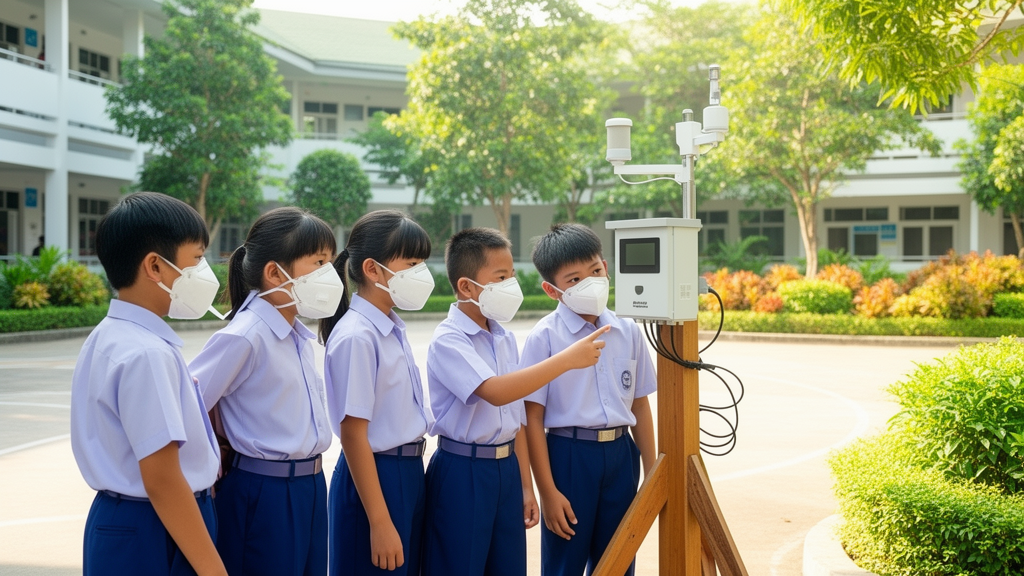
Lower secondary school students who participated in a six-week environmental health literacy program in Thailand reported larger gains in PM2.5 protective behaviors and knowledge scores than peers receiving usual instruction, according to an exploratory quasi-experimental study. However, because the trial assigned only one public school to each condition, researchers noted that the observed improvements cannot be separated from underlying school-level differences or attributed solely to the intervention.
The investigation examined changes in self-reported environmental health literacy and protective actions against fine particulate matter pollution following an educational initiative informed by protection motivation theory. Conducted across two public secondary schools in Chonburi Province, the program sought to evaluate whether structured health literacy sessions could encourage adolescents to adopt preventive measures during air pollution events.
To establish the trial cohorts, the participating schools were allocated to either the intervention or control condition by drawing lots. From each institution, investigators randomly selected 31 students to participate in the evaluation. At baseline, the participants exhibited modest demographic variation, with students in the intervention school being slightly younger on average than those in the control school, recording mean ages of 14.35 years and 14.68 years, respectively.
The educational intervention consisted of three active-learning sessions delivered over a six-week timeline, while the control school maintained its standard educational activities. Data collection relied on self-administered questionnaires completed by students at baseline and again at week six, coinciding with the day of the final active-learning session.
Between-group differences across time were evaluated using difference-in-differences calculations. Over the study window, environmental health literacy domain scores increased by 0.94 to 1.54 points among intervention students, whereas scores in the control cohort shifted between a decrease of 0.40 points and an increase of 0.10 points, yielding difference-in-differences values ranging from 1.14 to 1.54. In evaluating protective behaviors, the difference-in-differences reached 1.27 for health and community surveillance and 1.64 for dust exposure prevention. In addition, students in the intervention program reported a mean satisfaction score of 4.20 out of 5 across twelve evaluated items.
The authors concluded that while intervention participants reported greater gains in literacy and behavioral measures, broader claims of program efficacy remain constrained by the single-school cluster design. Future evaluations would require enrolling multiple schools per arm and monitoring students beyond the six-week intervention window to track behavioral persistence. The trial was registered retrospectively with the Thai Clinical Trials Registry under identifier TCTR20260818002.
Subject of Research: School-based environmental health literacy and PM2.5 protective behaviors among secondary students
Article Title: A school-based environmental health literacy program and PM2.5 protective behaviors among lower secondary school students in Thailand: an exploratory quasi-experimental study
Article References: Nilnate, N., Phosri, K., Kongkaeo, P., Somtrakul, N., Noppakiat, C., Sonjan, S., Phanphrom, P., & Kulwong, S. (2026). A school-based environmental health literacy program and PM2.5 protective behaviors among lower secondary school students in Thailand: an exploratory quasi-experimental study. BMC Public Health. https://doi.org/10.1186/s12889-026-30382-0
Image Credits: AI Generated
DOI: 10.1186/s12889-026-30382-0
Keywords: environmental health literacy, PM2.5 protective behaviors, quasi-experimental study, protection motivation theory, Chonburi Province, Thailand, lower secondary school students, school-based intervention, active learning, difference-in-differences, dust exposure prevention, health and community surveillance, air pollution education, public schools, adolescent health, Thai Clinical Trials Registry, program satisfaction
News Source: Ophelia Keating. (November 23, 2026). Thai School Program Linked to Increased PM2.5 Protective Behaviors in Exploratory Study. Scienmag.