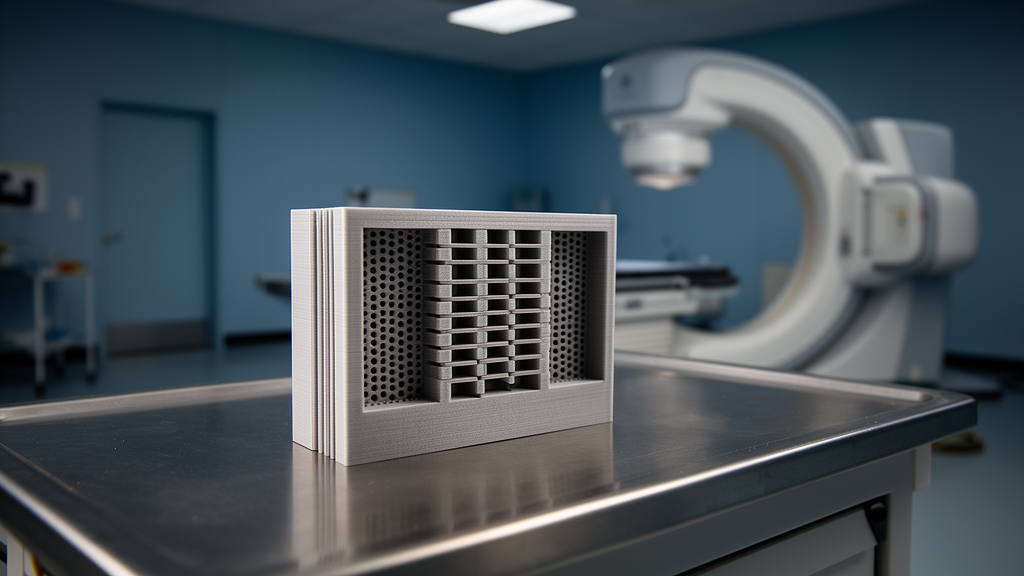
A multidisciplinary engineering and medical physics research team has designed, fabricated, and validated customized three-dimensional printed GRID collimators capable of delivering spatially fractionated radiation therapy with enhanced mechanical resilience and radiation dose modulation. Spatially fractionated radiation therapy, frequently designated as GRID therapy, is an advanced cancer treatment modality that employs specialized beam-modulating collimators to project high-dose radiation beamlets into bulky, deep-seated, or treatment-resistant tumors while intentionally sparing intervening and adjacent healthy tissue structures. In this comprehensive experimental investigation, researchers evaluated the mechanical integrity, thermal stability, and radiological attenuation performance of thermoplastic collimator prototypes fabricated from polylactic acid, acrylonitrile styrene acrylate, and acrylonitrile butadiene styrene.
The clinical motivation for developing additively manufactured GRID devices stems from severe logistical and therapeutic challenges encountered in conventional radiotherapy delivery, particularly within low-to-medium-income countries. Clinical reports show that late-stage, bulky malignancies account for a considerable portion of patient admissions in resource-constrained regions, where radiotherapy demand remains high yet nearly half of patients requiring intervention lack access because of prohibitive equipment costs and rigid manufacturing pipelines. Historically, clinical GRID collimators have been cast from solid Cerrobend, brass, or other heavy metal alloys, or configured through complex multileaf collimator programming. These conventional metal blocks present substantial physical mass, making them difficult to mount and maneuver on medical gantries, while their subtractive or foundry fabrication affords virtually no flexibility for patient-specific anatomical adaptation. Furthermore, standard metal blocks typically incorporate parallel vertical beam channels that inadvertently attenuate or cut off peripheral radiation beams at larger field dimensions, thereby restricting uniform dose distribution across expanded treatment targets.
To overcome the structural, geometric, and operational shortcomings of metallic blocks, the investigative framework was divided into three interrelated phases comprising conceptual design, additive manufacturing with mechanical validation, and radiological characterization. Phase one established computer-aided design parameters optimized to benchmark conventional solid brass collimators while integrating divergent aperture channels aligned with the divergent geometry of the primary beam source. Two distinct collimator thicknesses were modeled at 7.5 centimeters and 9.0 centimeters, featuring hexagonal honeycomb aperture layouts configured to yield alternating peak and valley radiation distributions. Because additive manufacturing constructs components layer by layer directly from digital geometry, the design eliminated the physical limitations of subtractive machining, permitting the inclusion of tapered, divergent channels that maintain consistent transmission across field apertures measuring from 5 by 5 centimeters up to 20 by 20 centimeters.
In the second phase, physical prototypes were fabricated via fused deposition modeling on industrial and precision desktop extrusion platforms, including the Raise3D Pro2 and Stratasys Fortus 450mc systems. For the Stratasys printer, ABS-M30 filament was processed through a dedicated nozzle tip using a 90-degree Celsius build chamber, a 270-degree Celsius nozzle temperature, and a standardized slice height of 0.254 millimeters. Comparative components made of polylactic acid and acrylonitrile styrene acrylate were produced on the Raise3D Pro2 using customized thermal envelopes, featuring nozzle temperatures of 205 degrees Celsius and a heated bed maintained at 60 degrees Celsius. Infill densities were methodically varied across 50 percent and 100 percent toolpaths while slicing parameters were tuned to eliminate structural voids and preserve uniform inter-aperture septal wall thickness throughout the honeycomb matrix.
Because polymer shells alone lack sufficient electron density to attenuate megavoltage therapeutic X-ray beams, the research team evaluated hybrid shielding strategies by loading the hollow printed matrices with dense materials. Experimental testing evaluated molten Cerrobend, an alloy composed of bismuth, lead, tin, and cadmium, alongside solid granular tungsten possessing a mesh sizing of minus 10 to plus 40. When molten Cerrobend was introduced into a 7.5-centimeter polylactic acid prototype submerged in a warm water stabilization bath above 66 degrees Celsius, the polymer matrix succumbed to the combined thermal stress and hydrostatic mass, resulting in severe wall bulging, channel collapse, and gross structural failure. Consequently, the team abandoned liquid metal casting within low-temperature thermoplastics and established dry tungsten granular packing as the viable, non-destructive infill method across subsequent configurations.
Thermal tolerance and dimensional stability were further quantified through standardized immersion tests, wherein five samples of each polymer material were immersed in an 80-degree Celsius heated water bath for one hour to determine volumetric shrinkage. Polylactic acid exhibited pronounced thermal degradation, demonstrating the highest volumetric shrinkage at 8.3 percent, while acrylonitrile styrene acrylate underwent 3.34 percent shrinkage. In contrast, acrylonitrile butadiene styrene exhibited exceptional resistance to thermal warpage, recording a minimal volumetric shrinkage of only 0.35 percent, a statistically significant distinction at p equals 0.01. This minute dimensional change aligned with previous reports on thermal conditioning in additive polymers, confirming that acrylonitrile butadiene styrene preserves the tight submillimeter tolerances required to maintain precise beamlet geometry without experiencing heat-induced geometric drift during preparation or clinical handling.
Mechanical integrity was comprehensively assessed through quasi-static three-point flexural testing using an Instron 3384 universal test frame equipped with a 150-kilonewton load cell operating under ASTM D790 standards at a constant crosshead speed of 1.5 millimeters per minute. Test specimens mounted across a 240-millimeter lower support span were subjected to flexural loading to measure elastic behavior, displacement under a baseline 250-newton clinical load, and ultimate load capacity at catastrophic failure. The 250-newton benchmark corresponded directly to the physical weight of a fully tungsten-loaded 9.0-centimeter collimator assembly weighing 9.65 kilograms. Under this operational load, the 7.5-centimeter polylactic acid block deformed by 2.71 millimeters, whereas acrylonitrile styrene acrylate deformed by 1.80 millimeters and acrylonitrile butadiene styrene displaced by only 1.56 millimeters. When the acrylonitrile butadiene styrene thickness was expanded to 9.0 centimeters, deformation under the 250-newton reference dropped to 1.35 millimeters at 50 percent infill and reached an optimal minimum of 1.14 millimeters at 100 percent infill density.
Ultimate failure loading reinforced the decisive mechanical superiority of acrylonitrile butadiene styrene under heavy flexural stress. Among 7.5-centimeter collimator blocks manufactured with 50 percent internal infill, polylactic acid registered the lowest ultimate load capacity at 1710 newtons, acrylonitrile styrene acrylate reached 1800 newtons, and acrylonitrile butadiene styrene achieved 1873 newtons. When the acrylonitrile butadiene styrene structure was thickened to 9.0 centimeters, the failure threshold increased to 2010 newtons at 50 percent infill and reached an impressive maximum of 2289 newtons at 100 percent infill. The stress-strain profiles revealed distinct viscoelastic performance, exhibiting initial linear elasticity followed by progressive yielding prior to fracture.
Radiological validation was conducted on a Varian TrueBeam medical linear accelerator platform using a 6 megavolt photon beam operating at a source-to-surface distance of 100 centimeters and an exposure rate of 100 monitor units per field. Custom collimator shells loaded with tungsten granules were aligned within the linac accessory tray above an IBA Blue Phantom2 scanning water tank equipped with a calibrated 0.13-cubic-centimeter CC13 ionization chamber. Percent depth dose profiles recorded along the central beam axis demonstrated that depth-dose curves for both 7.5-centimeter and 9.0-centimeter collimators were functionally superimposable across field sizes from 5 by 5 centimeters to 20 by 20 centimeters. The radiation beam exhibited a rapid surface dose buildup of approximately 50 percent, attained maximum dose accumulation at a standard depth of 1.5 centimeters, and steadily declined to roughly 25 percent at a depth of 25 centimeters, establishing that physical collimator thickness does not perturb beam quality or photon energy spectra along the primary axis.
Cross-plane beam profile scans, however, revealed significant dosimetric divergence between the two collimator thicknesses in spatial dose modulation and valley dose shielding. The hexagonal aperture matrix successfully generated the intended alternating high-dose peaks and shielded valleys, with the number of transmitted beamlet peaks scaling systematically from one peak at 5 by 5 centimeters up to seven peaks at 20 by 20 centimeters. In the 7.5-centimeter design, inter-aperture septal transmission permitted excess X-ray leakage into the valley regions, causing an elevated valley minimum dose that restricted the overall peak-to-valley dose ratio to 4.17. Conversely, the 9.0-centimeter collimator provided superior tungsten path attenuation between apertures, maintaining deeply suppressed valley doses and yielding a consistent peak-to-valley dose ratio of 6.8 at 6 megavolts across all field configurations.
The authors noted that while their 3D-printed ABS tungsten-loaded assembly delivered reproducible beamlet profiles surpassing historical polymer composite benchmarks, clinical translation will require focused evaluations of long-term material durability. Future research must address polymer fatigue from repetitive clinical handling, assess potential radiation-induced material embrittlement under cumulative high-dose monitor units, and integrate granular tungsten attenuation algorithms directly into clinical treatment planning systems. Nonetheless, this systematic validation demonstrates that 3D-printed thermoplastic collimators offer a structurally sound, highly customizable, and cost-effective alternative to rigid cast alloys, creating accessible pathways for advanced cancer care.
Subject of Research: Additive manufacturing and dosimetric evaluation of polymer GRID collimators for spatially fractionated radiation therapy
Article Title: Design and Manufacture of a 3D Printed GRID Collimator for Radiation Therapy
Article References: Pinckney, R., Parupelli, S. K., Sandwall, P., Chang, S., & Desai, S. (2026). Design and Manufacture of a 3D Printed GRID Collimator for Radiation Therapy. Biomedical Materials & Devices. https://doi.org/10.1007/s44174-026-00769-z
Image Credits: AI Generated
DOI: 10.1007/s44174-026-00769-z
Keywords: Spatially Fractionated Radiation Therapy, GRID Therapy, Radiation Therapy, 3D Printing, Additive Manufacturing, Collimator Design, Acrylonitrile Butadiene Styrene, Polylactic Acid, Acrylonitrile Styrene Acrylate, Tungsten Granules, Peak to Valley Dose Ratio, Percent Depth Dose, Dosimetry, Medical Linear Accelerator, Radiation Oncology, Mechanical Testing, Thermal Degradation
News Source: Denise Maddox. (November 23, 2026). 3D Printed ABS Collimator Enhances Spatial Dose Modulation for Radiation Therapy. Scienmag.