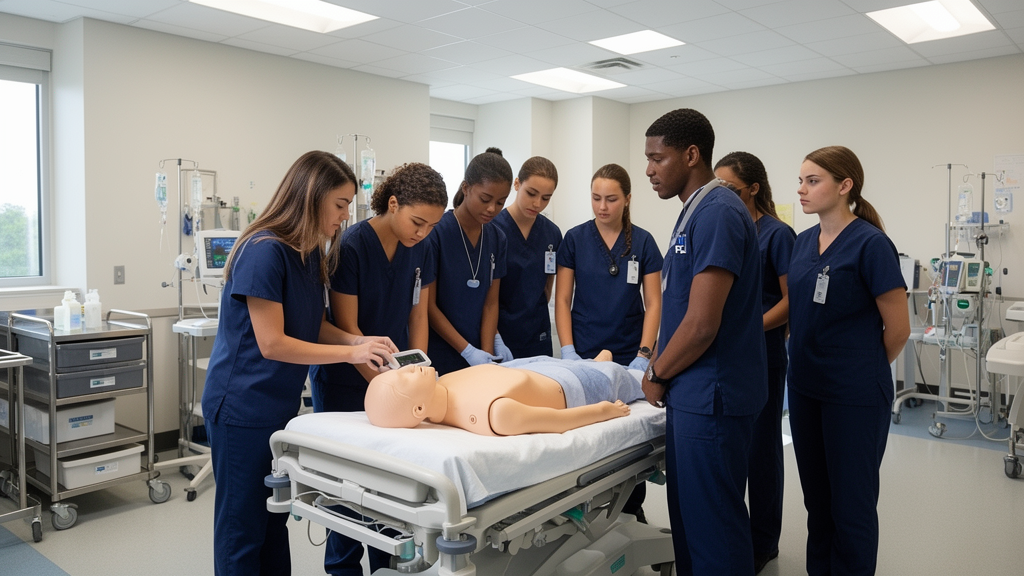
A comparative cross-sectional study evaluating clinical simulation across multiple healthcare degree programs found that students experienced uniformly high satisfaction regardless of their field, while reported self-confidence varied modestly depending on the specific program of study. The research examined responses from hundreds of trainees across five disciplines following structured learning sessions.
Clinical simulation has become a standard instructional strategy across health sciences education to foster technical and non-technical competencies. Despite its widespread adoption, empirical evidence directly comparing how students in distinct academic disciplines perceive their satisfaction and self-confidence after identical or standardized simulation formats has remained limited.
To address this gap, researchers conducted a descriptive cross-sectional investigation involving 469 participating students. The cohort comprised 102 students from Dentistry, 20 from Medicine, 100 from Nursing, 116 from Pharmacy, and 131 from Physiotherapy. Participants completed the National League for Nursing Student Satisfaction and Self-Confidence in Learning Scale following a structured simulation session.
Overall student satisfaction with the training was uniformly high across the entire sample, yielding an average score of 4.65 with a standard deviation of 0.70 on a five-point scale ranging from 1 to 5. One-way analysis of variance confirmed that satisfaction levels showed no statistically significant differences between the five academic programs, recording an F-ratio of 0.91 and a p-value of .456.
In contrast, ratings of self-confidence in learning showed statistically significant differences across disciplines, with an overall mean score of 4.50 and a standard deviation of 0.62. Analysis revealed a significant between-group effect with an F-ratio of 4.47, a p-value of .002, and an effect size eta-squared of .037. Self-confidence scores were notably higher among dentistry students compared with peers in medicine and pharmacy.
This disciplinary divergence in self-confidence persisted even after researchers applied general linear models to adjust for sociodemographic factors and prior clinical experience. In the adjusted model, the variation remained statistically significant, yielding an F-ratio of 4.42, a p-value of .002, and a partial eta-squared of .039, confirming that background variables did not account for the observed programmatic differences.
The authors noted that the observed effect sizes were small and suggested that differences in self-confidence might reflect varying degrees of curricular integration and early clinical exposure across fields. Furthermore, the medicine cohort included only 20 participants due to lower response rates, meaning estimates regarding medical students remain provisional and limit the precision of those specific comparisons.
Subject of Research: Comparison of student satisfaction and self-confidence after clinical simulation across health science degree programs
Article Title: Students’ satisfaction and self-confidence after clinical simulation across health science degree programs: a comparative study
Article References: García-Garcés, L., Ribelles-Llop, M., Lluesma-Vidal, M., León-Bello, G., Amer-Cuenca, J. J., Barrasa-Shaw, A., Picher-Martínez, M., & Rodríguez-Diez Caballero, B. (2026). Students’ satisfaction and self-confidence after clinical simulation across health science degree programs: a comparative study. BMC Medical Education. https://doi.org/10.1186/s12909-026-10906-3
Image Credits: AI Generated
DOI: 10.1186/s12909-026-10906-3
Keywords: clinical simulation, health sciences education, student satisfaction, self-confidence in learning, medical education, dentistry education, nursing education, pharmacy education, physiotherapy education, National League for Nursing, cross-sectional study, simulation training, health professional training, educational assessment, clinical competencies, undergraduate education
News Source: Ophelia Keating. (November 23, 2026). Health Science Students Report High Simulation Satisfaction While Self-Confidence Varies by Program. Scienmag.