Accelerating the deployment of low-carbon energy systems is intensifying global reliance on critical minerals and generating complex supply-chain vulnerabilities. While established criticality assessments examine mineral availability, production concentration, governance, recycling, and material demands, they often offer limited perspective on how vulnerabilities translate into technology-specific exposure once economic value and operational lifespans are accounted for. To bridge this analytical gap, researchers Mojawir Ahmad Sadat and Deyi Xu developed a price-weighted and lifecycle-adjusted assessment framework in Clean Technologies and Environmental Policy to systematically quantify exposure across six prominent generation technologies.
The evaluation framework examines photovoltaic systems, concentrated solar power, wind facilities, hydropower, nuclear stations, and biomass installations. By synthesizing mineral supply-risk indicators, technology-specific material intensity, prevailing mineral prices, governance conditions, and operational lifetimes, the modeling approach measures technology-level exposure directly. This integrated structure enables investigators to trace the distinct structural pathways through which upstream mineral vulnerabilities are transmitted to specific clean energy applications over their complete operational cycles.
Addressing data reliability in mineral accounting, the researchers established a dedicated analytical treatment for predominantly by-product minerals. Elements such as indium, gallium, germanium, and tellurium were evaluated separately from main products to reduce potential distortion linked to uncertain reserve and resource estimates. The analytical architecture then applies a comparative exposure-classification procedure to pinpoint mineral and technology combinations exhibiting elevated vulnerability, ensuring that distinct mining dynamics do not skew the relative exposure rankings.
To confirm the stability of the comparative classifications, the authors performed extensive sensitivity analyses across multiple model dimensions. These evaluations tested the influence of alternative mineral price baselines, differing weighting schemes, alternative normalization methods, operational lifetime assumptions, and distinct analytical treatments for by-product minerals. This systematic sensitivity testing confirmed how changing economic and technical parameters affect relative vulnerability across the studied generation types.
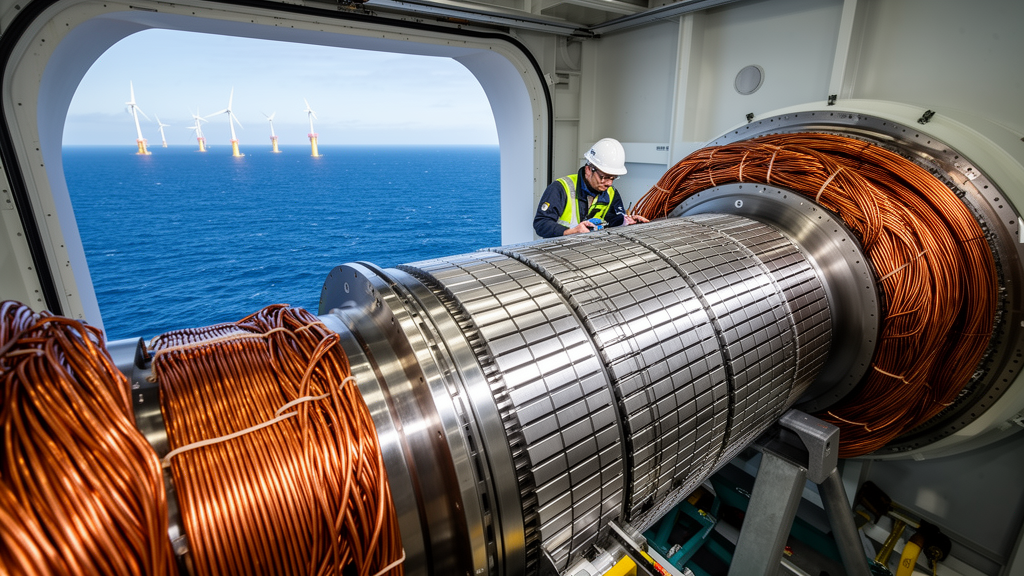
The baseline findings indicate that offshore wind exhibits relatively high lifecycle exposure, driven primarily by its operational dependence on rare-earth elements. Photovoltaic technologies display heterogeneous exposure profiles reflecting substantial differences in mineral requirements and underlying supply-chain configurations. Concentrated solar power demonstrates notable exposure due to extensive industrial-metal requirements, whereas hydropower, nuclear power, and biomass systems demonstrate comparatively lower lifecycle-adjusted exposure under baseline conditions.
The investigation reveals three primary structural vulnerability pathways: supply concentration paired with substitution constraints, by-product dependence alongside processing constraints, and large-scale industrial-metal consumption. Crucially, the researchers emphasize that the framework does not predict the probability or exact timing of future supply disruptions. Instead, the model operates as a transparent structural screening mechanism designed to identify persistent monitoring priorities and inform strategic diversification, material recycling, substitution research, and long-term supply-chain resilience planning.
Subject of Research: Critical mineral supply-chain exposure in low-carbon energy technologies
Article Title: A price-weighted and lifecycle-adjusted framework for critical-mineral supply-chain exposure in low-carbon energy technologies
Article References: Sadat, M. A., & Xu, D. (2026). A price-weighted and lifecycle-adjusted framework for critical-mineral supply-chain exposure in low-carbon energy technologies. Clean Technologies and Environmental Policy, 28(12), Article 293. https://doi.org/10.1007/s10098-026-03637-y
Image Credits: AI Generated
DOI: 10.1007/s10098-026-03637-y
Keywords: critical minerals, supply-chain exposure, low-carbon energy, offshore wind, photovoltaic technology, concentrated solar power, hydropower, nuclear energy, biomass energy, rare-earth elements, by-product minerals, material intensity, lifecycle adjustment, mineral prices, supply risk, governance indicators, material substitution
News Source: Courtney Benton. (November 23, 2026). Offshore Wind Faces High Supply Exposure from Rare Earth Dependence. Scienmag.